
A Meta Ads agency in Toronto should be evaluated on more than campaign screenshots and cheap-lead claims. PPC Guru's Meta Ads services emphasize creative, tracking and lead quality, but a buyer should still test whether any provider understands the offer, measurement limits and account ownership before discussing scale. The right partner may manage media, but the business still needs a truthful offer and a system for turning attention into qualified outcomes.
Short answer: ask who owns the Business Portfolio, ad account, data sources and creative; who produces and approves new ads; how experiments are designed; how qualified outcomes are measured; what the fee excludes; and what happens at exit. Avoid providers that promise scale before reviewing economics, creative capacity and conversion quality.
Why Meta agency selection is different#
Search advertising often responds to an expressed query. Meta campaigns rely heavily on interruption, audience signals, offer and creative. Creative operations are therefore a core part of management, not an optional extra.
An agency can change targeting and bids, but it cannot indefinitely compensate for an unclear offer, weak proof, poor landing experience or slow follow-up.
The 14 questions#
Use the questions as a discovery agenda, then score the six operating areas below. Fourteen questions do not mean fourteen separate fees or a universal package.
1. What business outcome will the campaign pursue?#
Separate reach, clicks, leads, qualified leads, sales and revenue. A cheap form is not automatically a useful customer.
2. Who owns the Business Portfolio and ad account?#
Ask the provider to show which business controls each asset and which permissions the agency needs. Record Pages, Instagram accounts, ad accounts, data sources, catalogues and domains separately. Access to use an asset is not the same question as who controls it. Do not assume that an account can simply be transferred at exit; require a workable handoff plan before signing.
For example, Meta distinguishes Facebook Page access from task access, and warns that people with full control can change access or remove other people. Review Meta's Page-access explanation with the provider rather than granting broad permissions by default.
3. Who owns the Pixel and data connections?#
Ask how access, documentation and continuity work if the relationship ends.
4. What is the creative strategy?#
The answer should identify audience problem, offer, format, message angle, proof, production and review - not merely the number of ads.
5. Who produces the creative?#
Clarify whether the client, agency, creators or subcontractors write, film, design and edit. Define usage rights and raw-file ownership.
6. How will you test without changing everything at once?#
A useful experiment states the variable, hypothesis, decision rule and next action. Ask whether the proposal is a structured experiment or a directional comparison of ads; the team should not present those as equally strong evidence. A small account may not generate enough outcomes for a decisive test. In that case, the agency should state the limitation instead of declaring a winner from a handful of leads.
7. How often will creative be reviewed?#
The cadence should depend on spend, audience, fatigue signals and production capacity. A universal weekly quota can create waste.
8. How do you assess lead quality?#
Require a shared process for unreachable, duplicate, wrong location, wrong service, qualified and won outcomes.
9. How will measurement limitations be explained?#
The provider should distinguish platform reporting from business records and explain what can and cannot be attributed reliably.
10. What happens before launch?#
Expect access review, offer and page assessment, tracking validation, creative plan, naming conventions, approvals and launch QA.
11. What does the fee include?#
Separate media, management, strategy, creative production, creator fees, landing pages and tracking tools.
12. Who will actually run the account?#
Ask for the operator role, workload, escalation path and meeting owner. Senior sales involvement does not prove senior delivery.
13. What will you report?#
Reports should explain spend, delivery, creative learning, funnel outcomes, limitations, changes and next decisions.
14. What happens when the relationship ends?#
Document access removal, asset transfer, creative rights, data continuity and the final handoff.
Score answers using evidence#
| Area | 0 | 1 | 2 |
|---|---|---|---|
| Ownership | Agency-controlled | Mixed | Client-owned and documented |
| Creative | Ad count only | Basic process | Research, production and learning loop |
| Measurement | Platform leads | Some business data | Qualified outcomes with limitations |
| Testing | Vague optimization | Activities listed | Hypotheses and decision rules |
| Pricing | Blended and unclear | Partially separated | Complete operating-cost view |
| Exit | Unclear | Basic access return | Documented continuity and rights |
This is a buyer tool, not a certification. Use it to expose where another question is needed.
Give each of the six areas a score from 0 to 2, for a maximum of 12. A high total cannot cancel an unresolved ownership or measurement problem. A score of 0 on either is a reason to pause and ask for written clarification, not to average the risk away.
Download the Meta agency comparison worksheet (CSV). Keep one copy per proposal and record the evidence behind each score. The table above provides an accessible version of the scoring rules.
A Toronto service-business example#
Illustrative scenario: a home-renovation business wants enquiries for kitchen projects in Toronto and the western GTA. It has completed-project photographs, but nobody available to film new footage every week. Its estimator can only handle a limited number of consultations.
One proposal promises a high volume of new ads without explaining who will supply the footage. Another starts with permission-cleared project photographs, a small set of distinct buyer questions, and a follow-up process that records service-area and project-fit rejections.
The second proposal is easier to evaluate because its dependencies are visible. That does not prove it will perform better. It does show what the client must provide and what the agency can reasonably deliver.
Ask both providers the same practical questions:
- Who obtains permission to use the project images and any identifiable people?
- Which messages help a visitor understand the type of renovation offered?
- How will the page and form explain the actual service area?
- Who reviews enquiries with the estimator and records rejection reasons?
- What changes if consultation capacity fills before the ad budget is spent?
The objective is not to make every lead expensive or add friction indiscriminately. It is to stop measuring success at the point where the business still knows almost nothing about fit.
Put the creative process in the proposal#
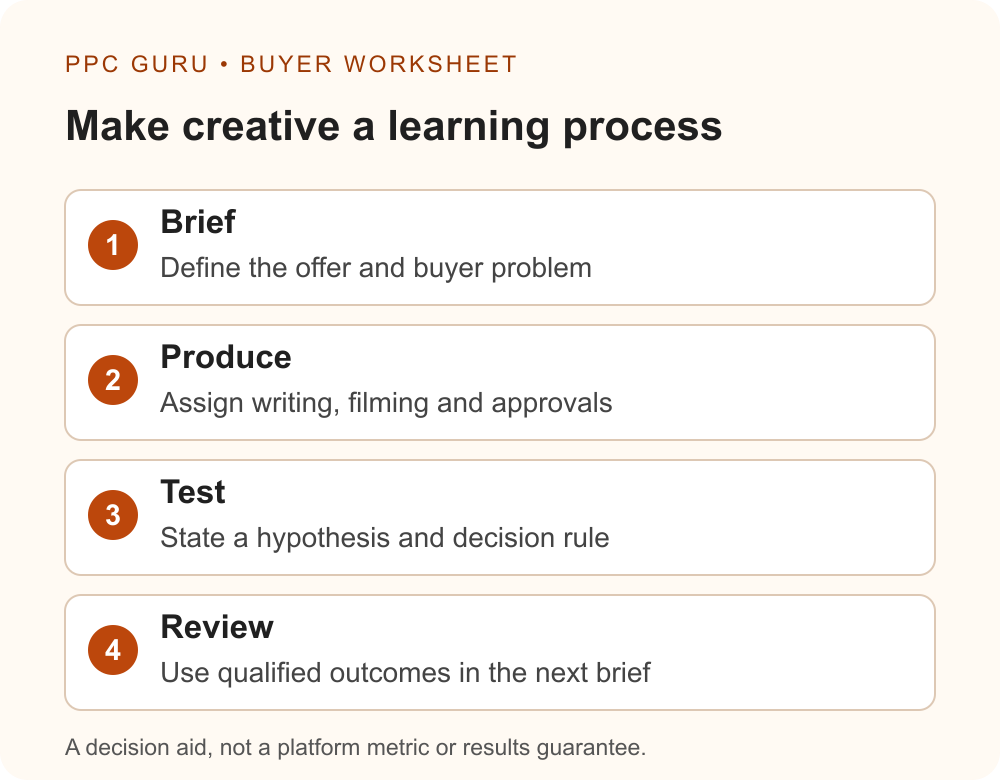
The four steps are:
- Brief: define the buyer problem, offer, proof and intended outcome.
- Produce: assign writing, filming, design, editing, permissions and approval.
- Test: state the question, comparison, outcome measure and decision rule.
- Review: examine qualified outcomes and use the learning in the next brief.
A deliverable count belongs inside this process, not in place of it. Ask whether a “new creative” means a new concept, a different opening, a resized file or a minor text variation. Those deliverables can all be useful, but they require different effort and answer different questions.
Also clarify what happens when production stalls. If the client cannot approve a claim or provide footage, does the agency adapt the plan, pause that test or continue billing for work it cannot deliver? Write the dependency into the scope.
Where the destination page is the constraint, ask about landing-page and conversion work separately from media management. A creative refresh cannot explain an offer that the page itself leaves unclear.
Compare total operating cost, not just the retainer#
Request a written breakdown without assuming every line is charged separately:
| Cost or responsibility | What to clarify |
|---|---|
| Media spend | Who pays the platform and controls the budget? |
| Management | Which strategy, execution and review activities are included? |
| Creative production | Which concepts, edits, revisions and formats are included? |
| Creators and licensing | What permissions, usage periods and paid-media rights are included? |
| Landing pages | Who builds, edits and checks the destination? |
| Measurement | Who configures, validates and maintains the agreed tracking? |
| Exit | Which files and records are handed over, and in what form? |
There is no universal “right” management fee in this guide. A narrow media-buying engagement and a production-heavy service are different purchases. Compare the work and dependencies before comparing totals.
What the first 30 days should clarify#
The first month should clarify account and data ownership, target customer, offer, creative inputs, landing experience, lead-quality feedback, initial tests and the decisions expected from early evidence. It should not be presented as guaranteed scale.
If the provider cannot describe the learning plan, optimization may mean unstructured changes.
Red flags#
- guaranteed return or lead volume;
- permanent agency ownership of assets;
- no creative-production responsibility;
- scaling before economics and lead quality are reviewed;
- case studies without relevant context;
- reporting based solely on platform conversions;
- no distinction between media and agency fees;
- unclear rights to footage and source files.
Frequently asked questions#
Should a Toronto business hire an agency or freelancer?#
Choose based on the work. A specialist can fit a focused account with available creative. An agency may suit a system requiring strategy, production, pages and analytics. Confirm the actual operator either way.
Does the provider need to be in Toronto?#
Local context may help, but operational fit, creative judgment, ownership and measurement matter more than proximity alone.
How much creative is enough?#
There is no universal quantity. The plan should match audience size, spend, offer, production capacity and observed performance.
Can PPC Guru review a Meta Ads proposal?#
Yes. Use PPC Guru's contact page and bring the proposed ownership model, creative scope, fee breakdown and lead-quality definition.
Method and status#
PPC Guru prepared this guide using agency-selection search results, directional Toronto keyword research and an original interview and scoring framework. Research and editorial checks were refreshed on September 3, 2026. The local example is illustrative, not a client case study.
The recommendations are procurement questions, not platform setup instructions or legal advice about intellectual property. Ask the provider to demonstrate current permissions in your own account, and have the appropriate people review contractual rights and data handling. No return, lead count or attribution accuracy is guaranteed.