
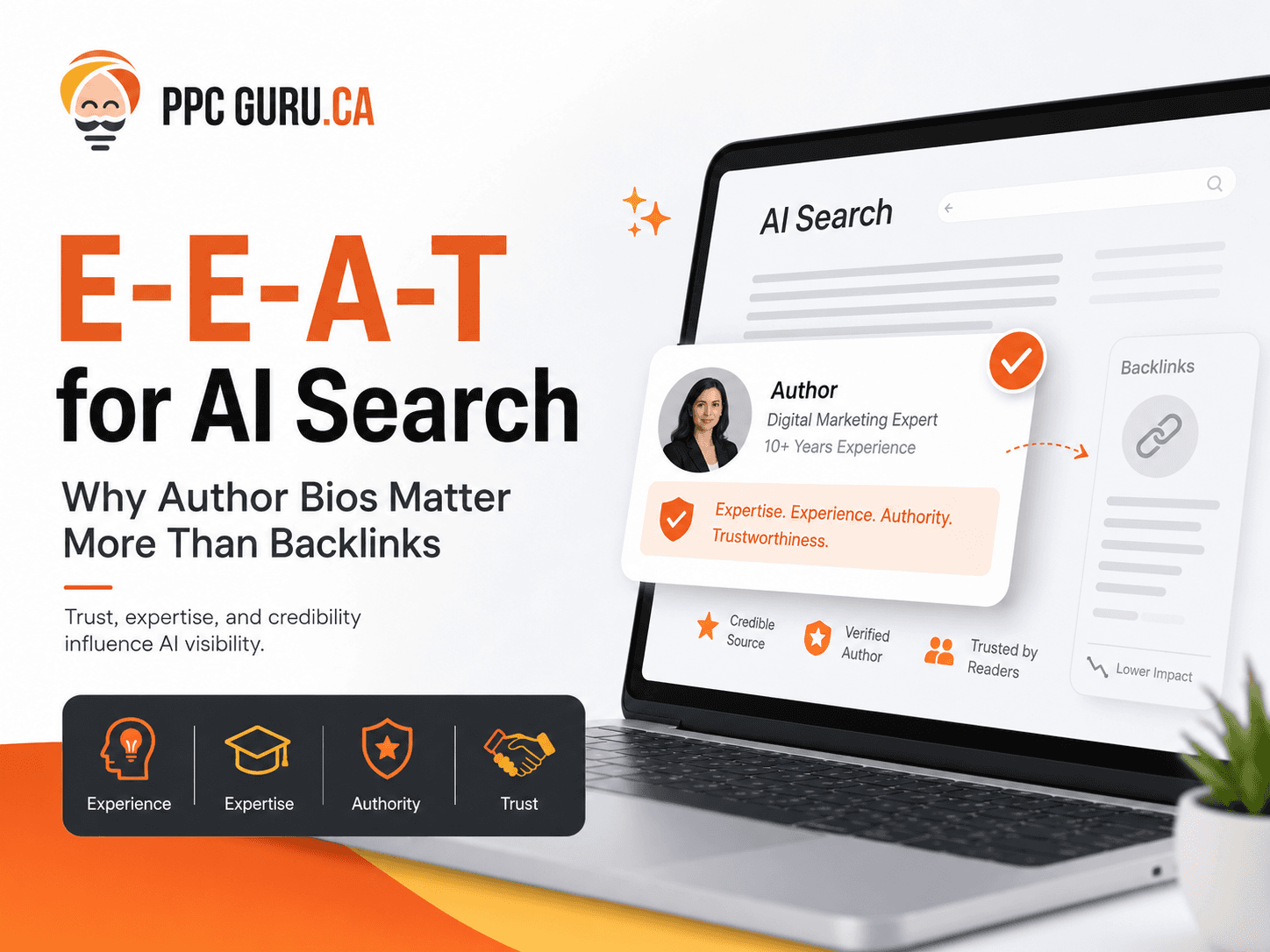
For years, backlinks have been treated as one of the strongest signs of authority in SEO. When reputable sites link to a page, that helps Google discover it, understand its relevance, and judge its prominence. None of that has stopped being true.
But AI-powered search is making a second question just as important: who actually created this, and why should anyone trust them?
When Google AI Overviews, ChatGPT, Gemini, or any other AI platform generates an answer, it needs content that's clear, credible, and easy to verify. A page can have excellent backlinks and still give the system no way to confirm the person behind it has real, first-hand experience. That gap is where author bios, expert profiles, and transparent authorship start to matter in a way they didn't five years ago.
Want to Increase your business AI Visibility, Consult PPC Guru Now!
The short version#
Author bios aren't a confirmed, standalone Google ranking factor. Pasting a two-sentence biography onto every article won't move rankings by itself, and nobody honest will tell you it will.
Their real value comes from connecting content to a recognizable person with genuine experience, a public track record, and evidence that can actually be checked. Think of the author bio as the center of a small authority network, not an isolated SEO trick bolted onto the bottom of a post.
What E-E-A-T actually stands for#
Experience. Did the author actually do the thing being described? A Google Ads specialist shows this by walking through real campaign problems, search-term patterns, and the tracking issues that only show up once you've managed real accounts. A plumber shows it with real repair photos and the specific problems they've run into on actual jobs, not textbook descriptions of pipes.
Expertise. Does the author have the training or hands-on background to explain the topic correctly? This can come from certifications, formal education, or simply years of doing the work.
Authoritativeness. Is this person recognized as a useful source in their field, by people other than themselves? Industry mentions, relevant backlinks, professional profiles, interviews, and a consistent body of genuinely useful content all feed this.
Trustworthiness. Can a reader tell who's responsible for the content, where the claims came from, and whether the business is being straight with them? This matters most for anything touching health, money, or safety, where bad advice has real consequences.
Google added the extra "E" for Experience specifically to emphasize first-hand involvement, and it's worth being precise here: Google has said its quality rater guidelines help evaluate its search systems, not that E-E-A-T functions as one direct ranking signal you can simply satisfy and move on from.
Why authorship suddenly matters more in an AI-driven web#
AI tools have made it trivially easy to produce polished, grammatically correct content at scale. The problem is that a lot of it just repeats what's already out there, dressed up in fluent sentences, with no actual experience or accountability behind it.
Here's a comparison worth sitting with. Two articles about improving Google Ads lead quality. The first says: use relevant keywords, improve your landing page, add negative keywords, optimize regularly. Fine advice. Also advice that could have been written by someone who's never touched an ad account.
The second explains which search terms tend to signal low buying intent, how a location setting quietly creates irrelevant leads, why adding a qualifying question to a lead form changes results, how call tracking can miscount short or missed calls, and what actually changed in performance after a specific account got restructured.
Same general topic. Only one of these reads like someone who's actually been in the account. Attaching that second article to a visible author with real, matching experience gives a reader — and increasingly, an AI system evaluating the page — a concrete reason to trust it over the generic version.
Do author bios directly improve rankings?#
No. There's no confirmed Google ranking factor called "author bio," and a short bio box won't rescue thin content, a weak site, or the absence of any real independent authority. What author bios actually do:
- Make authorship transparent instead of anonymous
- Explain why the writer is qualified to speak on the topic
- Connect multiple articles back to the same specialist over time
- Define what that person is actually an expert in, and just as importantly, what they aren't
- Give credentials and experience a home readers can check
- Support structured data that machines can read directly
- Make professional claims verifiable instead of just asserted
Google's own guidance on AI-generated content and Search recommends accurate bylines specifically for content where a reader would reasonably ask "who wrote this?" That's most expert or advisory content, which covers the bulk of what a service business publishes.
The distinction worth holding onto: a biography can describe expertise. It can't manufacture it. A claim of years of experience becomes credible when it's backed by a consistent employment history, published work, certifications, or independent mentions elsewhere — not when it's just typed into a bio field.
Author bios vs. backlinks: which one actually matters more?#
Wrong framing. They answer different questions. Signal What it actually proves Backlink Do other sites recognize or reference this page? Author bio Who created the information? Author page What experience and published work does this person have? External profile Can the author's claims be independently corroborated? Article schema How are the article, author, and organization formally connected? Original evidence Did the author add something beyond a generic summary?
A site with genuinely knowledgeable authors but zero outside recognition probably still needs backlinks and real digital PR. A site drowning in backlinks but publishing anonymous, generic content probably needs stronger authorship and more original insight. It was never "bios instead of backlinks." It's helpful content, written by identifiable experts, backed by technical SEO and real external recognition, that also happens to earn links along the way.
PPC Guru approaches this the same way through its SEO and local search work — combining content, technical optimization, structured data, and authority-building rather than leaning on any single tactic in isolation.
How AI search actually changes content authority#
Traditional search hands a user several links and lets them compare sources themselves. AI search often summarizes before anyone visits a website at all, which raises the value of information that's easy to interpret, verify, and attribute to someone.
Worth saying directly: there's no secret AI-authority score, and no special file or markup that guarantees a citation. Google's own guidance on succeeding in AI search states that traditional SEO fundamentals stay relevant, because AI features are built on top of Google's core search and quality systems, not separate from them. The recommendation is unglamorous and consistent: technically accessible pages, genuinely unique information, clear site structure, accurate structured data, strong text content, and real external recognition. Google explicitly warns against chasing unsupported shortcuts — fabricated mentions, "special AI files," or other so-called GEO hacks.
Author profiles help here by reducing ambiguity. They tie a piece of content to a real person with a defined role and a checkable history, instead of asking a system to trust an unattributed page on faith.
What should a strong author bio actually include?#
A useful bio answers five questions, in order.
Who is the author? Real professional name, current role. For example: Jaydeep Patel is the Founder and CEO of PPC Guru, a digital marketing agency serving businesses across Toronto, the GTA, and Canada. Specific, checkable, no inflation.
What has the author actually done? Specific work, not promotional language. Managing Google Ads for service businesses. Building conversion-tracking systems. Working across HVAC, dental, construction, and professional services. Concrete beats impressive-sounding every time.
What topics does the author actually cover? Pick a lane. Google Ads, or SEO and local search, or Meta advertising — not "digital marketing" as a catch-all that means nothing specific. Presenting every writer as an expert in everything is itself a small trust problem.
What evidence backs it up? A real, active LinkedIn profile. A detailed company bio. Certifications. Published articles. Interviews. Anything a skeptical reader, or an AI system checking for corroboration, could actually go verify.
Why should anyone trust them? Public accountability tied to a real business and a real body of work beats an anonymous bio full of phrases like "industry-leading expert" or "marketing guru" — phrases that, notably, prove nothing on their own.
Dedicated author pages are worth the extra step#
A bio box at the bottom of a post is useful. A full author page does more. A strong one includes the complete professional biography, current role, areas of expertise, relevant experience, certifications, articles written, media features, links to outside profiles, and ideally a "last updated" date. It should link out to that person's published work, creating a clear chain: author, to expertise, to content, to organization. That's useful for a human reader deciding whether to trust the page, and it hands search and AI systems a much clearer picture of who's actually behind a site's content.
Structured data: the part almost nobody sets up correctly#
Structured data helps machines understand the relationship between an article, its author, and the organization publishing it. The relevant types here are Article, Person, and Organization. Google's Article structured data documentation explains that this markup helps Google understand an article's author, title, and dates directly — not by inference from surrounding text, but as explicit, structured facts.
A basic example of how this looks in practice: json { "@context": "https://schema.org", "@type": "Article", "headline": "E-E-A-T for AI Search", "author": { "@type": "Person", "name": "Siddharth Sharma", "jobTitle": "SEO Specialist", "url": " ", "worksFor": { "@type": "Organization", "name": "PPC Guru" } }, "datePublished": "2026-07-31" }
The author property should point to a real Person or Organization entity, and whatever it claims needs to match what's actually visible on the page. Structured data should describe real authority, not invent it — mismatched schema is a fast way to lose trust with both Google and a careful reader.
External evidence still carries real weight#
A company can write a flattering biography about its own founder, and readers know that self-published claims have limits. Expertise gets more credible once it's corroborated somewhere else: interviews, guest contributions, media quotes, professional directories, podcast appearances, industry events, or a relevant backlink from a credible, unrelated source.
This is exactly why backlinks still matter, just not as the whole story anymore. A contextual link from a real publication strengthens both the site's authority and the author's connection to their subject — and the strongest version of that link isn't purchased or placed on some unrelated site, it's earned because the author actually contributed something useful.
Making content easier for AI systems to use, practically#
No technique guarantees a citation in ChatGPT, Gemini, or an AI Overview. Nobody selling that guarantee is being straight with you. But a few things genuinely help.
Answer the question immediately, then explain. Example: Do author bios help SEO? Author bios support SEO by improving transparency and connecting content to qualified people — they aren't a guaranteed standalone ranking factor on their own. Direct answer first, context after.
Use headings that actually say what the section covers. "What Should an SEO Author Bio Include?" tells a reader and a machine exactly what's coming. "Meet the Minds Behind the Magic" tells them nothing, no matter how charming it sounds in a meeting.
Add real, original experience. Screenshots, specific numbers, an account of something that went wrong and what fixed it. AI systems can already summarize generic definitions perfectly well on their own — original detail is the only thing that gives them, or a human reader, a reason to reference your page specifically instead of any other.
Link to primary sources. Official documentation, government data, recognized research, original datasets — not another blog's summary of the same thing.
Keep entity information identical everywhere. Same name, same role, same bio, same organization, across your site and every legitimate external profile. Inconsistency reads as a red flag to a system built to check for exactly that.
Common mistakes worth avoiding entirely#
Fake or invented authors. Vague bios stuffed with promotional adjectives instead of specifics. The same generic byline slapped onto every article regardless of who actually wrote it. Credentials nobody could verify if they tried. Schema that claims something the visible page doesn't back up. Publishing AI-assisted content with no human review at all. Treating backlinks as obsolete, which they aren't. Promising guaranteed AI citations or rankings, which nobody can actually deliver.
AI assistance in writing isn't the problem by itself — Google's own guidance allows it. Publishing large volumes of unreviewed, low-value AI content to game visibility is what crosses into its scaled-content spam policies. Human review, accuracy, and something genuinely original still have to be in the mix.
A realistic timeline, since this isn't instant#
Initial signals from implementing real bios and proper schema tend to show up within about 3 to 6 months. The bigger payoff — a byline building genuine recognition by showing up consistently across a site and other platforms — usually takes 12 to 24 months of actually sticking with it. This compounds. It doesn't spike.
Where to start, in order#
- Audit every page for a consistent byline. No author, or three slightly different versions of one, is the single most common gap.
- Write real bios: actual role, honest tenure, an actual area of focus. Skip the filler adjectives entirely.
- Link every bio to a matching, active LinkedIn profile.
- Add Person and Article schema site-wide, not on a handful of flagship pages.
- Keep publishing under the same name, consistently. One well-written bio on one page does far less than the same identity showing up again and again.
Final answer: do author bios matter more than backlinks?#
They don't replace backlinks, and nobody credible is arguing they should. Backlinks show that other sites recognize a page or a brand. Author profiles explain who made the information and why a reader might trust them. For a growing number of sites, weak or anonymous authorship is now a bigger authority gap than one more missing backlink would be.
The strongest approach combines expert-led content, clear and consistent bylines, real author pages, original evidence, accurate schema, outside corroboration, relevant backlinks, and solid technical SEO underneath all of it. Author bios stop being an afterthought at the bottom of a post and start being part of a connected system that helps search engines, AI platforms, and actual potential customers understand exactly who's behind the content.
If you want to see whether your site's author signals are set up the way search and AI systems actually check for, that's part of what we look at in a full visibility audit.
Frequently asked questions#
Do author bios help SEO? They support it — better transparency, a clearer connection between content and qualified people — without being a guaranteed standalone ranking factor.
Are backlinks still important for AI search? Yes. They still establish recognition and authority, and they carry more weight when they're relevant, credible, and tied to genuinely useful content or a real expert.
What should an author bio actually include? Real name, current role, specific relevant experience, a defined area of expertise, and links to credible outside profiles or credentials.
Does Person schema improve rankings on its own? No. It helps search and AI systems understand how an author, an article, and an organization connect to each other — it's clarity, not a ranking boost.
How can a business realistically improve its AI search visibility? Publish clear, original, well-sourced content under consistent, real authorship, keep entity information identical everywhere it appears, earn genuine outside mentions, and make sure pages are technically accessible in the first place.
Should every blog post have a named author? For expert, educational, or advisory content, yes — strongly. It tells a reader who's responsible for what they're about to read, and why that person might actually know what they're talking about.
Author Bio: Siddharth Sharma is an SEO Specialist at PPC Guru, a Toronto-based digital marketing agency, with 6+ years of experience in search and digital marketing.