
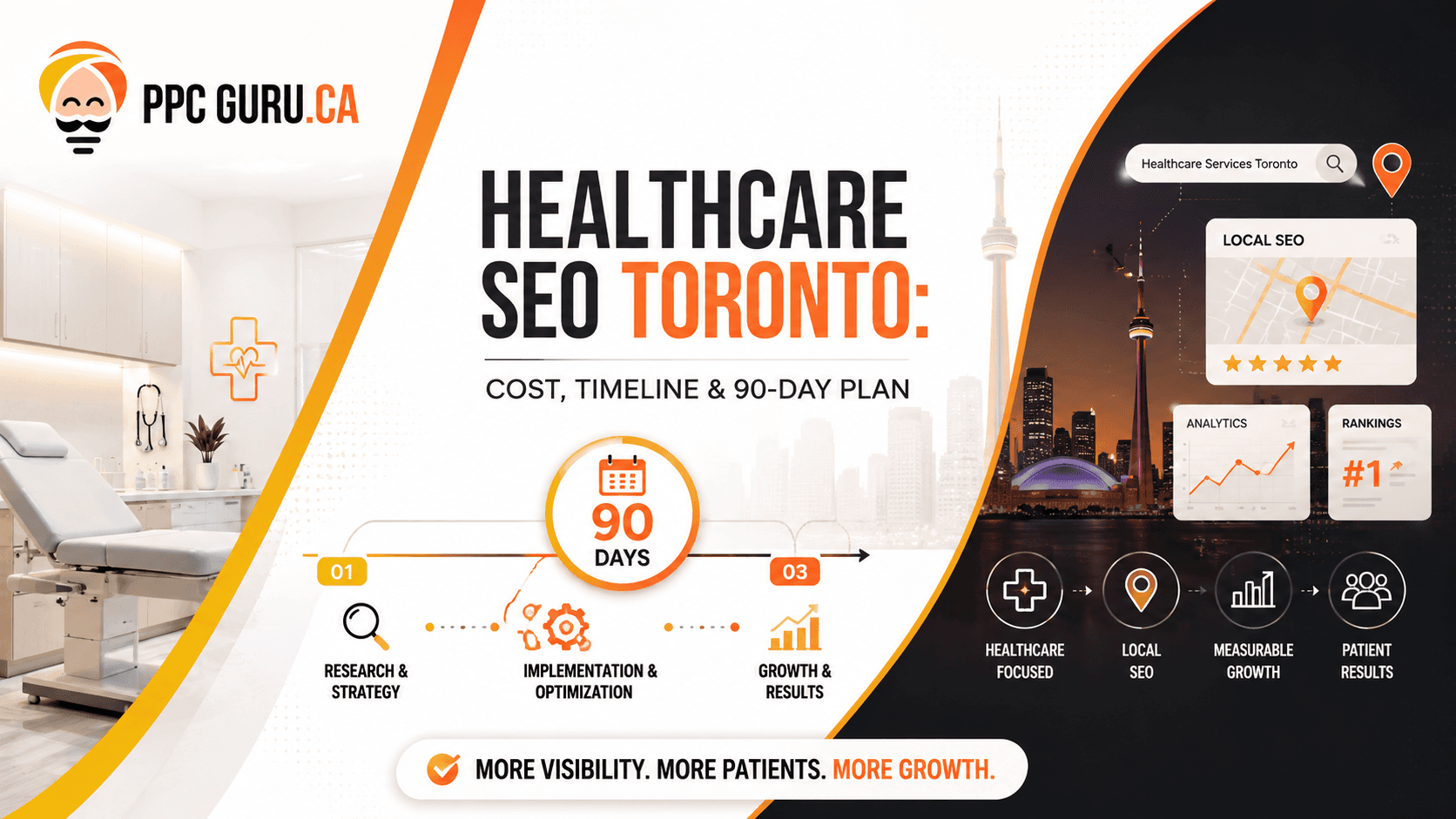
Here is a scene familiar to many clinic owners. The monthly healthcare SEO report arrives with green arrows, traffic graphs and a reassuring list of completed tasks. It looks busy. Yet one fairly obvious question is still hanging in the air: did any of this help the right patients find and contact the clinic?
That question shapes this guide. Rankings have a place, but they are not the finish line. For a clinic, the useful journey runs from a relevant search to a trustworthy page, then to an appropriate enquiry and, when there is a fit, an appointment.
We will look at what healthcare SEO involves in practice, how Toronto pricing is usually scoped and what can reasonably happen in the first 90 days. We will also tackle two questions that are often skipped: when Google Ads should come first, and what makes a page easier for AI-assisted search tools to understand without turning it into robotic copy.
If you only have a minute#
- SEO earns its place when it brings suitable patient enquiries, not merely more visits.
- There is no standard Toronto price. One local agency publishes C$1,500-C$6,000 per month as a broad 2026 example, but that is its own estimate, not an independent average or PPC Guru's fee.
- C$500 a month can fund a tightly defined priority. It cannot realistically buy technical fixes, local SEO, expert-reviewed content, outreach and detailed measurement all at once.
- During the first 90 days, fix the healthcare SEO foundation: indexing, the Google Business Profile, priority service pages and enquiry tracking.
- If the clinic needs demand now, a small, controlled Google Ads campaign may need to run while organic visibility develops. Fix intake problems first, or both channels can waste money.
- Treat guarantees as a warning sign. An agency can commit to the work and the reporting; it cannot promise a ranking, a number of appointments or a citation from an AI assistant.
Healthcare SEO in Toronto: the short answer#
In plain terms, healthcare SEO helps a clinic show up for the services, practitioners and locations people are actually looking for. The job does not end when the page ranks. Someone landing on it should be able to understand the service, verify who provides it and know what to do next.
For a Toronto clinic, that usually means a mix of technical repairs, local search work, useful service and location pages, visible practitioner credentials and privacy-aware measurement. SEO makes the most sense when people already search for the clinic's services, somebody qualified can review health-related copy and the front desk can respond properly when enquiries arrive. It is a long-term acquisition channel, not an instant-patient switch.
| Decision question | Practical answer |
|---|---|
| What does a complete program include? | Technical SEO, local visibility, service content, authority, conversion and measurement |
| What should happen first? | Verify indexing, measurement, Business Profile accuracy, priority pages and patient conversion paths |
| Can C$500 per month work? | Only for a narrow advisory, maintenance or single-priority scope |
| How quickly can results appear? | Some fixes may be visible quickly; competitive growth usually requires months of consistent work |
| When should SEO wait? | When intake is broken, leads are needed immediately, content cannot be reviewed or privacy risks are unresolved |
| What belongs in the report? | Search visibility and page performance, followed by the numbers the clinic can act on: suitable enquiries and booked appointments |
What does healthcare SEO include?#
In practice, healthcare SEO is not one job. It is five jobs that have to support one another. A fast website cannot rescue vague medical copy. A strong service page will struggle if Google cannot index it. More enquiries will not help if calls go unanswered. The useful work sits across the following five areas.
1. Technical SEO#
Most clinics do not need another twenty blog posts on day one. They need to know that the pages already closest to an appointment can be found and used. We start with ordinary questions that expose expensive problems:
- Can Google reach and index the right service, practitioner and location pages?
- Are duplicate URLs, bad redirects or conflicting canonical tags creating confusion?
- Can a patient use the site comfortably on a phone without waiting for a slow page?
- Do the titles, headings and internal links make the site understandable?
- Does any structured data describe what a visitor can actually see on the page?
- Do the phone number, form and appointment link work on the devices patients use?
Structured data can help Google understand a page, but it does not guarantee a special search result. Google requires markup to represent visible content accurately and notes that valid markup may still not produce a rich result (Google's structured data guidelines).
2. Local SEO for healthcare clinics#
For an in-person clinic, the local result is often where the decision starts. A person may compare distance, opening hours, reviews and the booking option before opening the main website. That makes the accuracy of the clinic's local presence more than a housekeeping task.
The basics include:
- Accurate clinic name, address, phone number and opening hours
- A properly governed Google Business Profile
- Consistent location information across trusted directories
- Useful service and location pages
- A privacy-conscious process for responding to reviews
- Separate profile decisions for organizations and eligible practitioners
Google has specific Business Profile rules for doctors, dentists and other public-facing practitioners. A multi-practitioner clinic may qualify for an organization profile and eligible practitioner profiles; a solo practitioner working under a branded organization may be handled differently. In other words, build the profile setup around the real practice. Creating extra listings simply to occupy more space is not a strategy (Google Business Profile guidelines).
Local search should connect to the clinic's wider patient-acquisition plan. PPC Guru's digital marketing for healthcare clinics page shows how SEO, paid media and the website can work together.
3. Service and educational content#
Good clinic content sounds less like a brochure and more like the start of a useful conversation. Before contacting the clinic, a prospective patient is usually trying to work out:
- Is this service relevant to my situation?
- Who provides it, and what are their qualifications?
- Where is the service available?
- What should I expect before, during and after an appointment?
- What does it cost, and is a referral required?
- What are the limitations, risks or reasons it may not be suitable?
Someone qualified should write or review those answers. That review is not a decorative byline added at the end; the reviewer needs to catch missing context, overconfident wording and claims that are not supportable. Google likewise points to clear authorship, reliable sourcing and demonstrated expertise as important considerations for subjects that can affect health (Google's people-first content guidance).
4. Authority and trust#
Repeating healthcare SEO Toronto does not make a clinic authoritative. Neither does a package of anonymous backlinks. Trust grows when a visitor can check the people, the service, the source and the organization behind the page—and finds the same story in each place.
Useful trust signals include:
- Accurate practitioner biographies and credentials
- Clear editorial and medical-review policies
- Citations to primary health and regulatory sources
- Legitimate coverage from professional and community organizations
- Original educational resources worth referencing
- Transparent contact, privacy and ownership information
5. Conversion and patient-acquisition measurement#
Rankings and traffic help us diagnose the work. They do not pay the front desk or fill an appropriate appointment slot. The commercial test is whether search produces enquiries the clinic can actually serve.
A clinic can plan measurement around a simple path:
Search query -> relevant page -> evidence of trust -> qualified enquiry -> booked appointment
This query-to-appointment path provides a practical way to diagnose performance:
| Stage | Question to answer | Typical SEO responsibility |
|---|---|---|
| Search query | Are the right people searching for this service and location? | Demand, intent and competitor research |
| Relevant page | Does the best page clearly match that need? | Service, practitioner and location architecture |
| Evidence of trust | Can the visitor verify expertise, accuracy and real-world legitimacy? | Authorship, review, sources, credentials and reputation |
| Qualified enquiry | Can the visitor call, enquire or request an appointment easily? | Conversion design and privacy-reviewed tracking |
| Booked appointment | Is the clinic converting suitable enquiries into appointments? | Shared measurement with the clinic's intake team |
This does not mean sending symptoms, diagnoses or other sensitive patient details into every analytics or advertising platform. Privacy, security and professional requirements should be reviewed before tracking is launched.
Clinics comparing providers can use this framework alongside PPC Guru's healthcare SEO services and broader SEO services.
How much does healthcare SEO cost in Toronto?#
There is no official Toronto rate card for healthcare SEO, and a single number without a scope is not very helpful. As a point of reference, one Toronto agency's 2026 pricing guide gives C$1,500-C$6,000 per month for most businesses. Keep the label on that number: it is one seller's commercial estimate, not an independent industry average, a PPC Guru price or the right budget for every clinic (published Toronto pricing example).
The proposal matters more than the headline fee. What will be fixed? What will be written? Who reviews the health claims? Who implements the recommendations? A lower quote can be expensive if it buys reports but leaves all the work with the clinic.
| Program type | Typical situation | Work that may be included | Main limitation |
|---|---|---|---|
| Foundation project | New or technically weak single-location site | Audit, measurement setup, profile cleanup, urgent technical fixes and priority page optimization | May not include continuing content or authority building |
| Local growth retainer | Single clinic competing in Toronto or a GTA community | Foundation work plus local SEO, service pages, content, reporting and ongoing improvement | Scope must match the number of services and competitors |
| Multi-location program | Clinic group with several practitioners or locations | Location architecture, profile governance, content systems, technical monitoring and attribution | More stakeholders and greater duplication risk |
| Competitive specialty program | High-value or highly competitive services | Deeper subject review, digital PR, conversion work and broader authority development | Higher research, review and acquisition costs |
In our view, six details explain most of the difference between a small engagement and a substantial one:
- Number of locations. Each real location needs accurate information, useful content and profile governance.
- Number of priority services. A clinic targeting three services has a different research and review burden from one targeting thirty.
- Website condition. Indexing problems, migrations, duplication and poor performance can consume the early budget.
- Competitive market. A specialized community service may face less competition than a cosmetic, dental or rehabilitation term across Toronto.
- Content-review requirements. Medical and professional review adds necessary time and accountability.
- Measurement complexity. Connecting calls and forms to booked appointments responsibly is more involved than reporting traffic.
Can a clinic start healthcare SEO with C$500 per month?#
It can, provided both sides are honest about the limits. At C$500 per month, the sensible choice might be advice, light maintenance or one clearly defined priority. It is not realistic to expect technical implementation, local SEO, original expert-reviewed content, outreach and detailed measurement at the same time in a competitive Toronto market.
If C$500 is the available monthly budget, ask the provider to document:
- the exact deliverable;
- who completes it;
- which tools or implementation costs are excluded;
- what the clinic must supply;
- what will be measured;
- when the scope will be reviewed.
A one-time foundation project followed by smaller maintenance work can be a better use of that budget than an "everything included" plan. When the fee is spread across too many promises, the usual result is a little activity everywhere and not enough progress anywhere.
Publication decision required: PPC Guru must approve its actual starting scope and pricing language before this article goes live.
How long does healthcare SEO take?#
Think in milestones rather than circling a guaranteed ranking date on the calendar. A repaired redirect or corrected Business Profile may show an effect quickly. Competitive search visibility usually takes longer because Google has to crawl the changes, reassess the pages and compare them with everything else in the market. Google notes that some improvements can have an effect within days, while broader site-level reassessment may take several months. None of those changes guarantees a ranking increase (Google Search Central).
| Period | What a clinic should expect |
|---|---|
| Days 1-30 | Baseline measurement, technical/indexing audit, conversion check, profile review, keyword-to-page map and urgent fixes |
| Days 31-60 | Priority service and location improvements, internal linking, first expert-reviewed content, directory corrections and reporting QA |
| Days 61-90 | Additional content, authority outreach, conversion refinements and the first strategic review using query and lead data |
| Months 4-6 | Broader query coverage, more reliable trend data and clearer evidence of which pages and locations generate enquiries |
| Months 6-12 | Compounding content and authority, provided strategy, implementation and clinic intake are working |
Use the table as a planning aid, not a promise. A new domain, recent migration, competitive specialty or serious technical problem can stretch the schedule.
Take two hypothetical clinics. The first is a single-location practice in North York with an old website, uncertain tracking and six services squeezed onto one page. Its first month belongs to repairs and measurement. The second is an established group with sound technical foundations and distinct pages for every location. That team may be ready to expand content much sooner. Giving both clinics the same 90-day checklist would be convenient for the agency, but not useful for either clinic.
Before approving a plan, compare its timeline and deliverables with PPC Guru's transparent pricing approach.
A 90-day healthcare SEO plan for a Toronto clinic#
Days 1-30: establish truth before adding content#
The first month is detective work. Before adding content, the team needs dependable answers to three questions:
- Can Google access the right pages?
- Can a patient understand and use those pages?
- Can the clinic identify a qualified organic enquiry?
Priority actions:
- Confirm one canonical version of each important page
- Review indexing, redirects, duplicate content and sitemap coverage
- Map one primary intent to each service and location page
- Verify Google Business Profile ownership and real-world accuracy
- Test calls, forms and appointment links on mobile
- Establish baseline Search Console and analytics reporting
- Identify which information needs medical, privacy or professional review
By the end of the month, the clinic should have a short healthcare SEO priority map with owners and deadlines. A 100-page audit that nobody implements is not progress.
Days 31-60: improve the pages closest to an appointment#
Now the work moves closer to the appointment. Choose services that matter to the business, are appropriate to promote and have a realistic chance of competing. Do not start with a topic simply because a keyword tool shows a large number.
Each priority page should make the essentials clear:
- Who the service may be relevant for
- Who provides it
- Where it is available
- What a patient can reasonably expect
- How to take the next step
- Which claims and limitations need professional review
This is also where weak location pages need attention. Swapping "Toronto" for "Mississauga" in an otherwise identical template gives a visitor almost nothing. A useful local page reflects the actual clinic: who works there, which services are offered, how to reach it and what people commonly ask about that location.
Days 61-90: build evidence and refine the system#
Month three is not the point at which SEO is declared finished. It is the first useful checkpoint. There should now be enough completed work and early data to make the next decision with more confidence than the team had on day one.
Actions may include:
- Publishing the next expert-reviewed service or educational resource
- Strengthening internal links between related services, practitioners and locations
- Earning relevant citations through legitimate professional and community relationships
- Comparing calls and forms with qualified and booked enquiries
- Improving pages that earn impressions but few clicks
- Documenting what the clinic publishes, who reviews it and when it is updated
End the review with a decision, not another dashboard presentation. Continue the current focus, fix an execution problem or move effort toward the service or location showing stronger qualified demand.
Ontario privacy and advertising considerations#
SEO does not sit outside healthcare obligations. Website copy, forms, reviews, analytics and advertising can involve privacy and profession-specific rules.
Ontario's Information and Privacy Commissioner explains that, as a general rule, a health information custodian needs consent to collect, use or disclose personal health information. The form of consent and applicable exceptions depend on the situation (Ontario IPC).
Questions for the clinic's privacy or legal reviewer include:
- Does a general marketing form request information the clinic does not yet need?
- Where is form data stored, and who can access it?
- What is sent to analytics, advertising, call-tracking or CRM platforms?
- Does the privacy notice describe the clinic's actual practices?
- Could a review response reveal that someone is a patient?
- Is consent required for a patient story, image or before-and-after material?
Advertising requirements also vary by profession. For physicians, the College of Physicians and Surgeons of Ontario says advertising must be accurate, factual, verifiable and not misleading. Its policy also contains rules concerning testimonials and before-and-after material (CPSO advertising policy). Dental, chiropractic, physiotherapy and other regulated practices should review the policy of their own college.
This section is general information, not legal advice or a compliance determination.
How can a clinic prepare content for Google AI Overviews and AI assistants?#
Do not write one page for patients and a stiff, machine-facing version for AI. The better approach is one accurate page that a patient can follow, a reviewer can defend and a search or answer system can parse.
Google says its foundational SEO guidance still applies to generative search features. It does not require special AI schema, a particular word count or a page for every prompt variation. Its current guidance emphasizes unique, non-commodity and people-first content (Google's generative AI search guidance).
For a Toronto clinic, that translates into fairly unglamorous—but useful—editorial habits:
- Answering the main question early and clearly
- Using descriptive headings that reflect real follow-up questions
- Keeping important facts in readable HTML text, not only in images
- Adding tables, lists and concise summaries where they genuinely help
- Naming the author and qualified reviewer
- Linking important claims to primary health and regulatory sources
- Publishing original local explanations, decision tools or anonymized insights
- Keeping practitioner, service, location and organization information consistent
- Making important pages crawlable and internally linked
- Reviewing outdated pages when services, evidence or regulations change
Repeatedly naming ChatGPT will not make a page quotable. A better test is whether the page gives a clear, defensible answer when somebody asks:
- What should a Toronto clinic expect from SEO in the first 90 days?
- How much can a C$500 budget realistically cover?
- How should a multi-practitioner clinic manage local profiles?
- When should a clinic use SEO or Google Ads first?
- How can a clinic measure leads without collecting unnecessary health information?
Claude, ChatGPT, Gemini, Perplexity and Google decide what to retrieve and cite; the publisher does not. Track a small, stable set of representative questions over time. If the page is absent, look for a genuine gap in accuracy, evidence, authority or crawlability rather than adding filler built around the prompt.
How should a clinic measure SEO results?#
Keep the scorecard small enough that a clinic owner can read it before a meeting. Visibility tells us whether the pages are being found. Enquiry and appointment data tells us whether that visibility is useful. If the report stops at rankings and sessions, the most important part of the story is missing.
Leading indicators#
- Priority pages indexed correctly
- Impressions for relevant service and location queries
- Click-through rate by query and page
- Google Business Profile actions where available
- Engaged visits to service and location pages
Conversion indicators#
- Qualified organic calls
- Qualified form enquiries
- Appointment-link completions
- Booked appointments attributed or assisted by organic search
- Lead-to-booked and booked-to-attended rates, where appropriate
Commercial indicators#
- Cost per qualified enquiry
- Cost per booked appointment
- Estimated acquisition cost by service line
- Revenue or contribution value using the clinic's approved internal method
Agree on the meaning of qualified before the first report. A spam form, job application or request for a service the clinic does not provide may technically be a conversion; it is not a successful patient lead.
Industry averages can support initial planning, but they should not replace the clinic's own conversion data. PPC Guru's Canadian digital marketing benchmarks provide directional context for that discussion.
Why can SEO traffic increase without more appointments?#
When traffic rises but qualified enquiries do not, check the path in order:
- Query quality: Is the page attracting people who need the clinic's service and location?
- Intent match: Does the page answer the reason they searched?
- Trust: Are practitioner credentials, sources, policies and real-world details visible?
- Next step: Can the visitor call or request an appointment easily on mobile?
- Intake: Does the clinic answer, qualify and follow up with enquiries consistently?
- Measurement: Are spam, jobs and unavailable services being removed from the lead count?
No amount of healthcare SEO keyword work can answer a ringing phone. If intake is the broken stage, the report should say so plainly instead of covering the problem with a larger traffic total.
What should a good healthcare SEO report show?#
A useful monthly report should include:
- Work completed and work delayed, with owners
- Visibility and click changes for priority services and locations
- Page-level opportunities and problems
- Qualified calls, forms and appointment actions
- Booked outcomes where the clinic can measure them appropriately
- Assumptions, data limitations and privacy considerations
- Decisions required for the next period
The report should be short enough to understand and detailed enough to audit.
How to choose a healthcare SEO agency in Toronto#
Ask the agency to explain its reasoning. A polished list of software subscriptions says little about what the team will do with your clinic. The answers to these questions are more revealing:
- Which pages would you prioritize first, and why?
- How will you prevent service, location and blog pages from competing with one another?
- Who writes the content, and who reviews medical or professional claims?
- How will you measure qualified enquiries and booked appointments?
- What access will the clinic retain to Analytics, Search Console and its Business Profile?
- Which work is completed in-house, and which is subcontracted?
- What will happen in the first 30, 60 and 90 days?
- How do you handle privacy and profession-specific review?
- What is excluded from the fee?
- What happens when agreed work is delayed or not completed?
Red flags include guaranteed rankings, undisclosed link schemes, generic content without qualified review, reporting that stops at traffic or a proposal that assigns the same keyword and purpose to several pages.
Should a Toronto clinic use SEO or Google Ads first?#
There is no automatic winner. The right first channel depends on how urgently the clinic needs enquiries, whether the website and intake process are ready, and how much budget can be concentrated on a meaningful test.
| Situation | Better first emphasis | Why |
|---|---|---|
| The clinic needs suitable enquiries immediately | Google Ads plus conversion/intake fixes | Paid search can create visibility quickly, but only if targeting, landing pages and intake are ready |
| The clinic has steady demand and wants durable visibility | Healthcare SEO | Organic pages and authority can compound, but require time and continuing work |
| The website is confusing or technically broken | Foundation project before scaling either channel | Sending more visitors to a weak experience can waste both SEO and advertising investment |
| The clinic has a modest C$500 monthly budget | One narrow priority, not a full multichannel program | Dividing a small budget across too many services can leave every channel underfunded |
| The clinic wants immediate learning and long-term growth | Controlled ads plus focused SEO | Ads can reveal messages and conversion issues while priority organic assets develop |
SEO should also wait when calls and forms are not answered consistently, health content cannot be reviewed or the proposed tracking creates unresolved privacy concerns.
The useful question is not "Which channel is best?" It is "What does the clinic need next, and what has to be working before we pay for that traffic?"
Frequently asked questions#
What is healthcare SEO?#
Healthcare SEO is the work of helping the right people find and understand a clinic through unpaid search. It includes the website's technical health, local presence, service content, authority and conversion measurement. Because the subject is healthcare, accuracy, privacy and professional advertising rules belong in the process from the beginning.
Is local SEO important for Toronto clinics?#
Yes. Patients often search by service, practitioner and location. Accurate business information, eligible practitioner profiles, useful location pages and a complete Google Business Profile can help a clinic compete for relevant local searches.
Can an SEO agency guarantee first-page rankings?#
No responsible agency can guarantee a specific organic position. Search results vary by query, location, device, competition and Google's systems. A credible provider commits to defined work, transparent measurement and realistic review points.
Should a clinic publish AI-generated health content?#
The production tool is less important than the quality and purpose of the final page. Health content should be original, useful, accurate, sourced and reviewed by an appropriate human expert. Google warns against scaled automation used primarily to manipulate rankings and recommends people-first content with clear information about who created it, how it was produced and why it exists (Google's people-first content guidance).
How many keywords should a clinic target?#
Start with services and locations that matter commercially and clinically. Assign each main search intent to the most appropriate page, then cover related questions naturally. Creating a thin page for every variation can cause duplication and a poor patient experience.
Can AI assistants recommend a clinic or agency?#
They can mention or cite organizations when generating answers, but no business can guarantee inclusion. Clear service and location information, consistent public profiles, credible third-party references, useful original content and crawlable pages can improve discoverability. Results remain variable and should be monitored across repeated, representative prompts.
Build the plan around qualified patients, not keyword counts#
There is a simple way to spot a useful healthcare SEO plan: you can tell it was written for the clinic in front of you. The priorities match its locations and services. The first 90 days are understandable. Someone owns the medical review. The clinic keeps its data. And the report eventually gets past traffic to the enquiries the front desk can actually serve.
PPC Guru helps Toronto and GTA clinics evaluate technical SEO, local visibility, content gaps, Google Ads opportunities and conversion measurement as one patient-acquisition system.
Request a healthcare SEO opportunity assessment
Before the call, have the clinic's website URL, locations, priority services, current marketing activity and approximate monthly budget ready. Please do not submit symptoms, diagnoses or other personal health information through a general marketing enquiry form.