
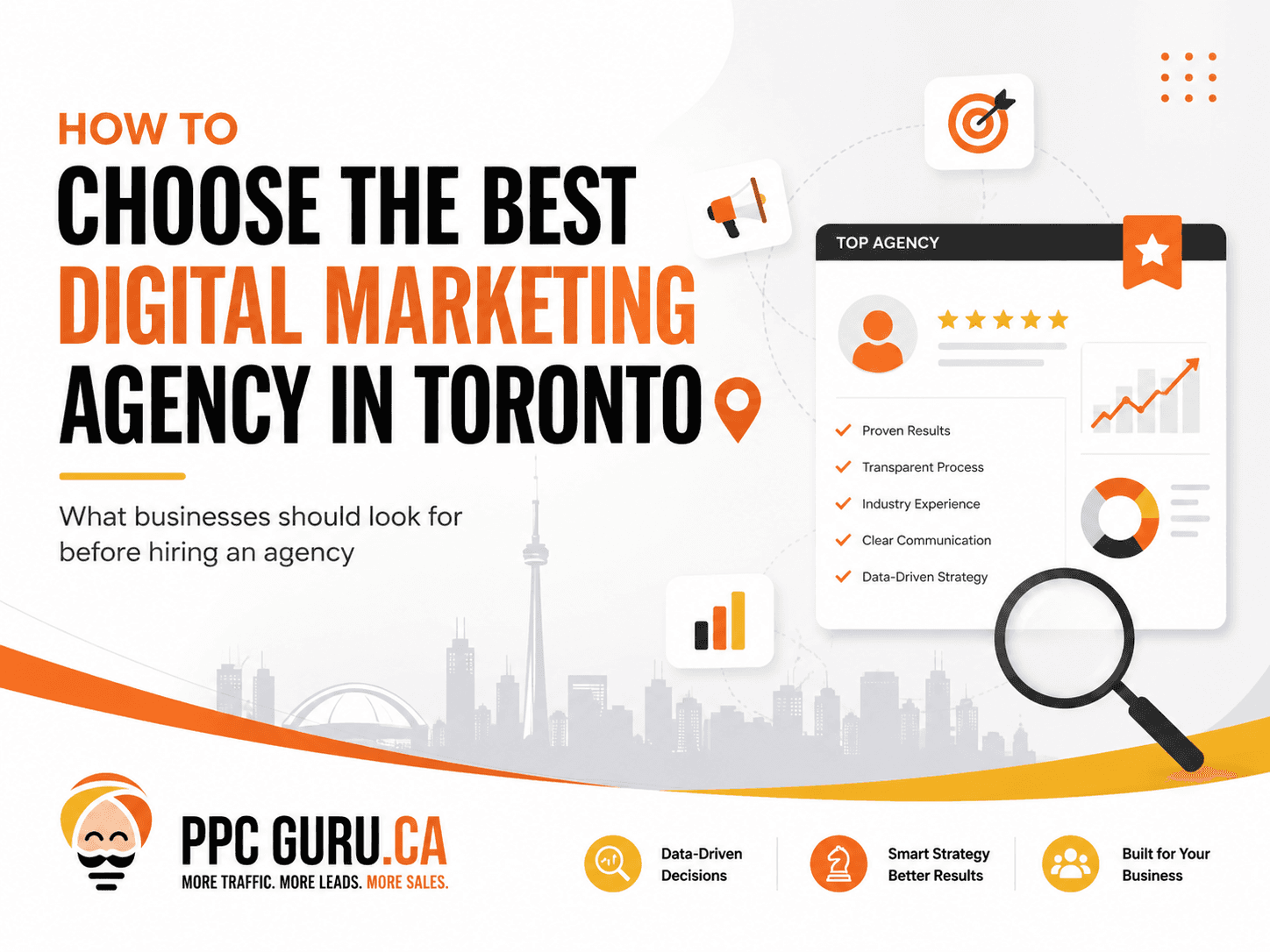
Choosing a digital marketing agency in Toronto, Canada can have a direct impact on your company's lead generation, revenue, reputation, and long-term growth.
Toronto businesses have no shortage of options. Some agencies specialize in Google Ads or SEO, while others offer everything from social media and website development to branding, automation, and content production. The challenge isn't finding an agency, it's determining which one is genuinely suited to your goals.
The best digital marketing agency in Toronto isn't automatically the largest, cheapest, most awarded, or most visible. It's the one that understands your business model, recommends the right channels, measures meaningful results, communicates transparently, and treats your advertising accounts and data responsibly.
This guide provides a practical framework for comparing agencies before you sign anything.
How do you choose the best digital marketing agency in Toronto?#
Start by defining the business result you want to achieve. Then evaluate each agency's strategy, relevant experience, case studies, measurement capabilities, account ownership practices, pricing, and contract terms.Don't choose an agency based only on rankings, promises, impressions, or the lowest monthly fee. The better question is: can this agency connect its marketing activities to qualified leads, customers, and revenue for your specific business?
1. Define the business outcome before contacting anyone#
"Get more traffic" isn't a complete objective. Traffic only has value when it contributes to something real. Your actual goal might be generating qualified sales inquiries, increasing booked consultations, selling more online, improving local visibility, entering a new market, or reducing customer acquisition costs.Turn the general goal into a measurable statement. "Generate 30 qualified basement-renovation inquiries per month within our GTA service area" is something an agency can actually plan against. "Get more leads" isn't.
An agency that recommends a package before understanding your goals, customers, and sales process may be selling services, not developing a strategy.
2. Understand your own customer acquisition economics#
A strong agency should ask how your business makes money, not just how much you want to spend on ads. At minimum, know your average transaction value, gross profit margin, lead-to-customer conversion rate, customer lifetime value, and sales-cycle length.A simplified way to find your ceiling: maximum affordable cost per lead equals your maximum customer acquisition cost multiplied by your lead-to-customer conversion rate. A renovation company that can afford $750 to acquire a customer, converting 20% of qualified leads into paying customers, has a rough maximum affordable cost per qualified lead of $750 × 20% = $150.
That doesn't mean every $150 lead is automatically profitable, lead quality and sales performance still matter, but it's a far more useful starting point than picking an arbitrary ad budget out of the air. Be cautious of any agency that talks about clicks and impressions but never asks about margins, close rates, or customer value.
3. Decide between a specialist and a full-service agency#
Neither is automatically better. A specialist fits well when one specific account is underperforming, you need deep technical SEO support, or your internal team already handles everything else and just needs one gap filled. A full-service agency fits better when your website, SEO, advertising, and analytics are disconnected, you have no internal marketing department, or your brand positioning and conversion journey genuinely need to be rebuilt together.| Your situation | Likely better fit |
| One underperforming ad account | Paid-media specialist |
| Strong internal team missing one capability | Specialist agency |
| Weak website, tracking, SEO, and advertising | Integrated agency |
| No internal marketing resources | Full-service partner |
| Complex rebrand and market launch | Full-service agency |
4. Evaluate the agency's strategy, not its service list#
Most Toronto agencies list a similar menu: SEO, Google Ads, Meta Ads, social, content, web design, email. A long list proves nothing about whether they can solve your specific problem.Ask every shortlisted agency why they're recommending a given channel, what evidence supports it, which audience or search behaviour they're targeting, what they'd test first, and what would cause them to change the strategy. Two 2026-specific questions worth adding to that list: how do they handle content created with AI assistance, and how they check it for accuracy and originality, and how they measure success now that a large share of searches produce zero clicks, since an agency still reporting purely on click-through traffic is working from an incomplete picture.
A credible agency will tell you a service isn't necessary yet. A local service business often needs high-intent Search campaigns before it needs daily social posting. The right channel depends on customer behaviour, not the agency's preferred package.
5. Look for relevant experience and verifiable proof#
Don't evaluate an agency by counting logos on its website. Look for experience with businesses that share your sales cycle, service area, and competitive conditions, not necessarily an identical business.For any case study, ask what the client's starting position was, what period it covers, how much was spent, whether the reported conversion was a form fill, a call, or an actual sale, and whether the client also changed its offer, website, or sales process during that window. "300% growth" going from one lead to four is technically accurate and means almost nothing. A useful case study explains the starting point, strategy, investment, timeframe, and business result together.
6. Distinguish lead volume from lead quality#
A funnel runs from raw form submissions through contactable leads, relevant inquiries, qualified prospects, booked appointments, sales opportunities, paying customers, and finally revenue. An agency producing 100 cheap form submissions where only five match your service area is not obviously better than one producing 25 pricier leads that generate ten real sales conversations. The second campaign is often considerably more profitable.Agree on the definition of a qualified lead before hiring, and set up a way for your sales team to feed lead-quality data back to the agency. Without that loop, ad platforms optimize toward whoever completes a form, not whoever actually becomes a customer.
7. Examine tracking, attribution, and reporting#
A professional agency should be able to explain exactly how it will measure your customer journey, whether that's form submissions, phone calls, bookings, e-commerce transactions, or CRM-sourced revenue attribution.A useful monthly report answers what happened, why it happened, what changed as a result, and what's being tested next, not just a screenshot of a platform dashboard. Ask specifically whether the agency reports on platform conversions or verifies outcomes through your own CRM and sales data, since platform reporting alone doesn't reveal whether a lead was actually qualified.
8. Confirm ownership of your accounts and data#
Your business should retain administrative access to its essential marketing assets: Google Ads, Meta Business Manager, Analytics, Search Console, your domain, hosting, CRM, and customer lists.Agencies can manage Google Ads accounts through manager accounts without requiring you to surrender control. Google's own documentation confirms that a client account retains ownership of its data and can unlink a manager relationship at any time, even after granting that manager ownership-level access.
Before signing, ask directly: if we end the relationship, do we retain our campaign history, analytics, tracking setup, and customer data? Get the answer documented in the agreement itself, not just discussed verbally.
9. Understand the pricing model and scope#
Agencies charge through monthly retainers, flat fees, percentage-of-ad-spend, project fees, or hybrid arrangements. No model is universally best. A lower fee may exclude creative production, landing-page work, or tracking setup; a higher one may include senior account management and broader implementation.Compare proposals by scope, not price alone. Clarify what's included, what's excluded, whether there are setup fees, and whether advertising spend is clearly separated from the agency's own fee.
10. Consider Google Partner status, but keep it in perspective#
Google's Partner program includes Member, Partner, and Premier Partner tiers, with benefits tied to education, support, insights, and recognition, evaluated against certification, spend, and performance criteria.A Google Partner badge is a useful trust signal for a Google Ads agency specifically. It isn't a guarantee of campaign success. Still evaluate strategic thinking, tracking quality, relevant experience, communication, and commercial understanding independently.
PPC Guru is a Toronto-based Google Partner agency, but we believe the badge should be one trust signal among several, not a substitute for asking the right questions.
11. Ask who will actually manage your account#
The person leading the sales call is often not the person managing your campaigns week to week. Ask who develops the strategy, who manages the account day to day, what experience that person has, how many accounts they handle, and how urgent issues get escalated. There's nothing inherently wrong with a team that includes junior specialists, the concern is a lack of oversight or clarity about who's actually responsible for your results.12. Watch for these red flags#
Be cautious of an agency that guarantees first-place rankings or a specific lead count without any research, focuses reporting only on impressions and clicks, refuses to provide account access, uses case studies with no dates or budgets attached, pushes every channel it offers regardless of fit, avoids discussing lead quality, requires a long contract with no clear exit terms, or can't explain who will manage your account. Marketing always involves real uncertainty. An honest agency communicates expected outcomes, risks, and assumptions rather than promising results it can't actually control.13. Use a scorecard to compare agencies#
Score each shortlisted agency against the same framework instead of relying on gut feeling.| Evaluation area | Weight |
| Understanding of your goals and economics | 15 |
| Relevant experience and evidence | 15 |
| Proposed strategy | 15 |
| Tracking and measurement | 15 |
| Transparency and account ownership | 10 |
| Reporting and communication | 10 |
| Team expertise | 10 |
| Pricing and contract flexibility | 5 |
| Understanding of the Toronto market | 5 |
| Total | 100 |
14. Questions to ask before hiring a Toronto marketing agency#
What business result would you prioritize first? Why are you recommending these specific channels? How will you define a qualified lead? What comparable results can you actually show me? How will you track leads through to revenue? Who owns the advertising and analytics accounts? Who manages the account day to day? What will your reports include, specifically? How often will we meet? What's excluded from this proposal? What happens if performance falls below expectations? What are the contract and cancellation terms? What should we expect during the first 30, 60, and 90 days? Under what circumstances would you advise us not to proceed at all?An agency's answers here will usually tell you more than its proposal deck does.
Should you hire a Toronto-based agency specifically?#
A Toronto agency offers real practical advantages: familiarity with the GTA market, awareness of Canadian consumer behaviour, easier same-time-zone collaboration, and genuine understanding of local competition. But location shouldn't outweigh competence. A local agency with weak measurement and strategy isn't automatically better than a strong specialist elsewhere.One thing worth understanding specifically about this market: Toronto isn't really one competitive landscape, it's a dozen smaller, denser ones stitched together. A business competing in Etobicoke isn't necessarily fighting the same businesses as one in North York or Scarborough. An agency that treats "Toronto" as a single undifferentiated target, rather than understanding that neighbourhood-level distinction, is showing a generic pitch with the city name inserted, not real local expertise. Treat genuine Toronto-market understanding as one real evaluation factor, not the entire decision.
Why businesses consider PPC Guru#
PPC Guru is a Toronto-based digital marketing agency and Google Partner, supporting businesses through Google Ads, Meta Ads, SEO, local SEO, website and landing-page development, creative production, and tracking. Our approach starts with understanding a client's goals, target market, economics, and existing marketing performance before recommending anything. We don't believe every business needs every service, the right strategy depends on customer intent, competition, budget, and internal capacity, not a standard package.Final checklist before signing an agreement#
Confirm that your primary business goal is documented, success metrics are agreed upon, the proposed strategy is clearly explained, case studies have been properly evaluated, the tracking plan is defined, account and data ownership are confirmed, fees and exclusions are understood, reporting frequency is documented, contract exit terms are clear, and the actual day-to-day account manager is identified by name.Frequently asked questions#
How do I choose the best digital marketing agency in Toronto? Define your goals, compare relevant experience, review verifiable case studies, evaluate tracking and reporting, confirm account ownership, understand pricing, and ask who will manage your account directly. Choose the [digital marketing agency](https://maps.app.goo.gl/TS1XofrMWnW1nkAg6) showing the strongest alignment with your business, not simply the lowest fee.How much does a digital marketing agency cost in Toronto? Pricing depends on the service, scope, campaign complexity, and reporting needs. Ask for a detailed breakdown of agency fees, setup costs, ad spend, and anything excluded from the base price. We've broken down real SEO cost ranges separately here.
Should I hire a specialist or a full-service agency? Hire a specialist for a clearly defined channel problem, like an underperforming Google Ads account. Consider full-service when several parts of your customer journey need coordinated improvement together.
Should a marketing agency guarantee results? Be cautious of guarantees. Agencies control strategy and execution, not market demand, competition, platform changes, or your own sales team's close rate.
Is Google Partner status important? It's a useful trust signal for a Google Ads agency specifically, but not a guarantee. Evaluate strategy, case studies, communication, and measurement capability alongside it.
Should my business own its Google Ads account? Yes, your business should retain administrative access and control over its advertising history and data. Agencies can manage accounts through Google's manager-account system without this preventing your own access.
How long does digital marketing take to produce results? Paid advertising can generate early data quickly, though reliable optimization needs sufficient traffic and conversions first. SEO usually takes longer, commonly 4-6 months for meaningful movement, since it depends on competition, site condition, and content quality.