

If you are deciding how to choose an SEO agency in Toronto, do not start with a provider's position in a “top agency” article. Start with your business goal, the work that must be implemented, and the evidence that will show whether search is producing qualified leads. PPC Guru uses the questions below when discussing SEO services in Toronto with businesses that want more than a ranking report.
Picture an illustrative sales call. The deck is polished. The tool audit has dozens of warnings. There is a traffic chart that rises neatly to the right. Yet nobody has asked what a good lead looks like, whether your developer can ship changes, or who will tell the agency which enquiries became customers.
Those missing questions matter more than the deck.
Short answer: Choose the agency that can diagnose your actual constraints, name who will implement each priority, measure enquiries through to qualified leads, protect your accounts and data, and explain a realistic first 90 days. Do not hire based on guarantees, a tool score, a generic package, or an agency's self-published ranking.
The two-minute screen#
Use this before a detailed proposal review.
| If a provider does this | Your response |
|---|---|
| Guarantees number-one rankings | Stop the conversation |
| Discusses traffic but not qualified leads | Ask for the measurement plan |
| Sends a generic package before seeing the site | Ask what evidence shaped the scope |
| Cannot say who implements recommendations | Treat delivery as unresolved |
| Wants to own your core accounts | Require client ownership and named access |
| Gives a clear 30/60/90-day plan with owners | Move it to the detailed scorecard |
Contents#
- Define the decision first
- How the scorecard works
- The 18 questions
- How to interpret the score
- Compare proposals
- The first 90 days
- Red flags
- Agency, consultant or in-house
- FAQ
Define the decision before you build a shortlist#
“Best” is not a universal category. The right provider has to fit the problem, the people available to solve it, and the economics of the business.
A GTA contractor may need to prioritize profitable project types and the service areas a crew can genuinely cover. A clinic may need careful service, location and practitioner information, with an approval process that protects accuracy. A professional-services firm may have fewer leads but a longer sales cycle, so a form fill on its own says little.
The same package cannot be assumed to fit all three.
Before a discovery call, write down six things:
- the service or product you most want to sell;
- the locations you can actually serve;
- what makes an enquiry qualified;
- who can approve content and development changes;
- the monthly budget the business can sustain; and
- the commercial result that would justify continuing.
This also makes the sales call fairer. The agency can say what it can own, what depends on you, and whether SEO is the first problem to solve.
How the 36-point scorecard works#
The PPC Guru Lead-Ready SEO Partner Scorecard has six gates. Score every answer:
- 0: vague, avoided or risky;
- 1: plausible but incomplete; or
- 2: specific, verifiable and assigned to an owner.
There are 18 questions, so the highest possible score is 36. This is a PPC Guru decision aid, not a Google metric, an industry certification, or a guarantee that an engagement will work.
Do not reward presentation quality by itself. A confident answer without a person, process or piece of evidence is still incomplete.
The 18 questions to ask an SEO agency#
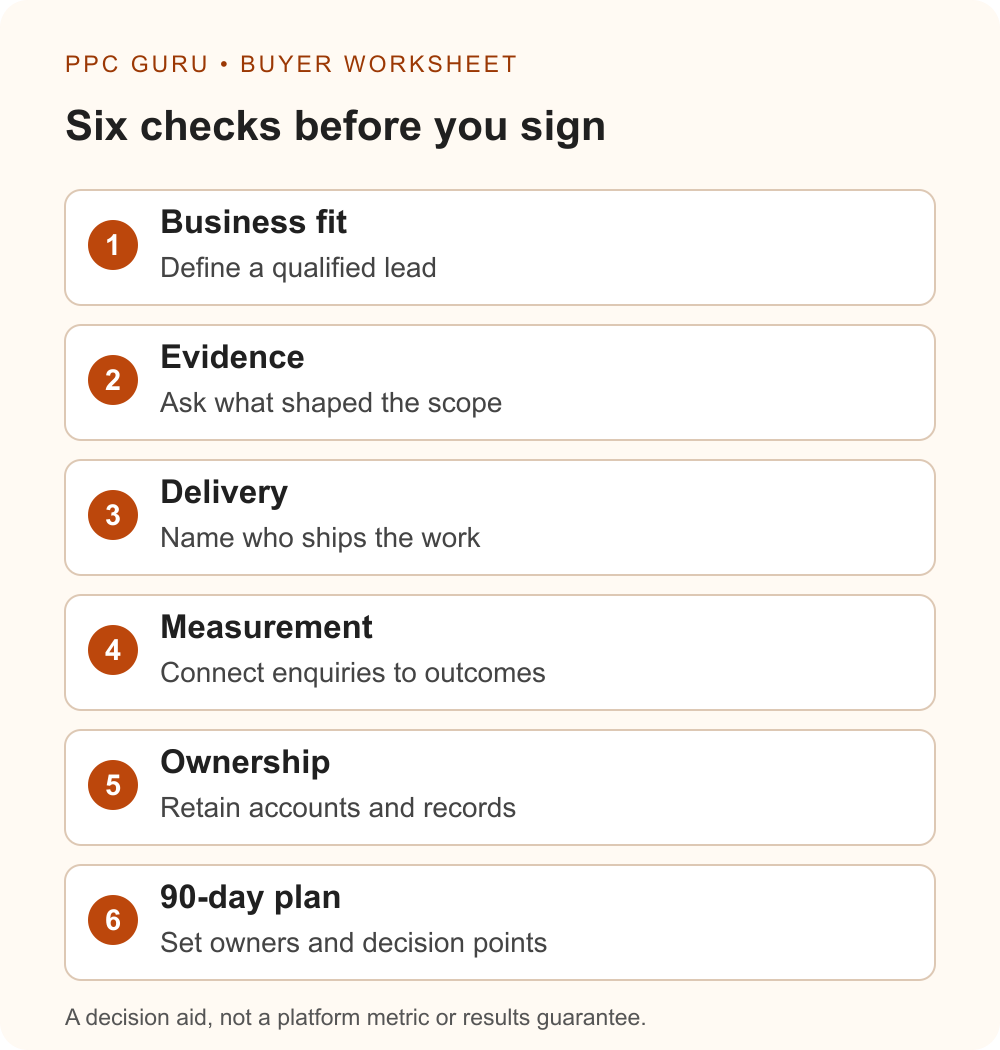
Download the editable SEO partner scorecard (CSV). The questions and scoring rules are also available in full below.
Gate 1: Does the agency understand the business?#
1. How do you define a qualified lead for us?#
“More leads” is too loose.
A form fill is an enquiry. A qualified lead matches criteria your business can act on: perhaps the right service, geography, project value, urgency, eligibility or buying role. A customer is the person or organization that eventually buys.
Ask how the agency will learn those distinctions from your sales or intake team. If the answer is “we will track forms,” the measurement plan stops too early.
2. Which services and locations should we prioritize?#
The answer should reflect demand, margin, capacity and operational reality.
“All services across the GTA” is not a priority. A contractor may make more from additions than small repairs. A clinic may have room for one service but a waiting list for another. An immigration practice may only accept certain matter types.
The agency does not need to know these facts before the first call. It does need to ask.
3. When would you tell us not to lead with SEO?#
This is one of the most revealing questions.
A credible provider can recognize when the first constraint is broken intake, a weak offer, an unusable website, missing tracking or a need for demand now. A controlled Google Ads campaign or conversion repair may come before a long organic program. Sometimes the business does not yet have the approval or development capacity to act on an SEO plan.
An agency does not build trust by prescribing SEO for every problem.
Gate 2: Is the diagnosis based on evidence?#
4. What evidence supports the first priorities?#
Look for a mix of sources:
- the site's crawl and index state;
- Search Console queries and pages;
- analytics and conversion tracking;
- service, location and competitor results;
- content and internal-link ownership;
- customer questions and sales feedback; and
- implementation constraints.
A tool export can help find issues. It cannot decide which issue matters commercially without business context.
5. Can you separate symptoms from root causes?#
Low traffic is a symptom. So is a falling ranking.
The underlying problem might be that Google cannot reliably process the intended page, the page addresses the wrong intent, the business has no distinct page for an important service, competitors provide stronger proof, visitors cannot understand the offer, or changes never reach production.
“Publish more content” and “build more links” are actions. Ask the agency to explain the diagnosis that makes those actions appropriate.
6. What is explicitly out of scope?#
This question prevents ugly surprises in month two.
Development, design, copy approval, photography, review management, local-profile work, call tracking, CRM changes and sales follow-up can become hidden dependencies. A proposal should say what is included, what is excluded, and what happens when an excluded dependency blocks an included deliverable.
Gate 3: Can the plan be implemented?#
7. Who makes strategy decisions and who does the work?#
Ask who will remain in the account after the sale.
You need to know who sets priorities, who researches and writes, who handles technical decisions, who speaks with your developer, and who is accountable when a task stalls. Titles alone are not enough; ask how much capacity and senior review your account receives.
8. Who implements technical and content recommendations?#
An audit does not fix a site.
Establish whether the agency, your developer, an internal marketer or another vendor will ship each type of work. Then ask who validates the finished change. “We send recommendations” may be a perfectly valid consulting scope, but it is not the same service as implementation.
If nobody owns the handoff, even an excellent recommendation can sit in a spreadsheet for six months.
9. How are changes approved, documented and checked?#
The answer should cover:
- who approves customer-facing claims;
- who approves technical changes;
- where work and decisions are recorded;
- how the agency checks staging and production; and
- how a harmful change can be reversed.
For regulated or sensitive subjects, accuracy review may be as important as search optimization. The workflow should make that visible.
Gate 4: Can performance reach the sales conversation?#
10. How will search activity connect to qualified leads?#
Google Analytics offers recommended events for stages such as generate_lead, qualify_lead, disqualify_lead, working_lead and close_convert_lead. The exact setup depends on the site, CRM, consent requirements and sales process. The principle is what matters: rankings and traffic should not be the end of the reporting chain (Google Analytics Help).
Ask the agency to map the journey:
| Stage | Working definition | Possible evidence |
|---|---|---|
| Search visit | A person arrives from an organic search surface | Analytics landing page and source data |
| Enquiry | A person calls, submits, books or messages | Form, call or booking event |
| Qualified lead | The enquiry meets agreed business criteria | CRM or intake status |
| Opportunity | The business is actively pursuing the work | Pipeline stage |
| Customer | The work is won or purchased | Closed outcome, where appropriate |
Not every organization can connect every stage perfectly. Honest limitations are better than false precision.
11. What decision will the monthly review help us make?#
An emailed dashboard is not a strategy meeting.
Ask which priorities could change and what evidence would trigger that change. A useful review might decide to improve one service page, consolidate overlapping articles, fix a conversion break, change an internal-link plan, or pause content while development catches up.
If the meeting only recites rankings, the report is describing activity rather than managing it.
12. What happens when tracking is incomplete?#
Most measurement is imperfect. The agency should identify the gap, explain what can and cannot be inferred, assign responsibility for repair, and validate the repair afterward.
It should not quietly combine unrelated conversion actions or present a phone-number click as a booked customer.
Gate 5: Are risk, access and ownership clear?#
13. What access is required, and at what stage?#
Google advises site owners to give an SEO read-only Search Console access during an audit before granting broader write access. Use named users and the least access necessary for the work (Google Search Central).
Ask why each permission is needed. Shared passwords and immediate ownership transfers are avoidable risks.
14. Who owns the accounts, content and data when the contract ends?#
The client should know how these assets can be retained, transferred or exported:
- Google Analytics and Search Console;
- Google Business Profile;
- tag-management and call-tracking accounts;
- keyword and content research;
- approved copy and creative files;
- reporting history; and
- documentation of changes.
Put transition steps and notice terms in the contract. Do not wait for an unhappy final month to discover that a critical account belongs to someone else.
15. Which tactics will you refuse to use?#
Ask specifically about doorway pages, keyword stuffing, hidden links, undisclosed paid links, scraped content and ranking guarantees.
Google's spam policies describe practices that can reduce visibility or remove pages from results (Google Search Central). A provider should be able to explain not only what it will do, but which shortcuts it will reject.
Gate 6: Is the first 90 days an operating plan?#
16. What will you learn, fix and ship in 30, 60 and 90 days?#
Look for milestones, dependencies, named owners and decision points—not a ranking promise.
The agency may not know every task before access and diagnosis. It should still be able to explain how uncertainty becomes a prioritized plan and how early work reaches the site.
17. What could delay results or change the plan?#
A useful answer may mention:
- access and data quality;
- legal, medical or brand approvals;
- development capacity;
- current site quality and migration risk;
- competition and seasonality;
- the business's ability to answer enquiries; and
- evidence that a different service or page deserves priority.
“Nothing” is not confidence. It is a missing risk review.
18. When should we continue, change course or stop?#
Agree on review points before signing.
A professional engagement should be able to change priorities when evidence changes. It should also explain what happens if implementation remains blocked, the business changes direction, or the work cannot be justified. Renewal should be a decision, not a surprise.
How to interpret the score#
Add the 18 answers, then use this as a conversation guide:
| Score | Interpretation | Next action |
|---|---|---|
| 30-36 | Specific and operationally credible | Verify references, people, scope and contract |
| 22-29 | Promising but unresolved | Get missing ownership and measurement details in writing |
| 14-21 | Material delivery risk | Compare another provider before deciding |
| 0-13 | Too vague or risky | Do not sign on the current information |
One unresolved high-risk item can override the total. Account ownership, prohibited tactics, implementation responsibility or measurement integrity should not be averaged away because the sales presentation scored well elsewhere.
The score also cannot predict rankings, leads or the working relationship. It simply makes important assumptions easier to see.
Compare SEO proposals without getting lost in deliverables#
Copy this worksheet and use one row for each meaningful priority:
| Priority | Evidence | Work to ship | Owner | Due or decision point | Success signal | Dependency |
|---|---|---|---|---|---|---|
| Example: improve a core service page | Query and page evidence | Rewrite, proof, internal links and QA | Named agency lead plus client approver | Day 30 | More relevant visibility, engagement and qualified enquiries | Subject-matter approval |
This exposes the difference between a deliverable and a strategy.
“Four articles per month” is a deliverable. A better explanation for a commercially important question, connected to the correct service page, supported by trustworthy evidence and measured through qualified enquiries, is a strategy.
For a deeper scope comparison, use PPC Guru's guide to what monthly SEO services should include. For budget context, read the separate guide to Toronto SEO cost and timeline considerations. Keeping those questions on their existing pages prevents one article from trying to own every commercial query.
What the first 90 days should clarify#
The exact tasks should follow the diagnosis. Still, the proposal should explain how learning becomes implementation.
| Period | Main purpose | Examples of evidence or work |
|---|---|---|
| Days 1-30 | Establish reality | Access, tracking review, indexing, page/intent inventory, lead definition, technical and conversion priorities |
| Days 31-60 | Ship the highest-confidence work | Priority page improvements, technical fixes, internal links, local facts, content or proof needed for the decision journey |
| Days 61-90 | Validate and adjust | QA, early search and conversion signals, sales feedback, unresolved dependencies and next-quarter priorities |
This table is PPC Guru's planning framework, not a universal timetable. It is not a promise that rankings or leads will appear inside 90 days. It tests whether useful work, ownership and decisions will be visible.
Consider this illustrative comparison of two agencies:
- Agency A promises 20 articles, 100 links and first-page rankings. It cannot name the developer, the target services or the qualified-lead definition.
- Agency B proposes fewer initial outputs. It first verifies page ownership, tracking and sales priorities, then assigns the first three changes to named people with approval dates.
Agency B has not guaranteed a result. It has made the operating risk easier to evaluate.
SEO agency red flags that deserve a pause#
Pause when a provider:
- guarantees a number-one ranking;
- will not explain its methods;
- asks to own essential business accounts;
- proposes hundreds of near-duplicate location pages;
- sells links without explaining the source, disclosure or risk;
- reports only rankings, impressions or traffic;
- cannot name who implements recommendations;
- pushes a fixed package before understanding the business; or
- treats AI-search visibility as a separate shortcut.
Google explicitly warns that no one can guarantee a number-one ranking. Its hiring guidance also recommends asking how results will be measured, how the provider communicates, and what changes it plans to make (Google Search Central).
For Google's AI search experiences, established SEO fundamentals still apply. Google says special AI files, special schema and artificial “AI chunks” are not required. Ask the agency how it will improve accessibility, answer quality, evidence, entity consistency and measurement instead (Google Search Central).
PPC Guru's SEO vs AEO vs GEO guide explains where those practices overlap and where the labels can distract from the first broken layer.
Agency, consultant or in-house?#
The scorecard can be used for any operating model.
| Model | Often useful when | Watch for |
|---|---|---|
| Agency | You need several disciplines and implementation capacity | Sales-to-delivery handoff and unclear account ownership |
| Consultant | You have capable internal implementers but need senior diagnosis and direction | Recommendations can stall without delivery capacity |
| In-house hire | SEO is continuous, strategically central and can support a full role | One hire may still need development, design, PR or analytics support |
Choose the model after identifying the bottleneck. A larger team is not automatically better. A cheaper retainer is not automatically lower risk. A brilliant consultant cannot compensate for a company that never implements; an implementation-heavy agency cannot compensate for the wrong commercial priority.
Frequently asked questions#
Can an SEO agency guarantee first-page rankings?#
No credible provider can control Google's rankings or guarantee a number-one result. An agency can commit to work, communication, documentation and measurement—not a position it does not own.
Does the agency need Toronto experience?#
Toronto/GTA experience can help with geography, local competition, service areas and buyer context. It is not proof of quality by itself. Test the agency's reasoning, implementation and measurement just as carefully.
Should I choose the lowest-priced SEO proposal?#
Compare the work, ownership, dependencies and measurement before comparing totals. A lower fee can be appropriate for a narrow scope. It becomes expensive when essential implementation is excluded or the team cannot tell whether leads are qualified.
What should SEO reporting include?#
Use technical and search diagnostics to explain what happened, then connect them to meaningful business stages: enquiries, qualified leads, opportunities and customers where tracking and privacy requirements permit. The report should also state data limitations and the next decision.
Should I give an agency ownership of Analytics or Search Console?#
Usually, the business should retain ownership and grant named users the permissions needed for their work. During an initial audit, Google's SEO hiring guidance recommends read-only Search Console access. Broader permissions should follow a documented need and approval process.
Should the agency optimize for ChatGPT and other AI tools?#
It should understand how answer and generative systems affect discovery, but it should not sell a guaranteed citation formula. Ask how the plan improves useful answers, source quality, entity consistency and measurement while preserving sound SEO fundamentals.
How long should I take to choose an SEO agency?#
Long enough to resolve ownership, scope, access, measurement, risk and the first plan. The calendar matters less than whether the people who will approve and implement the work are part of the decision.
A useful next conversation#
If you are comparing Toronto SEO agencies, bring PPC Guru three things: your website, the service you most want to grow, and one proposal you are considering.
Use the conversation to ask which issues deserve verification first, who would own the work, and whether another problem should be fixed before an SEO retainer. That might lead to a fit conversation; it might save both sides from the wrong engagement.
Request an SEO conversation with PPC Guru. There is no ranking or lead guarantee. The purpose of the first discussion is to establish the goal, constraints, lead definition and fit.
Method and sources#
PPC Guru prepared this guide using agency-selection search results, directional Toronto keyword research, existing PPC Guru topic coverage, and primary Google guidance. Research and editorial checks were refreshed on September 3, 2026. The scorecard is an original editorial decision aid, not a validated predictor of results. Adapt it to your business, contract, security and risk requirements.