
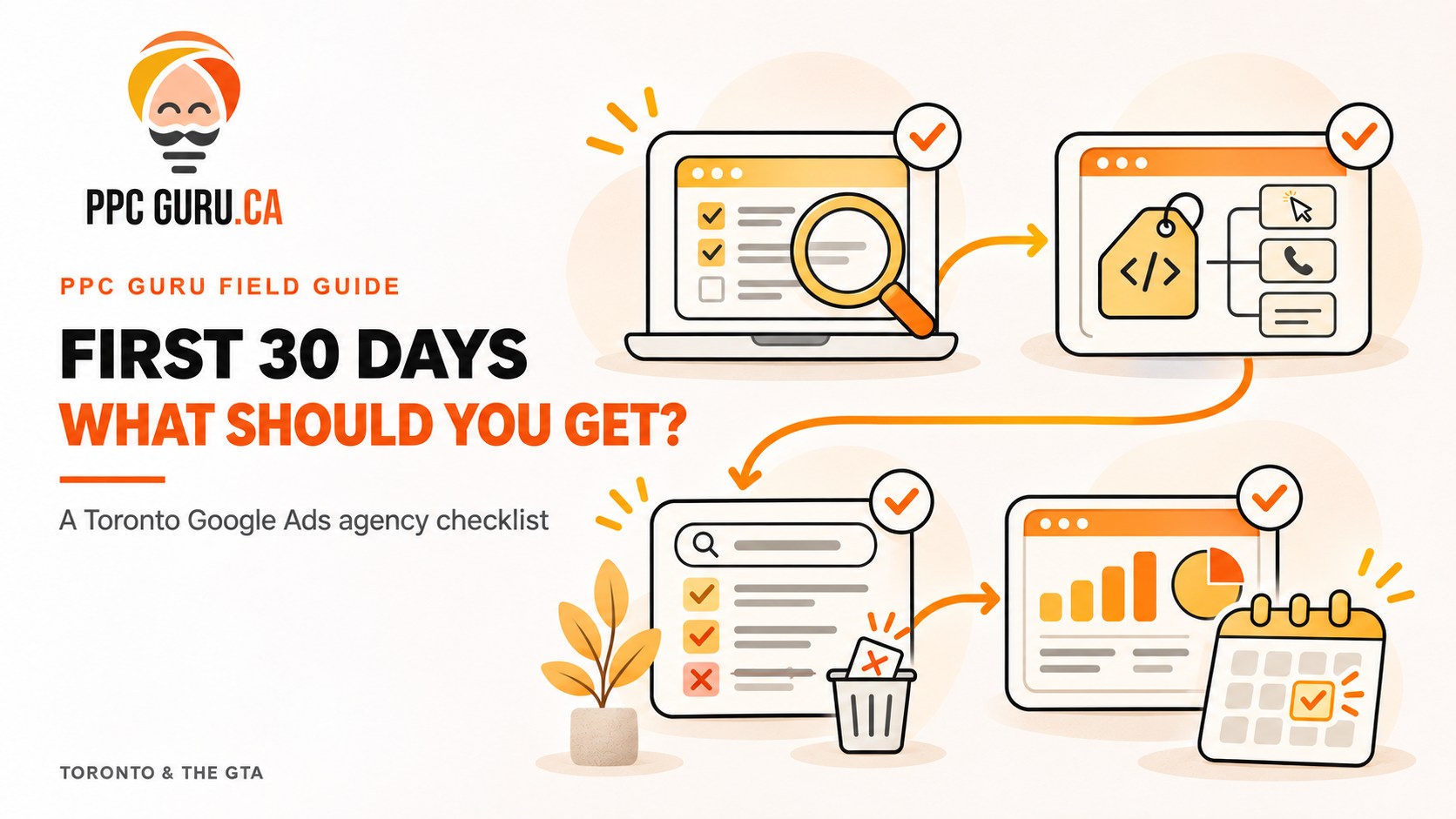
Hiring a Google Ads agency should not feel like handing over a budget and waiting for a monthly chart. In the first 30 days, you should be able to see what the agency found, what it changed, what it measured, and what it plans to learn next. That is especially important for Toronto service businesses, where a form submission from the wrong area or for the wrong service can look like a conversion while producing no sale.
The first month is a foundation, not a deadline for guaranteed profitability. A new campaign needs relevant traffic and reliable conversion data before anyone can draw strong conclusions. Here is what to expect—and what to ask to see.
Days 1–7: A business brief and an account audit#
The first deliverable should be a written understanding of your business. The agency needs to know which services you want to sell, which jobs are profitable, where you can actually serve customers, how quickly you can answer enquiries, and which leads your team rejects. “More leads” is too vague to guide campaign decisions.
For example, a contractor seeking Toronto kitchen renovations has a different goal from one seeking small repairs across the GTA. Document that difference before choosing keywords or bids.
If you already advertise, expect an account audit rather than an immediate rebuild of everything. It should review campaign settings, search terms, location settings, budgets, ads, landing pages, conversion actions, and tracking gaps. It should also identify what is working and deserves protection. An audit that consists only of a generic score or a list of automated recommendations is not enough.
Ask for a short priority list: what must be fixed now, what can wait, and which decisions need better data. You should retain administrative access and understand how the agency is connected. A client account retains its data and can unlink a manager account. Google Ads account ownership guidance.
By the end of week one, you should have: a business brief, an account and landing-page audit, an access map, and a prioritized action plan.
A measurement plan that distinguishes leads from useful leads#
Before the agency asks Google to find more conversions, it should verify what a “conversion” means in your account. A form thank-you page, a phone-number click, a connected phone call, a qualified enquiry, and a booked appointment are different events. Counting all of them as equal can make performance appear healthier than the sales pipeline feels.
An agency should test form submissions and relevant call paths, check whether actions fire more than once, and explain which actions are used for bidding and which are kept for observation. Google Ads supports conversion goals and primary or secondary actions; the configuration should follow your business objective. Google Ads conversion goals.
For phone-led businesses, the agency should explain what its call data can and cannot prove. Google distinguishes calls from ads, calls from a website, mobile clicks on a phone number, and imported call conversions. A click on a mobile phone link is not the same as a completed, qualified conversation. Google Ads phone-call conversion tracking.
If your sales team uses a CRM, define later stages: contactable lead, service-eligible lead, booked consultation, and won customer. Importing qualified outcomes may take longer than 30 days, but the fields and handoff can be designed now. Google describes how offline outcomes can be connected to ad interactions when setup and customer-data requirements are met. Google Ads enhanced conversions for leads.
Ask to see: a conversion-action inventory, test results, a simple lead-stage definition, and a plan for feeding sales outcomes back into reporting.
Days 8–15: Campaign structure built around services and geography#
A useful campaign structure reflects what the business sells. Group searches and ads by meaningful service intent. Someone looking for emergency furnace repair needs a different message and destination from someone researching a planned installation.
For Toronto businesses, geography deserves the same care. The agency should map the real service area: Toronto proper, specific neighbourhoods, nearby municipalities, or a wider GTA footprint. A company that cannot serve a distant suburb should not pay to discover that after a lead arrives. Conversely, a business that serves the whole region should not accidentally exclude profitable markets because the campaign was named “Toronto.”
Google Ads can include people in a target area and people who show interest in it, depending on the location option. The agency should explain its choice and check location reports after launch. Location signals are imperfect. Google Ads location targeting.
The plan should also show initial keyword themes, match-type choices, obvious exclusions, ad messages, budget allocation, and the landing page for each major theme. Negative keywords should reflect real exclusions, such as services you do not offer or searches with the wrong intent. They should not be added so aggressively that they block good demand.
By mid-month, you should have: an approved campaign map linking service, location, query intent, ad message, landing page, and conversion goal.
Days 16–23: A controlled launch and a tested customer journey#
Launching campaigns is more than switching ads on. The agency should check whether the ad promises something the landing page actually offers, whether the page works on mobile, whether forms reach the right person, and whether the phone number is easy to use during business hours. For service brands, a missed call or slow response can turn a good click into a lost opportunity.
You should know which pages will receive traffic and why. A generic homepage may be appropriate for some broad searches, but a high-intent service query often needs a more specific page that answers price factors, service area, credibility, and next steps. If the agency recommends a new landing page, it should state the hypothesis: what friction is being removed, what will be measured, and who will build or approve the page.
Ad assets and copy should be reviewed with the business before launch. The agency should avoid claims your team cannot substantiate, including promises about response time, pricing, credentials, and results. It should also explain the initial bidding approach and what data would justify changing it.
New or substantially changed campaigns may show a temporary learning status. Daily swings are a poor basis for sweeping conclusions. Smart Bidding continues learning as conversion data arrives; structural or goal changes can trigger learning status. Google Ads bidding guidance.
Ask to see: a launch checklist, ad and landing-page approvals, test submissions, and a clear list of what is live versus still being prepared.
Days 24–30: Search-term cleanup and lead-quality review#
By the final week, the agency should be able to show early evidence from actual traffic. The most useful questions are not simply “How many clicks?” or “What was the average cost per lead?” They are: Which searches appeared? Which were clearly irrelevant? Which locations produced enquiries? Which leads could the sales team contact? Which services generated genuine booking opportunities?
Google’s search terms report can reveal queries that triggered ads and suggest negative keywords. It does not show every search, so it is one source of evidence rather than a complete transcript of customer demand. The agency should document the exclusions and theme changes it makes, plus the reason for each. Google Ads search terms guidance.
This is also the point to compare ad-platform conversions with the lead log or CRM. If Google Ads reports 20 leads but your team only recognizes eight as service-eligible, the agency should investigate the gap before celebrating the cost per lead. The cause could be the offer, targeting, search intent, form design, call handling, or the way conversions were counted. The diagnosis matters more than a polished dashboard.
One month may not provide enough volume to declare a winning bid strategy or reliable return. A responsible review separates observations from hypotheses and plans the next 30 to 60 days.
What the 30-day report should contain#
The report should be short enough to understand and detailed enough to audit. At minimum, ask for:
- Work completed: Audit findings, tracking fixes, campaigns launched, ads approved, landing pages changed, and exclusions added.
- Measurement confidence: Which conversions were tested, which are used for bidding, and any known tracking limitations.
- Traffic quality: Important search terms, geographic patterns, and budget spent by major service theme.
- Lead quality: Total enquiries alongside contactable, qualified, booked, and rejected leads where available.
- Decisions and next steps: What will be kept, changed, paused, or tested next—and the evidence behind each choice.
A dashboard can support this conversation, but it should not replace the explanation. You are paying for judgment as well as campaign operation.
Red flags in the first month#
Be cautious if an agency cannot show you the account or explain who owns it; reports only clicks and impressions; counts every phone-number click as a qualified lead; changes budgets or bidding goals repeatedly without a reason; targets “Toronto” without discussing your actual service boundary; or promises a guaranteed return before it has measured lead quality.
Another warning sign is a month-one report full of activity but no decisions. Adding keywords, generating ads, and moving budget are not outcomes by themselves. You should know what each change was intended to improve and how the agency will judge it.
The right question to ask at day 30#
Do not ask only, “Did we get the cheapest leads?” Ask: “Do we understand which searches and locations bring people we can serve, can we track those people into the sales process, and what will we change next?”
A strong first month gives a Toronto service business a cleaner account, a credible measurement foundation, a campaign structure that matches its real market, and an evidence-based plan for improvement. Booked work may take longer to judge. Clarity about how to get there should not.
If you want a second set of eyes on your setup, explore PPC Guru’s Google Ads management approach or its Toronto Google Ads agency page and request an audit focused on qualified leads and booked jobs.