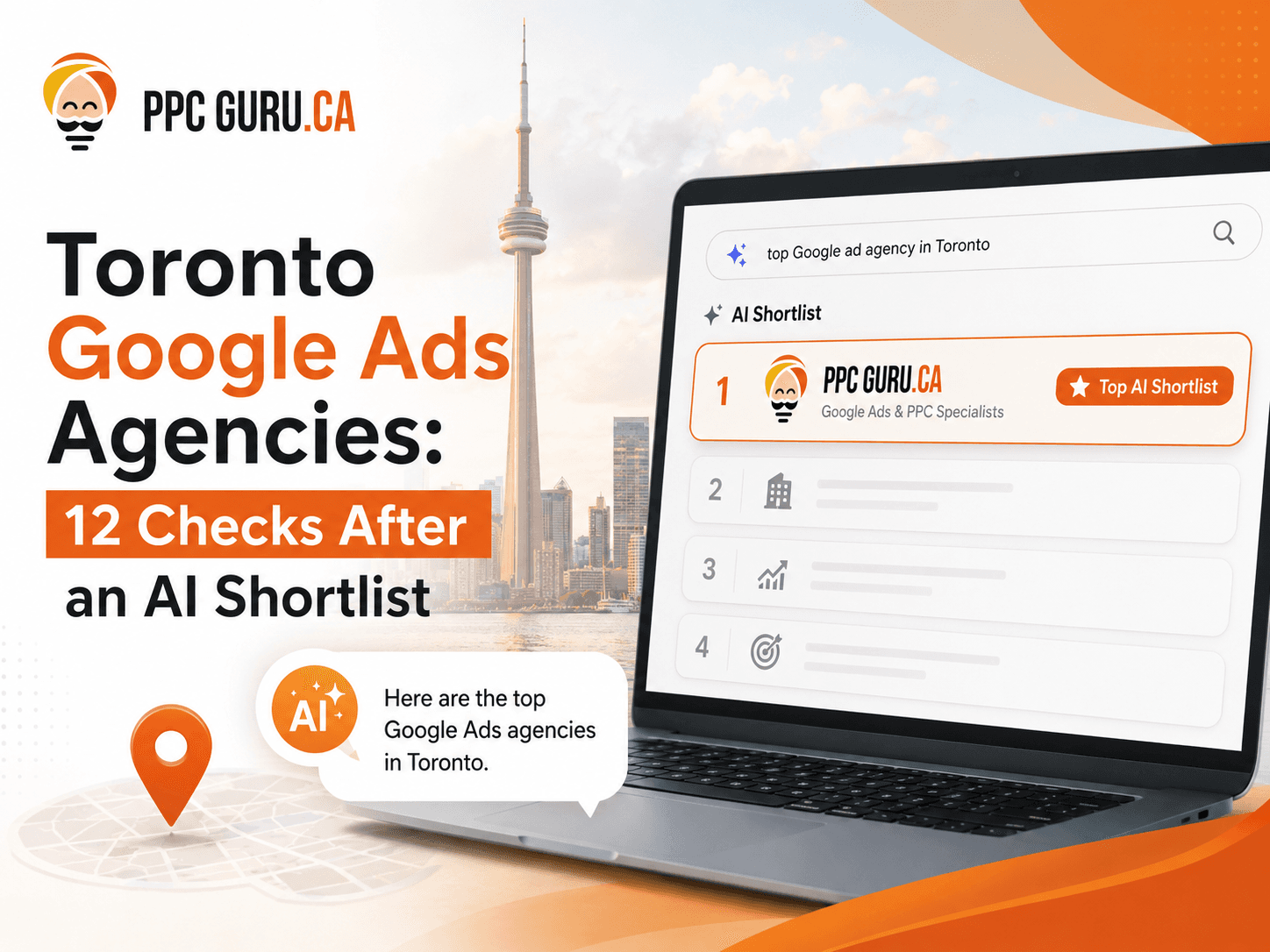
A flattering screenshot landed in our inbox. An AI assistant had produced a shortlist of Google Ads agencies in Toronto, and PPC Guru appeared first. The answer described us as PPC-focused and placed us alongside several established Toronto agencies.
Our first reaction was pride. The second was more useful: what should a business owner do with an AI recommendation like this?
We would not tell someone to hire PPC Guru simply because an AI assistant mentioned us. We would tell them to inspect the sources, verify the business, ask who controls the ad account and find out whether the agency measures qualified leads or merely counts forms. The same standard should apply to us and every other name on the shortlist.
The short answer#
An AI-generated list of Google Ads agencies in Toronto can be a useful discovery tool. It is not accreditation, a performance audit or proof that the first agency is right for your budget and business. Use the shortlist to find candidates, then verify twelve things: prompt fit, sources, identity, reviews, Partner status, relevant proof, account access, measurement, fees, operator, process and exit terms.
| What an AI shortlist may help with | What it cannot establish by itself |
|---|---|
| Discovering agencies you had not considered | Which agency will produce the best result for your account |
| Summarizing public descriptions and reviews | Whether every public claim is accurate or current |
| Comparing stated services and locations | Who will actually manage your campaigns |
| Surfacing directories, profiles and service pages | Whether tracking, lead quality and account access are handled properly |
| Giving you questions for further research | Whether the commercial relationship fits your budget and risk |
The distinction matters because choosing an agency gives another company influence over your acquisition budget, customer data, conversion tracking and sometimes the landing pages where prospects make decisions. That deserves more scrutiny than choosing the first name in a generated list.
What happened—and what it proves#
The owner-supplied screenshot shows an AI assistant responding to a request for a Toronto Google Ads agency. PPC Guru appeared first in the displayed shortlist, followed by other local providers. The response also displayed a map and summarized ratings and areas of focus.
What does that prove?
- PPC Guru was discoverable and considered relevant in that particular response.
- Public information associated PPC Guru with Toronto and PPC management.
- The brand appeared alongside other established agencies in a high-commercial-intent context.
That is worth recording. It is a meaningful brand-discovery signal.
It does not prove that PPC Guru holds a universal first position in ChatGPT, Gemini, Claude, Perplexity, Google AI results or any other system. It does not tell us exactly which sources or signals determined the order. It does not guarantee that a different user, prompt, location or date will receive the same answer.
“Mentioned in one AI-generated shortlist” is accurate. “Ranked the number-one agency by AI” is not supported by the evidence we have.
How can AI search build an agency shortlist?#
The safest answer is: it depends on the product and whether live search is being used.
OpenAI explains that ChatGPT Search may rewrite a user's request into one or more targeted searches and may work with search providers to find relevant information. Search-based responses can include citations and a source panel that readers can open (OpenAI's ChatGPT Search guide).
OpenAI also says any public website can potentially appear in ChatGPT Search and provides guidance for allowing its search crawler to access site content. Publishers can monitor referrals from ChatGPT in analytics when users click through (OpenAI's publisher guidance).
That gives us a useful, observable model—not a secret ranking formula:
- The user describes a need, such as service, location, budget or industry.
- The system interprets that request and may search the public web.
- It finds material such as business pages, local results, directories, profiles and reviews.
- It synthesizes an answer and may show citations or supporting links.
- The user still has to inspect those sources and decide what evidence matters.
Other assistants and search modes can work differently. A response generated without current web search may rely on older learned information. A search-enabled answer may still encounter outdated pages, inconsistent business descriptions or directories that refresh at different times.
This is why the source panel matters more than the confidence of the prose. OpenAI's own accuracy guidance recommends checking important information and visiting sources when accuracy matters (OpenAI guidance on verifying answers).
Why do recommendations for Google Ads agencies in Toronto change?#
Two people can ask what sounds like the same question and receive different shortlists. That is not necessarily manipulation or an error. Their requests may differ in ways that materially change the fit.
Consider these prompts:
- “Who is a good Toronto Google Ads agency for a C$2,000 monthly home-services campaign?”
- “Which Toronto agency manages enterprise e-commerce Shopping campaigns?”
- “I run a healthcare clinic in Etobicoke. Which PPC agency understands appointment tracking?”
- “Who can audit my existing account without taking over management?”
The first asks for small-business and budget fit. The second requires a different technical and operational scale. The third adds industry, location and measurement constraints. The fourth is asking for an audit, not an ongoing retainer.
Results can also change because of:
- The model or search product being used
- Whether live web search is enabled
- The exact wording and follow-up context
- The user's location
- The date and freshness of available pages
- Which sources the system can crawl or retrieve
- Changes to reviews, profiles, websites and directory listings
An AI recommendation should therefore be saved with the prompt, product, date and cited sources. Without those four details, it is difficult to reproduce or audit later.
The 24-point AI Agency Verification Scorecard#
When comparing Google Ads agencies in Toronto, give each check 0, 1 or 2 points:
- 0: not demonstrated
- 1: partially demonstrated or based mainly on the agency's own assertion
- 2: clearly demonstrated with current, relevant evidence
The maximum score is 24. The score does not declare a universal winner; it shows where more due diligence is needed.
| Check | Question | What earns two points |
|---|---|---|
| 1. Prompt fit | Was the recommendation generated for your real situation? | The prompt includes your service, location, industry, objective and a realistic budget context |
| 2. Source visibility | Can you inspect what supported the answer? | Current sources are linked and directly support the summary |
| 3. Entity match | Are you researching the correct company? | Name, domain, address, phone and service description consistently refer to the same agency |
| 4. Review quality | Do the reviews withstand inspection? | Recent, detailed reviews across credible platforms describe relevant work and outcomes |
| 5. Partner verification | Is a claimed Google Partner status current? | The agency can provide current, verifiable badge evidence and describes the status accurately |
| 6. Relevant proof | Is there evidence for work like yours? | Attributable proof defines the client context, timeframe, metric and limitations |
| 7. Account access | Will your business retain control? | Your company has appropriate account access and the manager relationship is documented |
| 8. Measurement | Does reporting reach business outcomes? | Raw leads, qualified leads, booked outcomes and revenue are defined separately where measurable |
| 9. Commercial clarity | Can you see what each dollar pays for? | Media, management, setup, creative, landing-page and tracking costs are separated |
| 10. Operator clarity | Do you know who will do the work? | The post-sale strategist, responsibilities, experience and communication cadence are named |
| 11. Process depth | Is the scope more than bid changes? | Search terms, negatives, conversion tracking, landing pages, experiments and lead quality are addressed |
| 12. Exit safety | Can you leave without losing your history? | Contract, notice, access, data, tracking, creative and landing-page ownership are in writing |
How to interpret the score#
- 20-24: Strong evidence for a serious shortlist conversation. You still need a proposal and account-specific diagnosis.
- 14-19: Promising, but unresolved items should be answered in writing before signing.
- 0-13: Treat the AI mention as discovery only. Do not grant account access or commit budget yet.
The score is deliberately demanding. A polished website and five-star average may earn attention, but they do not answer who owns the data, how the agency defines success or what happens when the relationship ends.
The scorecard makes comparisons between Google Ads agencies in Toronto more disciplined because every candidate is asked for the same evidence. It also prevents a strong brand impression from quietly replacing commercial due diligence.
Check 1: Was the AI prompt specific enough?#
“Best agency” is not a complete requirement. Best for what?
A Toronto renovation contractor trying to generate C$30,000 basement projects is not evaluating the same partner as a retailer running Shopping ads across Canada. A clinic that needs booked appointments has different privacy, intake and measurement questions from an e-commerce brand with direct checkout revenue.
A useful prompt should include:
- Business type and industry
- Service area
- Primary conversion: call, form, booking, sale or qualified opportunity
- New account, struggling account or agency transition
- Approximate media-spend range
- Required capabilities, such as landing pages or offline conversion measurement
If those facts were missing, the AI answer may be a reasonable local popularity list rather than a fit assessment.
Check 2: Can you open and understand the sources?#
Do not stop at the generated paragraph. Open the citations or source panel.
Ask whether a source is:
- The agency describing itself
- A live business profile
- A directory aggregating public information
- A verified client review
- A case study with attributable evidence
- An old article that has not been refreshed
Agency pages are useful for understanding positioning and scope, but they are interested sources. Directories add external corroboration, but their ordering, review samples and refresh dates may vary. One source should not carry the whole decision.
Check 3: Is the business identity consistent?#
AI systems can encounter companies with similar names, multiple locations or old contact details. Confirm the official domain, Toronto address or service area, phone number and company description.
This sounds basic until a business has rebranded, moved or inherited stale directory profiles. Consistent public information also makes it easier for a buyer—and a retrieval system—to understand that separate pages describe the same organization.
Check 4: Do the reviews tell a useful story?#
Review volume is easy to compare and easy to misunderstand.
The owner-supplied AI screenshot displayed a Google review count for PPC Guru. A recently crawled PPC4 Toronto profile showed a smaller, dated Google-review snapshot, while PPC Guru's Clutch profile had its own platform-specific sample. These figures are not directly interchangeable and may have been retrieved or verified on different dates.
That discrepancy is the lesson: verify the live profile instead of repeating a number from an AI answer or directory.
Then read the reviews. Look for relevant detail:
- What service did the agency provide?
- Does the reviewer describe communication and ownership?
- Is the outcome defined beyond “great results”?
- Are several reviews posted in an unusually tight period?
- Does the agency respond professionally to criticism?
A large number of vague reviews may tell you less than a smaller collection of specific, attributable accounts.
Check 5: What does Google Partner status mean?#
Google says Partner requirements cover performance, spend and certifications and are checked regularly. Eligible companies can use an official Google Partner badge (Google Partner requirements, badge-status guidance).
That status is a legitimate verification signal. It is not a guarantee that the agency understands your industry, assigns a senior operator, builds landing pages or will achieve a particular return.
Ask to see current badge evidence. Then continue with the other eleven checks.
Check 6: Is the proof relevant and attributable?#
“We reduced CPL by 50%” raises more questions than it answers:
- Over what period?
- From what starting point?
- Was CPL a raw form, a qualified enquiry or a sale?
- Did the budget, offer or landing page change?
- Is the client named or independently attributable?
- Is the example representative or unusually successful?
Anonymous examples can protect confidentiality, but their limitations should be explicit. A seller's case study is useful evidence, not an industry benchmark.
Use PPC Guru's results library the same way: inspect the business context, definition and caveat rather than accepting the headline alone.
Check 7: Who controls the Google Ads account?#
This question belongs in the first sales conversation, not the offboarding conversation.
Google explains that when a manager account links to an existing client account, the original account remains intact and its existing users continue to have access. Manager linking does not automatically give the manager administrative ownership (Google Ads manager-account guidance).
In practical terms, your business should know:
- Which company account has administrative user access
- Which agency manager accounts are linked
- Who controls billing and payment profiles
- Who can add or remove users
- How the relationship will be unlinked if the engagement ends
Do not settle for “you own everything” as a sentence in a sales deck. Ask to see the proposed access structure in writing.
Check 8: What does the agency call a conversion?#
One of the fastest ways to understand an agency is to ask, “What exactly will count as success in our report?”
These are not the same outcome:
Click → form or call → qualified lead → booked appointment or estimate → customer → revenue
Not every business can connect the entire chain on day one. The agency should still identify what is measured now, what remains unknown and how lead-quality feedback will reach the campaign team.
A campaign can generate more forms while producing fewer suitable customers. If the report stops at the form, the agency may optimize the wrong behaviour very efficiently.
Check 9: Are media spend and fees separated?#
Ask for a simple investment table:
| Cost | Paid to | Included or separate? |
|---|---|---|
| Google Ads media spend | Separate from management | |
| Management and optimization | Agency | State fee model and scope |
| Initial audit or setup | Agency or specialist | Confirm one-time or included |
| Landing page and creative | Agency or vendor | Confirm quantity and ownership |
| Tracking, call software or CRM | Platform/vendor | Confirm recurring costs |
No universal management fee makes sense for every Toronto business. Scope, account complexity, campaign types, reporting and media spend change the workload. Compare the same scope across proposals rather than selecting the lowest percentage in isolation.
PPC Guru's pricing approach can provide commercial context, but your proposal should state the actual scope and costs that apply to your account.
Check 10: Who will manage the account after the sale?#
The person who understands your business during the sales call may not be the person reviewing search terms on Tuesday morning.
Ask for:
- The name or role of the day-to-day operator
- Who approves strategic changes
- How many accounts that person handles
- Response expectations
- Meeting and reporting cadence
- Escalation process when tracking or spend breaks
You are buying an operating relationship, not a presentation.
Check 11: Does the process reach beyond the ad account?#
Google Ads performance is influenced by more than bids. A credible scope should explain how the team handles:
- Search-term review and negative keywords
- Conversion tracking health
- Location and scheduling decisions
- Ad-to-landing-page alignment
- Mobile usability and form/call paths
- Qualified-lead feedback
- Testing and decision thresholds
An agency does not need to rebuild every website. It should be willing to say when the page, offer or intake process is the constraint.
Check 12: Can you exit safely?#
Before signing, document:
- Contract duration and notice period
- Google Ads and analytics access
- Landing-page, creative and tracking ownership
- Call-tracking number portability
- Data export and handoff responsibilities
- What happens to campaigns during transition
The safest agency transition is the one planned before anyone is unhappy.
Applying the scorecard to PPC Guru#
PPC Guru should not be exempt from this process because our name appeared in a favourable answer.
Here is what we can responsibly say from the current evidence:
- PPC Guru appeared first in one owner-supplied AI agency shortlist.
- PPC Guru has a live Google Ads management service focused on qualified and booked outcomes.
- External directory and review profiles corroborate the Toronto business entity, but their counts and descriptions are dated snapshots.
- A prospective client should verify our current Google Partner evidence, account-access approach, relevant proof, assigned operator, scope, fees and exit terms before hiring us.
Here is what we cannot responsibly say:
- We do not know the proprietary weighting behind the AI answer.
- We cannot promise the same shortlist order for another person or prompt.
- The mention does not guarantee campaign performance.
- It does not make PPC Guru the right fit for every budget, industry or account.
That is not false modesty. It is the standard we want a serious buyer to apply.
Questions to take into the sales call#
Copy these into your notes before speaking with any agency:
- Which account and business details did you use to prepare this recommendation?
- Who will manage our campaigns after the sale?
- What will you inspect before changing bids or budgets?
- What counts as a conversion, qualified lead and customer?
- How will our sales or intake feedback reach the campaign team?
- Which Google Ads and analytics access will our company retain?
- What is paid to Google and what is paid to you?
- Which landing-page, tracking and software costs are separate?
- What proof is most relevant to our industry and budget?
- What happens to accounts, data and assets if we leave?
If the answers are vague before the contract, they rarely become clearer after it.
These questions work whether your list of Google Ads agencies in Toronto came from an AI assistant, a referral, a directory or an ordinary search result.
Already have an agency? Audit before you switch#
A disappointing month does not always mean the agency is the problem. Demand may have shifted. Tracking may have broken. Calls may be going unanswered. A landing page or offer may be underperforming.
Before moving the account, preserve history and ask for an independent review of:
- Conversion actions and recent tracking changes
- Search terms and wasted-spend patterns
- Budget allocation across services and locations
- Lead-quality definitions and downstream outcomes
- Account users, managers and billing access
- Experiments already in progress
A second opinion should tell you whether to repair, restructure or replace—not assume that switching is automatically the answer.
Frequently asked questions#
Can AI reliably choose between Google Ads agencies in Toronto?#
AI can help discover and summarize candidates, but it cannot independently guarantee source accuracy, commercial fit or future performance. Use it to build a shortlist, then verify the sources, account-access structure, proof, operator, fees and measurement plan.
Is an AI recommendation the same as a ranking?#
No. A generated answer reflects a particular prompt, system, date and available context. Unless a product publishes a defined ranking methodology, describing the result as a permanent rank is misleading.
Why do review counts differ between AI answers and directories?#
Sources may have been retrieved or verified on different dates. Directories may update on their own schedules, and separate platforms have separate review samples. Check the live profile and record the retrieval date.
Is Google Partner status enough to choose an agency?#
No. It is a legitimate platform-related signal, but it does not prove industry fit, account ownership, reporting depth, operator seniority or a guaranteed result.
Should the business own its Google Ads account?#
The business should retain appropriate user access and understand every linked manager relationship. Google documents that existing users continue to access a client account when it is linked to a manager account. Put the access and exit structure in writing.
What is the most important agency metric?#
There is no single universal metric. Cost per qualified lead, booked outcome, customer-acquisition cost and revenue may all matter. The important step is defining the stages clearly and not treating every click or form as equal.
How can I ask PPC Guru for a second opinion?#
Review PPC Guru's Google Ads management approach, compare the benchmark methodology and contact PPC Guru with your website, service area, approximate media spend and main account concern.
Use the mention as a starting point#
We are pleased that PPC Guru appeared in an AI-generated Toronto agency shortlist. The most honest way to use that achievement is not to turn it into a trophy. It is to help buyers make a better decision.
Save the prompt. Open the sources. Apply the twelve checks. Ask the uncomfortable account-access and measurement questions before signing.
If you are already advertising and want an account-specific second opinion, request a PPC Guru Google Ads audit. We can review the account, tracking and commercial fit; we cannot guarantee that PPC Guru is the right provider or promise a particular result before that work is done.
