

Google Ads for contractors should start with the jobs the business actually wants: the service, location, timing and project fit. For a GTA contractor, that means separating campaigns only where a different budget, service area, landing page or lead value requires control. This PPC Guru guide complements our Google Ads services with a practical way to evaluate campaign structure and distinguish enquiries from qualified opportunities.
Short answer: organize the account around meaningful service and geography differences, send each search to a page that answers the same need, review actual search terms, and feed qualified-lead outcomes back into measurement. More campaigns are not automatically better. Better control and better business feedback are.
A two-minute account test#
Ask these questions before changing bids or adding another campaign:
- Can you name the services the business wants more of?
- Can the team identify which cities or postal areas are genuinely serviceable?
- Does each important service have a useful destination page?
- Can someone distinguish an enquiry from a qualified project?
- Can qualified and won outcomes be traced back to the original source?
If the answer to the last two questions is no, optimizing cost per form may simply produce more forms.
Contents#
- Start with business boundaries
- Use the campaign-split test
- Control GTA geography
- Review search terms
- Match the landing page
- Build the lead-quality loop
- Use a weekly rhythm
- FAQ
Start with business boundaries, not campaigns#
Illustrative example: a renovation company serves Toronto, Mississauga and Oakville. It wants kitchen renovations and full basement projects, but not handyman requests or material-only enquiries. Its crews can travel farther for a major project than for a small repair. This is a planning scenario, not a client case study.
That business does not have one undifferentiated market. It has combinations of service, geography, urgency and project value.
Write the boundaries down before opening the campaign editor:
| Boundary | Question | Why it changes the account |
|---|---|---|
| Service | Which projects do we want and avoid? | Shapes keywords, ads, pages and negatives |
| Geography | Where will we travel for each project type? | Shapes targeting, exclusions and budget |
| Timing | Emergency, near-term or planned? | Changes message, call handling and value |
| Capacity | How many new estimates can the team handle? | Prevents buying leads the operation cannot serve |
| Qualification | What makes a project worth estimating? | Defines the feedback sent into reporting |
This is the commercial foundation. A technically tidy account cannot repair an unclear offer or an undefined service area.
Separate a campaign only when the split changes control#
Many guides prescribe one campaign per service. That can be sensible, but it is not a universal rule. At a modest budget, excessive separation can leave every campaign with too little activity to evaluate. At a larger budget, combining unlike services can hide where money and lead quality differ.
Use the PPC Guru campaign-split test. Create a separate campaign when at least one answer is materially different:
- Does this service need its own budget?
- Does it target a different area or schedule?
- Does it need a different landing page and promise?
- Does a qualified lead have a meaningfully different value?
Roof repair and full replacement may deserve separate control because urgency, job value and page content differ. Two closely related renovation searches may work inside one campaign with focused ad groups if they share budget, location and destination.
The point is not to maximize campaign count. It is to make budget and optimization decisions visible.
Treat GTA geography as an operating constraint#
Google Ads allows targeting by countries, sub-regions, cities, radiuses and other available location types. It also distinguishes people who are likely to be physically present from people who have shown interest in a location. Google notes that location detection uses multiple signals and is not perfectly accurate. Review the current location-targeting documentation before launch.
For a contractor, the setting should reflect the operating decision:
- Use a serviceable-area list based on actual crew capacity.
- Exclude places the team consistently declines.
- Review where clicks and qualified enquiries originate, not just the selected targets.
- Consider whether presence-only targeting better matches a local job requirement; do not assume it is always superior.
- Separate a distant area only when it needs its own budget, economics or message.
A broad GTA label can conceal very different travel time and job economics. A downtown emergency call, a renovation in Oakville and a material-only request from outside the service area should not be interpreted as equivalent leads.
Review search terms by job fit#
Keywords are account inputs. Search terms are the searches that actually triggered ads. Google explains that the two can differ and that the search terms report can support keyword and creative refinement. The report does not expose every query; some are omitted for privacy, so it is not a complete record of demand.
Review search terms using business categories, not only click metrics:
| Search-term category | Possible action |
|---|---|
| Wanted service and wanted location | Preserve and assess landing-page fit |
| Wanted service but wrong city | Review location settings and exclusions |
| Wrong service or project size | Add a careful negative or narrow the theme |
| Employment, training or DIY intent | Exclude when clearly irrelevant |
| Material-only or supplier intent | Exclude if the contractor does not sell materials |
| Research intent that later qualifies | Do not exclude automatically; inspect outcomes |
Google provides a workflow for using search terms as negative-keyword ideas. Use it carefully. Negative keyword matching behaves differently from positive keyword matching, and an aggressive list can block valuable variations.
The right question is not, "Did this query convert?" It is, "Did this query create the kind of project we can serve profitably?"
Match the ad to a useful landing page#
An ad for basement renovation should not land on a generic homepage that asks the visitor to rediscover the service. The destination should confirm the service, area, process, fit and next action without making unsupported promises.
For GTA contractor traffic, a useful page normally needs:
- a clear service and service area;
- examples of the type of work offered, without inventing proof;
- qualification information that helps the wrong-fit visitor self-select out;
- a mobile-friendly call or enquiry path;
- truthful ownership, licensing or credential information where relevant;
- a privacy-conscious form that asks only for information needed at this stage.
The related PPC Guru construction and renovation marketing page should own broader industry-service intent. This article supports the paid-search implementation decision.
Build the contractor lead-quality loop#
Start by agreeing which outcomes your intake team can reliably record. A form submission, an estimate and a won project answer different questions; combining them into one undifferentiated conversion total hides that distinction.
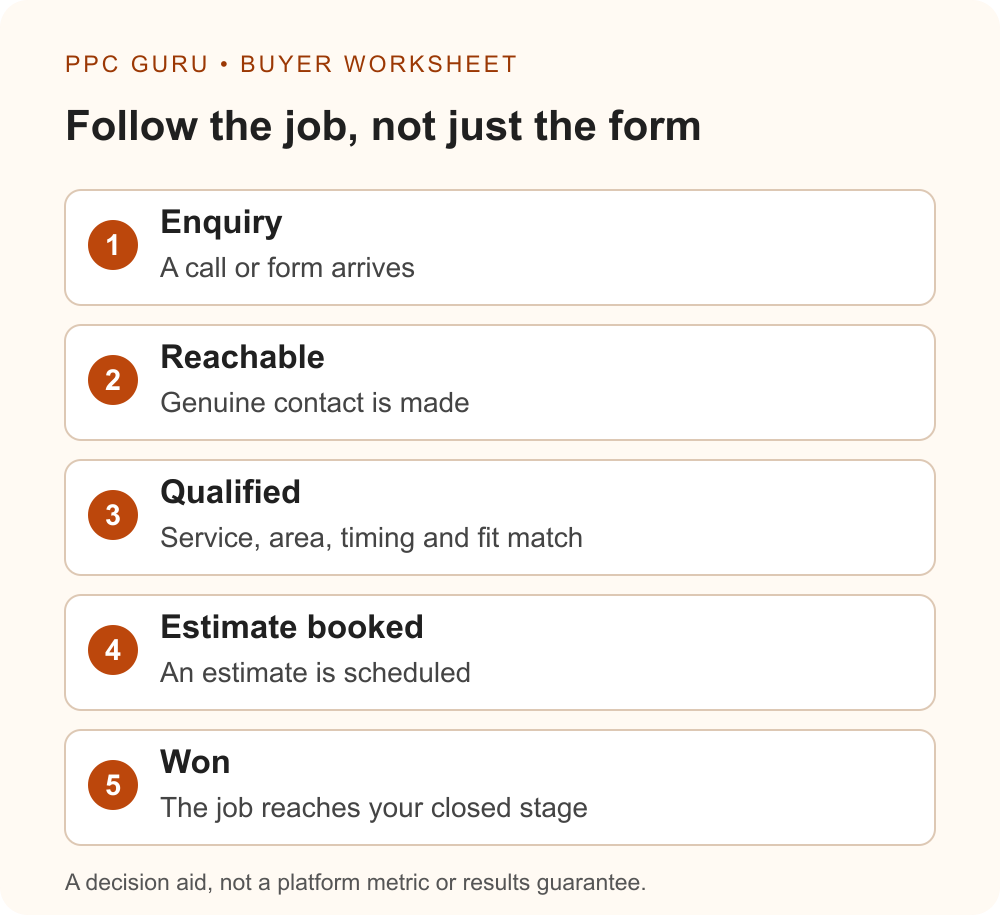
For a contractor, use a simple ladder:
- Enquiry: a call or form arrived.
- Reachable: the team made genuine contact.
- Qualified: service, location, timing and project fit passed the business rules.
- Estimate booked: a consultation or estimate was scheduled.
- Won: the job reached the business's defined closed stage.
The exact definitions belong to the business. A roofing company may qualify by property type, issue and service area. A renovation company may also need project scope, timing and decision readiness. Do not collect sensitive or unnecessary information simply because a field is available.
Download the contractor lead scorecard (CSV) for a reusable starting structure. Keep personal customer information in your approved business systems, not in a publicly shared worksheet.
When the technical and policy requirements are met, enhanced conversions for leads can combine hashed first-party data with offline imports to improve attribution. Google's setup guidance covers identifiers, conversion names and times, consent and other implementation details. This needs a privacy-aware technical setup; it is not a copy-and-paste marketing setting.
Do not automate around weak signals#
Automated bidding can only act on the goals and data it receives. If the primary signal is every form submission, the system cannot independently know that one request was outside the service area and another became a high-fit estimate.
Before asking automation to pursue deeper outcomes:
- verify that the basic conversion fires once and at the correct moment;
- define qualified and converted stages consistently;
- make sure offline events map back to the original interaction where technically possible;
- monitor volume, lag and data quality;
- keep a human review of search terms, locations and real lead outcomes.
No bidding strategy fixes an intake team that never records why leads were rejected.
Use a weekly operating rhythm#
A practical review can fit on one page:
Search intent#
- Which searches spent money?
- Which produced qualified opportunities?
- Which wrong-fit themes need exclusion or a clearer page?
Geography#
- Where were users located?
- Which areas produced reachable and qualified leads?
- Did travel or project value make those leads worthwhile?
Funnel#
- How many enquiries were reachable?
- How many qualified, booked an estimate and became won work?
- Are rejection reasons recorded consistently?
Experience#
- Did the ad and page describe the same service?
- Were calls answered and forms followed up promptly?
- Did the page help visitors judge fit before contacting the business?
Decision#
- What single change will be tested next?
- What evidence would justify keeping or reversing it?
Avoid changing bids, keywords, pages and conversion goals simultaneously. If everything changes, the team cannot tell what improved the result.
What this framework cannot promise#
Google Ads can create access to active demand. It cannot guarantee a particular lead count, job value or return. Outcomes depend on auction conditions, demand, competition, offer, reputation, website experience, sales handling, capacity and measurement quality.
This article deliberately avoids universal cost-per-click, cost-per-lead and budget benchmarks. A useful budget decision requires current account and market evidence plus the contractor's economics. Seller-published competitor numbers are examples of their experience, not neutral GTA benchmarks.
Frequently asked questions#
Should every contractor service have a separate campaign?#
No. Separate a service when it needs independent budget, geography, landing-page treatment or lead-value control. Closely related services can share a campaign when those operating decisions are genuinely the same.
What is a qualified lead for a contractor?#
It is an enquiry that passes the business's defined service, location, timing and project-fit rules. The definition should be written, applied consistently and recorded in the intake or CRM process.
Should GTA contractors use presence-only location targeting?#
It can make sense when the business only wants people likely to be in the service area. It may also reduce reach. Review Google's current options, inspect geographic performance and choose based on the business requirement rather than a universal rule.
What should be tracked besides forms?#
Track calls and forms appropriately, then record reachable, qualified, estimate-booked and won stages. Keep traffic, enquiries, qualified leads, booked opportunities and revenue distinct.
How often should search terms be reviewed?#
Review them frequently enough to control material waste and learn from real demand. A new or changing campaign normally needs closer attention than a stable account. The right cadence depends on spend, query volume and operational capacity.
Can PPC Guru review an existing contractor account?#
Yes. A useful review should examine service and location boundaries, search terms, landing pages, conversion definitions and the path from enquiry to qualified work. Bring the account goals plus the business's current lead-qualification rules so the review can distinguish campaign volume from qualified-job performance.
Method and review status#
PPC Guru prepared this guide using Google Ads documentation, directional Toronto keyword research, search-result review and original campaign-split and lead-ladder frameworks. Research and editorial checks were refreshed on September 3, 2026. Examples are illustrative; no campaign result or performance guarantee is claimed.
This is an account-planning guide, not an account audit or a privacy implementation specification. Have the people responsible for advertising and data handling validate any tracking changes against your account, permissions and applicable requirements before implementation.