
Key takeaways
- Your AI visibility score measures how often, and how prominently, AI tools like ChatGPT, Gemini, and Perplexity name your business.
- It is not a Google ranking. The pages Google ranks and the sources AI cites barely overlap anymore, so ranking well is no proof of AI visibility.
- Two-thirds of AI answers name no brand at all, a wide, mostly uncontested opening for local businesses that act early.
- You raise the score by earning citations from sources AI trusts, structuring content so a model can quote it, and keeping pages fresh, not by stuffing keywords.
- Your AI visibility score moves week to week, so a one-time check is close to useless. Track the trend, per engine.
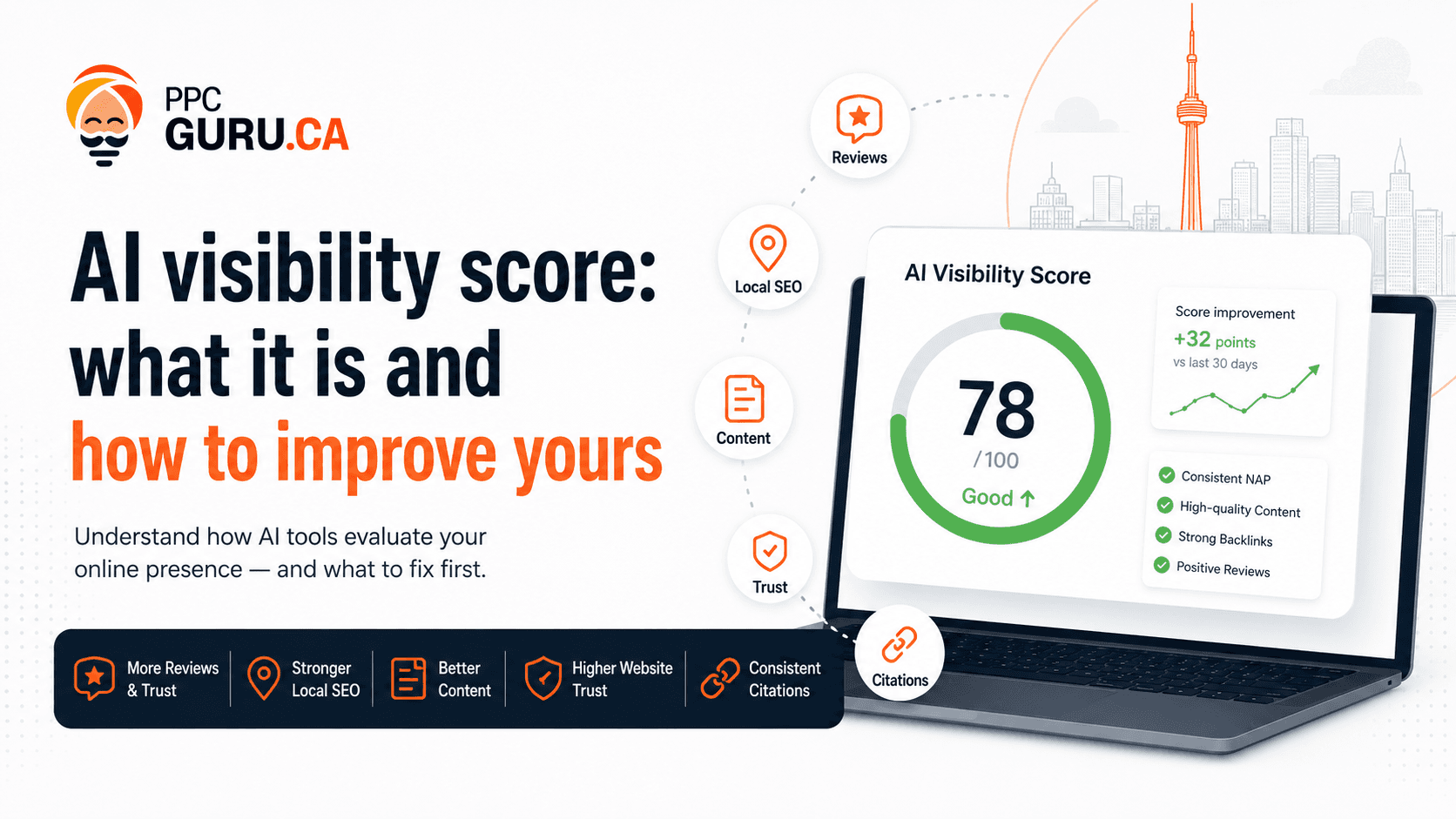
Your AI visibility score measures how often AI tools like ChatGPT, Gemini, Perplexity, and Google's AI Overviews name your business when someone asks a question you should answer. Most trackers express it as brand mentions divided by the number of prompts tested, shown as a percentage or a number out of 100. Show up in 40 of 100 relevant answers and your score is 40%.
I have watched search change shape several times: the keyword-stuffing years, featured snippets, the local-pack shakeups that rewrote Google Maps. This shift is bigger.
Most Toronto owners are treating it like it can wait. It cannot. This guide covers what it measures, why your SEOwill not carry it, and how to move it.
What an AI visibility score actually measures#
Most trackers roll four things into one number: how often you are mentioned, where you land in the answer, the sentiment of the mention, and your share of voice against competitors.
A neutral mention is not a win. After enough audits you learn to read the sentiment line first, because a wall of neutral mentions is a brand the model recognizes but will not vouch for.
The bigger shift is what "visibility" even means here. On Google you can rank fourth and still pull clicks. In an AI answer there is no fourth place. Your business is named or it is not.
That makes your AI visibility score closer to a probability than a ranking: how likely the model is to name you when a real customer asks.
One caution: every tool weights mentions, position, and sentiment its own way, so a 62 in one platform is not a 62 in another. Track the trend inside one tool, and do not compare across them.
AI visibility score vs your Google ranking#
They look alike and behave nothing alike.
Google ranking AI visibility score What it measures Your position in a list of links How often AI answers name your brand How you show up A ranked, clickable page A mention inside a written answer, or nothing Partial credit Yes, page two still exists No, you are named or invisible Stability Fairly steady week to week Volatile, changes fast Source of the answer Google's index A different source pool per engine
If you built your marketing on Google rankings over the last decade, this is the uncomfortable part.
Research found the overlap between top Google links and AI-cited sources fell from roughly 70% to under 20%. About 93.7% of the links in Google's AI Overviews come from pages outside the top 10, and only around 11% of domains cited by ChatGPT are also cited by Perplexity.
So "we rank on Google" is no longer evidence that AI will find you. A strong ranking can sit right next to a weak AI visibility score.
Why your AI visibility score differs on every engine#
Each engine builds its answers a different way, so your AI visibility score is really several scores.
ChatGPT's live search runs on Bing's index, and Wikipedia supplies close to half of its top citations, so well-sourced, reference-style pages do well there. Perplexity leans hard on recency, and Google's AI Overviews pull from a pool of their own.
Winning on one engine does not mean you won on the next, so measure your AI visibility score on each engine separately, not once.
Why Toronto small businesses have a rare opening#
Here is the part almost nobody in Toronto is talking about. In a Wellows analysis of 11.1 million AI citations between December 2025 and March 2026, two-thirds of AI answers named no brand at all, and only about 6.8% of cited sources carried a brand mention. Most of the space is simply empty.
That emptiness favours local businesses. Ask an AI for the best drain cleaner in Etobicoke or a bookkeeper near Liberty Village, and the model leans on local signals: your Google Business Profile, local directories, and reviews.
A national company fights thousands of rivals for a category term. A Toronto contractor going after "basement renovation in Scarborough" faces a handful of local sites, most of which have done nothing intentional about their AI visibility score.
I have seen this opening before. It is the same one local businesses had with Google Maps over a decade ago, and the shops that moved first still own the local pack today. Low competition plus high buyer intent is the cheapest opening you will get, and it closes fast. We wrote more about what this invisibility gap actually costs a Toronto business here.
Why this is worth doing now#
AI search has stopped being a future problem. OpenAI announced ChatGPT had crossed 900 millionweekly active users in February 2026, and Google's AI Overviews now appear on about half of tracked searches, per BrightEdge.
For a growing share of your customers, the AI answer is the first impression, formed before they reach your website. Ignoring your AI visibility score used to be safe. It is not anymore.
Show up consistently now and the advantage compounds. Stay invisible and you lose deals before a call is ever booked.
How to improve your AI visibility score#
None of this needs a big budget, just the right moves in order.
- Baseline it, per engine and per real question. Run the 20 to 30 questions an actual customer asks across ChatGPT, Gemini, and Perplexity, in their words, not category terms. "Best emergency plumber in North York for a burst pipe" tells you far more than "best plumber." Generic prompts describe a customer who does not exist. Log where you appear and where you vanish; that gap list is your plan. We walk through exactly how to run this audit here.
- Answer the question in the first two lines. AI reads the top of a page first. Lead every page with a direct 40 to 60 word answer, then expand below it. This one change lifts an AI visibility score more reliably than any other single edit.
- Load pages with real facts. A 2024 study from Princeton, Georgia Tech, and the Allen Institute for AI found that statistics, citations, and quotes could lift a lower-ranked page's AI visibility by up to 40%, while keyword stuffing did nothing or backfired. Named sources, numbers, and dates get quoted; vague copy gets skipped.
- Structure content so a model can lift it cleanly. Clear headings phrased the way people ask, a real FAQ section, comparison tables, and structured data (schema types like LocalBusiness, FAQPage, and Article) all make your page easy to quote and attribute.
- Earn the mentions AI already trusts. Models treat third-party consensus as proof. For a local business that means a consistent Google Business Profile, directory listings with matching name, address, and phone, genuine reviews, and mentions in Toronto publications or on Reddit. These often move your AI visibility score more than anything on your own site. This is the core of the local SEO work we run for clients.
- Get indexed where the engines look. ChatGPT's search leans on Bing, so submit your sitemap to Bing Webmaster Tools, not just Google Search Console.
- Keep it fresh. In that same Wellows data, about 65% of the sources AI cites changed within two weeks. Stale pages drop out, so put a visible "last updated" date on key pages and refresh them every quarter.
- Re-measure on a schedule. Because citations move that fast, a single audit is out of date almost immediately. Re-run your baseline questions monthly and watch your AI visibility score trend, not one reading.
Common mistakes that keep your score low#
A few habits quietly cap your AI visibility score. Tracking only broad category prompts hides how you do on the buyer-intent questions that lead to sales, and auditing once instead of monthly leaves you blind to drops.
Two more are self-inflicted: publishing thin, undated pages a model has no reason to quote, and leaning on your own site while ignoring the directories, reviews, and third-party mentions AI trusts most.
What a realistic timeline looks like#
Do not expect overnight movement. In twenty years of watching search, I have never seen this kind of work pay off instantly, for anyone.
Fresh or updated content usually takes four to eight weeks to start showing up in AI answers. Anyone promising an instant jump is selling something. It is a slow, stacking advantage, and moving before your competitors do is the whole point.
Frequently asked questions#
Is an AI visibility score the same as an SEO ranking? No. An SEO ranking is your position in a list of links. An AI visibility score is how often AI answers name your brand. They often move independently, because AI engines cite different sources than Google ranks.
What is a good AI visibility score? There is no universal number, since each tool scores differently. A practical target is beating your closest competitor's share of voice and improving your own score month over month inside one tool.
Do I need a paid tool to track my AI visibility score? Not to start. Build a rough baseline by hand: run your top customer questions through ChatGPT, Gemini, and Perplexity and log the results. Paid trackers mainly save time once you are watching dozens of prompts.
How is an AI visibility score different from GEO? The score is the scoreboard. Generative engine optimization, or GEO, is the game you play to move it. GEO is the set of tactics; the score tells you whether they worked.
How often should I check my AI visibility score? Monthly for most local businesses. Citations shift week to week, so quarterly is too slow, and daily is more noise than signal.
The one move to make this week#
Ask ChatGPT the most valuable question a customer could ask about your business, and see whether you are in the answer. That five-minute test is your real starting AI visibility score. If you want a Toronto team to run the full audit across every engine and close the gaps, that is what we do.
Author bio: Siddharth Sharma is an SEO Specialist at PPC Guru, a Toronto-based digital marketing agency offering SEO, PPC, Google Ads, and social media marketing services. With 6+ years of experience in search and digital marketing, he focuses on helping small and mid-sized businesses build sustainable organic visibility. He writes about SEO, AI search, and practical digital marketing strategy.