
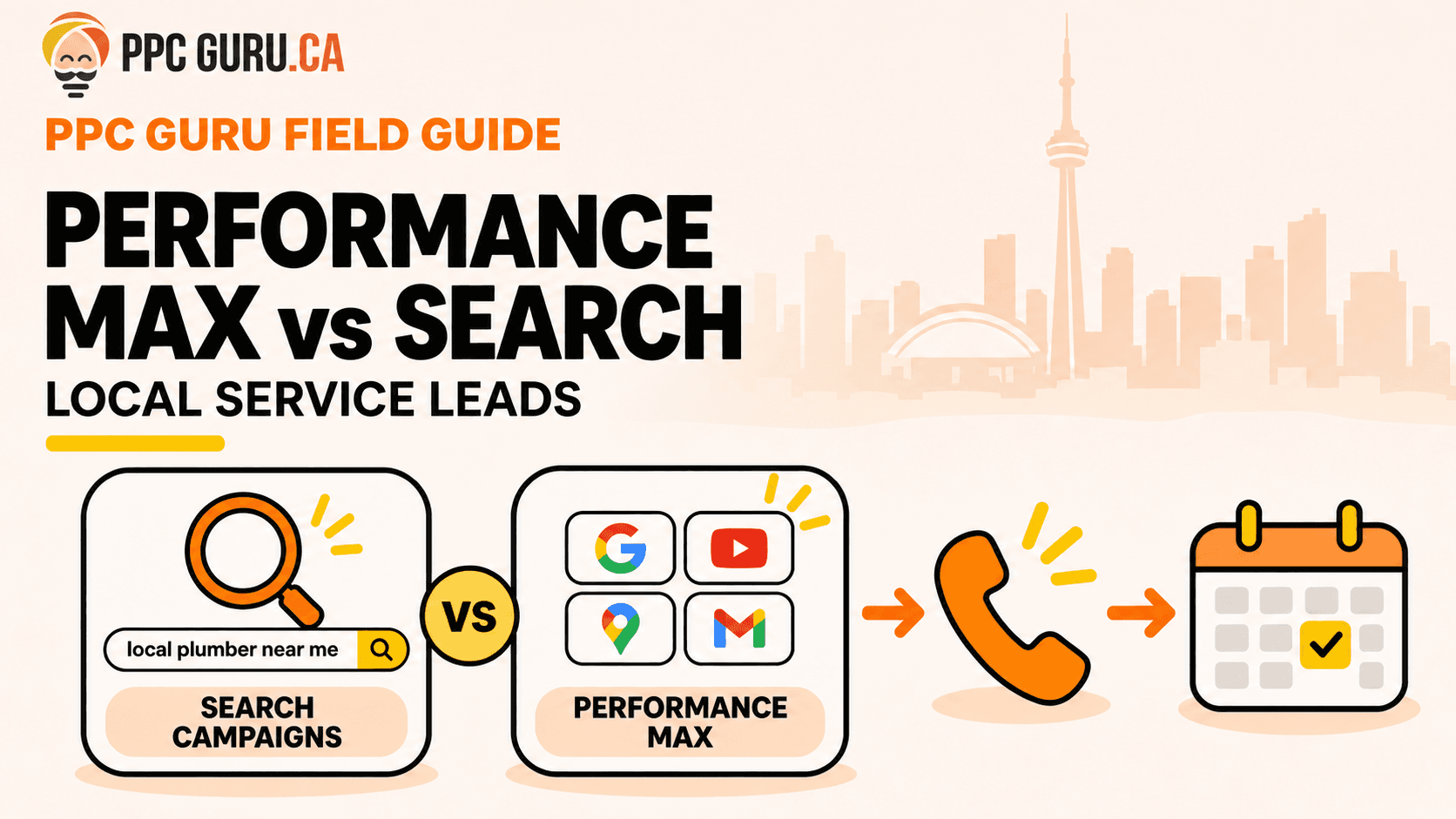
Two campaigns that generate booked tasks and missed calls, out-of-area enquiries, or persons who never answer can have the same cost per lead, according to a GTA service company. Because of this, the lead count cannot be the only factor used to decide between Google Search and Performance Max.
Start with Search when you need to capture specific, high-intent service queries and learn which jobs your budget can win. Consider Performance Max when your conversion tracking is reliable, you have useful creative assets and you want to test reach beyond keyword-led Search. Judge both on qualified leads and bookings, not just form submissions.
What does each campaign actually do?#
Search campaigns show ads to people searching for relevant products or services. You choose keywords, write ads and direct visitors to pages that answer those searches. A Toronto plumber can separate “emergency drain repair” from “water heater installation,” with different messages, budgets and landing pages. Google describes Search campaigns as a way to reach people actively searching.
Performance Max is predicated on objectives. Google's available inventory, which includes Search, Maps, YouTube, Display, Discover, and Gmail, can all be served by a single campaign. Google determines where advertising can generate conversions by combining your objectives, assets, and signals. Although the mix of ads and search intent can vary, it can increase reach beyond keyword-based search. The scope and controls are described in Google's Performance Max guide.
| Decision factor | Search | Performance Max |
|---|---|---|
| Main starting point | Queries and keywords | Conversion goals and assets |
| Reach | Search results and selected search inventory | Multiple Google channels |
| Practical control | Direct keyword, ad and landing-page structure | Goals, assets, exclusions, search themes and URL controls |
| Best first question | Which service searches bring qualified jobs? | Can more inventory add qualified jobs beyond Search? |
Why Search often comes first for local services#
Local service demand is frequently explicit. Someone searching “furnace repair Vaughan” or “emergency dentist North York” has named the service and area. Search lets you put that offer in front of them, then examine the terms that triggered the ads.
This facilitates the diagnosis of a first campaign. Examine searches, match kinds, negatives, location settings, ad copy, and the destination page if calls are pointless. Examine call handling and scheduling if calls are pertinent but few are booked. How to make those choices without obstructing worthwhile searches is demonstrated in PPC Guru's search-term triage guide. Use reasonable service boundaries to safeguard budgets.
When Performance Max becomes worth testing#
Performance Max may help when Search already covers the obvious high-intent terms and you want incremental demand across Google's channels. It can also be useful when you have strong images, video, service pages and conversion data that distinguish a booked customer from a casual enquiry.
Don't think that Performance Max is a blank slate. Ad-format context is included in Google's Search keywords and landing pages for Performance Max report. Before making any exclusions, review it for weak destinations and irrelevant themes. Then, verify the actual lead outcomes.
Measure the lead after it arrives#
Both campaign types can look successful when every form or short call is counted as a conversion. For a local service company, the useful stages are new enquiry → qualified lead → booked appointment or estimate → customer.
Define a qualified lead in operational terms: contactable, in the service area and seeking a service the business offers. Record missed calls and duplicate forms separately. Feed later outcomes back into Google Ads when the tracking setup and consent allow it. Google recommends enhanced conversions for leads and conversion goals such as qualified leads or booked appointments to give its systems better quality signals.
Compare cost per qualified lead, cost per booking and, when the sales cycle permits, cost per customer. If Performance Max brings more cheap enquiries but fewer booked jobs, the lower cost per lead is misleading. If it brings additional bookings at an acceptable cost without reducing Search performance, it may have earned a place in the budget.
How the campaigns interact#
Doing both does not guarantee that every search query will be sent to Search. According to Google, a search term that exactly matches the user's inquiry is preferred above Performance Max; if not, eligibility, relevance, and Ad Rank can decide which ad is served. Look up themes in Performance Max are cues, not a replacement for a carefully thought-out keyword strategy.. Google explains campaign interaction.
Watch for overlap when reviewing results. A new Performance Max campaign may report leads you expected Search to capture. Compare total account bookings and costs, not just each campaign's dashboard. For a more structured measurement, Google offers Performance Max uplift experiments to test whether adding it creates incremental results. Give a test enough time and qualified outcomes to be useful; a handful of forms in the first week is not a verdict.
One naming caution matters in 2026: Google's newer Performance Max with pay-per-lead goals is a separate product based on Local Services Ads. Google's current targeting guidance says its initial launch is limited to US businesses. A GTA advertiser comparing standard Search with standard Performance Max should not assume the pay-per-lead option is available in Canada.
A practical decision for a GTA business#
Start by listing the jobs and areas you most want. Confirm that calls and forms reach a real person, and decide what counts as qualified and booked. Then:
- Build or repair Search around high-intent services and realistic service areas.
- Review lead outcomes, not only Google Ads conversions, until you know what each service line costs to book.
- Test Performance Max with clear goals, suitable assets and a separate review of its search terms, landing pages and lead quality.
- Keep or change the budget based on incremental qualified bookings and customer value.
Frequently asked questions#
Is Performance Max better than Search for local lead generation?#
Not automatically. Performance Max can extend reach, while Search offers a direct route to specific service queries. Compare qualified bookings and customer value for your account before deciding.
Should a new local business start with Performance Max?#
Start with a targeted search campaign and correct the intake procedure if tracking is lacking or lead quality is unclear. Once you can identify which queries resulted in actual consumers, evaluating Performance Max becomes simpler.
Can Performance Max take traffic from my Search campaign?#
The campaigns can overlap. Google's prioritization rules protect some identical Search keyword matches, but other cases depend on eligibility and Ad Rank. Review total account performance and use an experiment where feasible.
What is the most important metric in this comparison?#
For most service businesses, cost per qualified booking is more useful than cost per raw lead. Include answered calls, service-area fit and booked jobs in the calculation.
If you are deciding where your next Google Ads dollar should go, request a PPC Guru audit. Bring your campaign conversion report and a sample of actual lead outcomes so the recommendation can reflect booked work.