
Key takeaways
- ChatGPT does not run on Google. It leans on Bing's index plus sources like Wikipedia, Reddit, and directories, so a strong Google ranking barely registers with it.
- Each AI platform trusts a different set of sources, so the same Toronto business can be recommended by Gemini and invisible on ChatGPT for the same question.
- AI answers are probabilistic. The same prompt can return different businesses each time, which is why checking once tells you almost nothing.
- The businesses that get cited share four traits: consistent listings everywhere, strong recent reviews, structured data, and credible third-party mentions.
- There is no AI Search Console yet. You build the report yourself by running real buyer questions across each platform every month.
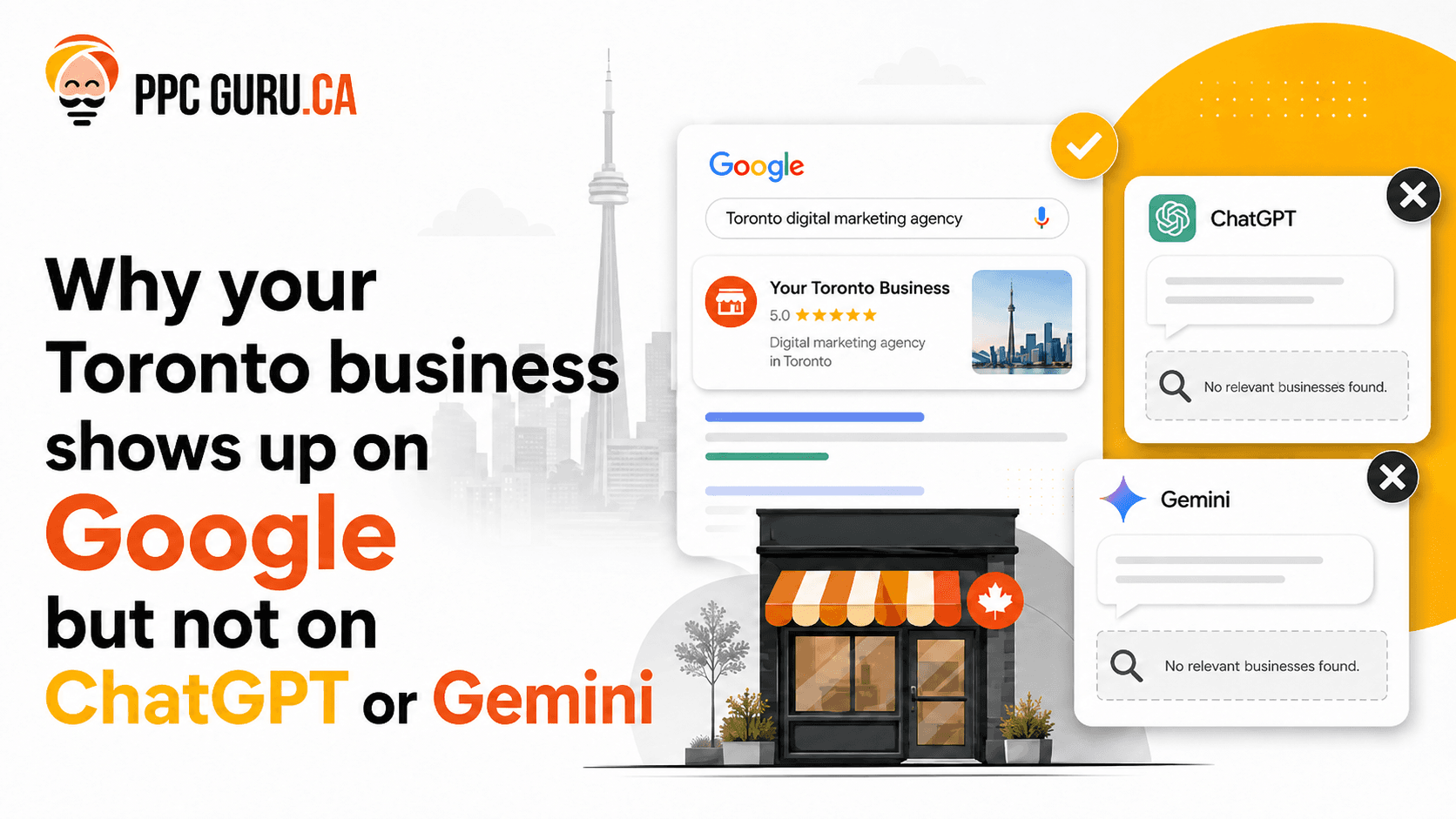
If your Toronto business ranks on page one of Google but never gets named by ChatGPT or Gemini, the cause is not a broken ranking. It is that these tools read a different internet than Google does.
Your Google Business Profile and local rankings carry little weight with most AI assistants, because they assemble answers from their own mix of citations, reviews, and directories. A business that looks strong on Google can be completely absent from AI search, and traditional SEO alone will not fix it.
This is not a fringe problem anymore. BrightLocal's 2026 Local Consumer Review Survey found the share of consumers using AI to find a local business jumped from 6% in 2025 to 45% in 2026.
Nearly half of your potential customers now ask an assistant before they ever open a map. If the assistant does not say your name, you do not exist to them.
Google and ChatGPT are not reading the same internet#
Here is the mechanism most owners miss. ChatGPT does not use Google's index. It runs mainly on Bing's index, topped up with a specific set of public sources it trusts, including Wikipedia, Reddit, Forbes, and third-party directories.
Google's AI Overviews and Gemini pull from Google's own ecosystem: Search, Maps, the Knowledge Graph, and your Business Profile. Two systems, two completely different source lists.
The proof is in the citations. SEMrush found that when ChatGPT cites a webpage in a local search, that page sits at position 21 or lower in traditional Google results nearly 90% of the time.
The pages AI recommends are usually the ones your SEO never targeted, because you were optimizing for a ranking AI mostly ignores.
There's a mechanical reason for this, worth understanding rather than just accepting. AI assistants don't search for the single page that best matches your exact phrase. They break your question into a batch of related sub-questions and build the answer from whichever sources show up consistently across most of them — a pattern sometimes called query fan-out. A business that ranks well for "plumber Etobicoke" but has thin, inconsistent information everywhere else gets skipped, because it only answers one of the sub-questions, not the cluster. A business with consistent, matching information across directories, reviews, and a few third-party mentions answers more of the cluster at once, and that's what gets it named.
Platform What it reads first What that means for you ChatGPT Bing index, Wikipedia, Reddit, directories A clean Google profile is not enough; your Bing and directory presence matters Gemini Google Search, Maps, Knowledge Graph, your Business Profile A strong, consistent Google presence tends to carry you here Google AI Overviews Google's index plus brand and review sites You need to appear in organic results and in trusted third-party pages Perplexity Live web with visible citations, community content You need to be cited in credible articles and discussions it can link to
This is why "we rank well on Google" and "we show up in AI" are two separate scoreboards.
Analysts at EMARKETER have made the same point: the tactics that win traditional rankings do not reliably win AI citations. Good SEO is a foundation, not a guarantee.
Why one AI platform names you and another ignores you#
It gets more fragmented the closer you look. A study of more than 12,500 prompts found ChatGPT mentions a brand in roughly 24% of relevant queries, while Gemini mentions brands less often, closer to 14%, but places them more prominently when it does.
Only a small slice of brand recommendations, somewhere between 11% and 17%, overlaps across both platforms for the same query. Being visible on one tells you almost nothing about the other.
For a Toronto service business, the split usually looks like this.
Gemini and Google AI Overviews reward a clean house inside Google. When your Business Profile, Maps listing, categories, and structured data all agree, these surfaces are the most likely to carry you, since they live in the same ecosystem you already optimize for.
ChatGPT rewards presence across the open web it actually reads. That means an accurate Bing Places listing, mentions in local directories, an active or referenced Reddit thread, and review sites beyond Google. Reddit specifically appears to carry real weight here — several analyses have flagged it as one of ChatGPT's more heavily used sources for business recommendations, alongside Wikipedia. A Toronto business that has never touched Bing Places is often invisible here, no matter how good its Google ranking is.
Perplexity rewards citable proof. It shows its sources openly, so it favours businesses that turn up in credible third-party articles, "best of" lists, and community discussion it can link back to.
You are not fighting one algorithm. You are trying to stay consistent and credible across several systems, each with its own memory of who you are.
Checking once tells you nothing, because AI answers move#
There is a deeper reason your visibility feels impossible to pin down. Traditional Google results are fairly stable. Search the same term twice and you get a broadly similar page.
AI answers are probabilistic, so the same prompt can return different businesses on different runs, shaped by phrasing, timing, and which sources the model pulled that moment.
The volatility is measurable. Analysts at EMARKETER reported that 40% to 60% of the sources cited in AI answers change from one month to the next across tools like Google's AI Mode and ChatGPT.
So if you ask ChatGPT "best PPC agency in Toronto" once and do not see your name, that is a sample of one on a moving target. You measured noise, not your position.
There is a second trap. Most owners test with generic prompts like "best marketing agency in Toronto." Real customers rarely ask that cleanly. They ask with context: their industry, their budget, their problem, the neighbourhood they are in.
A business can look visible on the broad prompt and vanish on the specific, high-intent ones that come right before a purchase. Test the questions your real buyers ask, not the tidy ones.
What actually gets a Toronto business cited in AI answers#
Start with the uncomfortable number. SOCi's 2026 Local Visibility Index, which analyzed hundreds of thousands of business locations, found ChatGPT recommends only about 1.2% of local businesses when asked for an option.
That is a near-total filter, not a gentle reshuffle. The businesses that make the cut share a few concrete traits.
Consistent identity everywhere. Your name, address, and phone number (the technical term is NAP) has to match exactly across Google, Bing Places, Apple Maps, Yelp, and local directories. One mismatched suite number is enough to make AI systems doubt you are a single, verifiable business.
Since ChatGPT leans on Bing, claiming and completing your Bing Places listing is one of the highest-leverage jobs most Toronto businesses have never done.
Reviews with volume and recency. AI tools weigh reputation on its own, separate from ranking. One analysis found the average rating of businesses ChatGPT recommends sits around 4.3 stars, and businesses with fifty or more recent reviews get surfaced far more often than higher-ranked competitors sitting on thin or stale ones.
Ask every satisfied customer, and reply to the critical ones in public.
Structured data on your site. Schema markup (a small code layer that spells out your business facts for machines) lets AI read your services, service area, hours, and reviews without guessing. For a local service business the core stack is LocalBusiness, Service, Review, and FAQPage.
Semrush data links properly implemented schema to roughly 45% higher AI citation rates.
Answer-style content in your customers' words. AI pulls short, direct answers out of pages. Build service pages around the exact questions a Toronto customer types, such as "How much does emergency furnace repair cost in Toronto?" and answer inside the first two or three sentences, then add the detail underneath.
Credible third-party proof. A single mention in a trusted "best of Toronto" list, a local news piece, or an active Reddit thread can feed citations for months, especially on ChatGPT and Perplexity. This is where a little digital PR quietly beats another round of on-page tweaks.
How to build your own AI visibility report#
There is no AI Search Console yet, so you build the report by hand. Pick five to ten questions a real customer would ask to find a business like yours, written with the context they actually carry. Run each one in ChatGPT, Gemini, Perplexity, and Google's AI Overviews.
Record three things: whether you appear, which competitors show up instead, and whether the details about you are correct. Repeat on the first Monday of every month and watch the trend line rather than any single result. Over time, the competitors who keep appearing tell you exactly which sources you still need to earn your way into. We cover the full version of this process, including how to structure the questions themselves, here.
The bottom line#
The businesses winning AI search in Toronto are not the ones with the biggest budgets. They are the ones managing every source AI reads, not just their Google ranking.
Google still matters, but it is now one input among several. The goal is to be the same consistent, well-reviewed business everywhere an assistant might look, so whichever tool your customer opens, your name is the answer. If you'd rather have a Toronto team run this audit and fix the gaps, that's what we do.
Frequently asked questions#
Does my Google Business Profile help me show up in ChatGPT? Indirectly, and less than you would hope. ChatGPT runs mainly on Bing's index, not Google's, so it does not read your Google profile the way Google does. Keep the profile strong for Gemini and Google AI Overviews, then reinforce the same facts on Bing Places, Apple Maps, and the review sites ChatGPT can actually reach.
Is AI search optimization the same as SEO? They overlap but are not the same. SEO aims to rank a page in a list of links. AI search optimization, often called generative engine optimization or GEO, aims to make your business the answer an assistant gives. Solid SEO is a foundation for it, not a guarantee of it.
How long does it take to show up in AI search? It depends on the platform. Gemini and Google surfaces can reflect changes within a few weeks once your listings and pages line up. ChatGPT tends to update in bursts as it re-crawls its sources, so gains there can lag and then jump.
Why do I appear on Perplexity but not on ChatGPT? Because they read different sources. Perplexity favours visible citations and community content, while ChatGPT leans on Bing, Wikipedia, and directories. Showing up on one is no promise of the other, which is exactly why you optimize for each platform separately.
Author bio: Siddharth Sharma is an SEO Specialist at PPC Guru, a Toronto-based digital marketing agencyoffering SEO, PPC, Google Ads, and social media marketing services. With 6+ years of experience in search and digital marketing, he focuses on helping small and mid-sized businesses build sustainable organic visibility. He writes about SEO, AI search, and practical digital marketing strategy.