
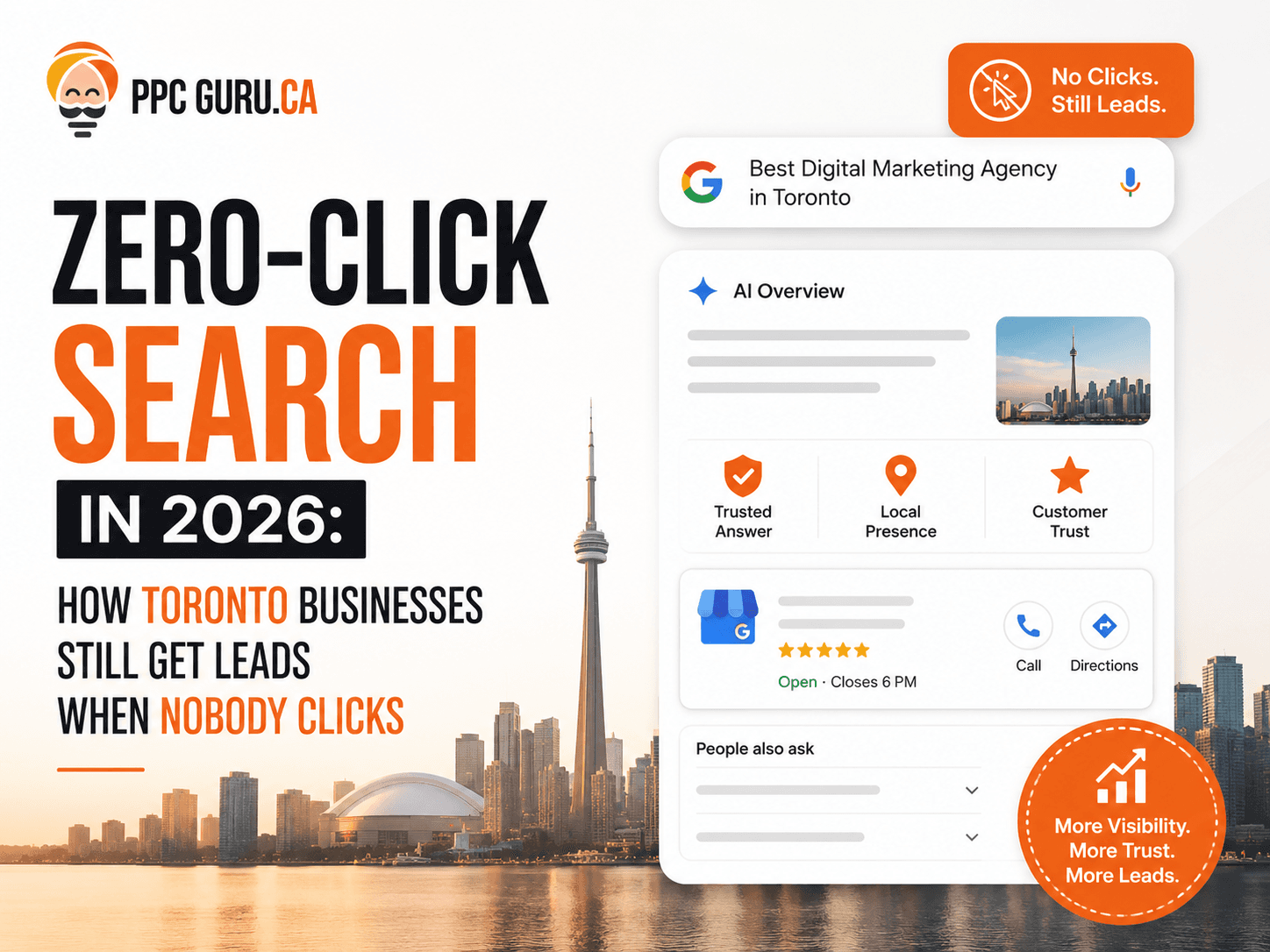
A zero-click search is any Google query where the person finds the answer on the results page and never clicks through to a website. In early 2026, 68.01% of US Google searches ended in zero clicks (SparkToro, June 2026). Canadian search behaviour tracks the same pattern. For Toronto businesses, this means lead generation now happens inside the Google My business Profile, in click-to-call and WhatsApp links, and in AI Overview citations. Ranking still matters. Ranking alone no longer produces the phone call.
What zero-click search is in 2026, in one paragraph#
Zero-click search covers any query where the searcher gets what they need without leaving Google. That includes AI Overviews at the top of the page, Local Pack results with hours and reviews baked in, People Also Ask boxes, knowledge panels, and featured snippets. SparkToro's June 2026 study of Similarweb clickstream data found the zero-click rate hit 68.01% in early 2026, up from 60.45% in 2024. Translated to raw volume, only 276 of every 1,000 US Google searches now reach the open web, down from 374 in 2024. About a quarter of the traffic that used to reach independent websites has disappeared in twenty-four months.
Why the jump from 60% to 68% happened this fast#
Two things changed at once. Google's AI Overviews scaled from a limited rollout in mid-2024 to appearing on a large share of informational queries by early 2026. When an AI Overview shows up, the zero-click rate climbs to 83% (Bain and Company, February 2025). In Google's newer AI Mode, it hits 93% (Semrush, September 2025). Pew Research found that only about 1% of AI Overview views produce a click on any cited source.
The second factor is Google's product incentive. Google announced at I/O 2026 that AI Mode had passed 1 billion monthly users and that queries were more than doubling per quarter. Keeping people inside the results page increases ad inventory, and it is now clearly the direction of travel. Gartner's often-quoted 25% drop in traditional search volume by 2026 is a projection about query volume, not a measured traffic loss, so treat it as directional.
Why Toronto businesses feel this shift harder#
Two structural facts make Toronto-area small businesses more exposed than the average website.
First, roughly 46% of all Google searches carry local intent (Search Endurance, 2026). If you are a plumber in East York, a family dentist in North York, or an immigration consultant in Mississauga, the Local Pack is your storefront on Google. The Local Pack sits at the top of the results page, which is precisely where zero-click behaviour is now the most concentrated.
Second, mobile drives that local intent. SparkToro's data pegs mobile zero-click at 77% versus 46.5% on desktop. Toronto's local search volume skews mobile hard. Someone Googling "walk-in clinic near me" from the Line 1 subway car is not opening a laptop when they get off.
Then there is a change most owners have not been told about. Through 2025 and into 2026, Google began removing the one-tap Call button from the organic Local Pack on mobile. That button had been there for roughly a decade and was one of the highest-intent conversion mechanisms on the internet. The customer now has to tap into the full profile, scroll, and tap Call, and every extra step strips off intent. Local Services Ads at the top of the page still have their call button intact. The shift is not subtle. Google is nudging free organic real estate toward paid.
The five moves that actually work in a zero-click search environment#
The Toronto businesses adapting to this environment share a mindset. They stopped treating their website as the primary lead destination and started treating their Google Business Profile, their schema markup, and their messaging channels as the actual conversion surface.
1. Treat your Google Business Profile like your homepage
Birdeye's State of Google Business Profile 2026 report found that verified profiles now generate up to 4x more website visits and double-digit lifts in calls and directions requests versus unverified profiles. WebFX's 2026 benchmark data shows that for service categories like plumbing and roofing, 10 to 15% of GBP views end in a click-to-call. The average verified profile handles about 595 calls per year, 90% of them on weekdays.
The practical implication is that every field on your GBP is doing revenue work. Categories, service list, business hours, service area, opening hours, offer posts, product photos, review responses, and Q&A are not vanity fields. They are the raw material Google's local ranking model uses to decide whether you appear when someone taps "physiotherapist near me" at 8:47 on a Tuesday morning. A profile that is 60% complete does not perform at 60%. It performs at a fraction of a fully populated profile, because Google penalises information gaps in local intent categories.
2. Fix every click-to-call surface you own
Since Google is moving the free Call button out of the Local Pack, your call surfaces have to move with it. Three fixes matter.
Add tel: links to every button, header, and footer on your mobile site. The syntax is and the effect is that one tap opens the dialer with your number filled in. A surprising number of Toronto service sites have "Call Us" as plain text that is not actually a link. Every one of those is a lost call.
Put a persistent, sticky "Call Now" button in the mobile header. Not hidden behind a hamburger menu. Visible in the top bar, still there when the user scrolls. In 2026, mobile design decisions like this outperform most keyword-level SEO tactics for local businesses.
Set up call tracking on both your website and your Google Ads Location Extensions, since the GBP call-click metric measures intent to call, not completed calls. You want to know which channel produced which phone conversation.
3. Add WhatsApp click-to-chat as a second inbound channel
WhatsApp is now the second-largest inbound channel for many Toronto service businesses, particularly in categories with significant South Asian, Middle Eastern, or Latin American customer bases. The mechanic is a simple wa.me link, formatted https://wa.me/14165551234, that opens a chat with your business the moment someone taps it. No phone-number save required.
Meta shut down the native chat feature inside Google Business Profile on July 31, 2024. In many regions, GBP now allows you to set a WhatsApp link as the external chat destination. Where the field does not yet live in Canada, the same wa.me link belongs on your website header, your Instagram bio, your ad landing pages, and your email signature. Industry benchmarks put WhatsApp reply rates between 20% and 60% in the first 24 hours, three to five times higher than traditional form-fill rates.
4. Put your phone number inside LocalBusiness schema
Structured data is how Google and the AI answer engines extract facts about your business as data, not as free text. The telephone property inside a LocalBusiness schema block is what makes your number appear in knowledge-style answers, voice search results, and AI Overview citations. Add the same schema block to your homepage and every service page. Include name, address, phone, opening hours, price range, service area, and any relevant certifications. Structured data does not guarantee AI Overview citation, but its absence significantly reduces the odds.
5. Write to be the answer, not the link
Ahrefs found that when an AI Overview appears, the click-through rate to the top organic result drops by roughly 58%. Some of that lost traffic reappears as citation exposure. Businesses cited inside AI Overviews see 35% more organic clicks and, when a click does happen, 4 to 9x higher conversion rates than a standard search click, because the visitor has already read a summary and is looking for depth (Dataslayer, 2025).
Getting cited is a fact-density and structural-clarity problem, not a keyword-density one. AI systems extract answer-shaped content: clear definitions, specific numbers with named sources, service areas, prices, timeframes, and structured lists. Vague marketing prose gets skipped. For a Toronto business, this means writing a service page that answers "how much does emergency drain cleaning cost in Toronto" with an actual price range, an actual response window, an actual service radius, and a byline from a real person on your team who does the work.
What to measure now that clicks are half the picture#
If you are still evaluating SEO by clicks alone, you are working from a metric that measures a shrinking share of your visibility. Track impressions, SERP feature appearances, and branded search volume alongside clicks. Google Search Console now reports impression data by SERP feature type, which lets you see when you appear in Local Packs, Featured Snippets, and AI Overviews even when those appearances do not send traffic. Watch your GBP Insights weekly for call volume, directions requests, and profile views. Then track "Share of SERP", the percentage of the visible results page your brand occupies, which BrightEdge and Conductor now treat as the new market-share metric for local SEO in 2026.
The next 30 days#
Three moves matter more than the rest. Fully populate every field of your Google Business Profile and post to it weekly. Add a sticky click-to-call button and a WhatsApp link to your mobile site, and put your phone number inside LocalBusiness schema. Rewrite one high-intent service page in the answer-shaped format that AI Overviews cite, with real prices, real timeframes, and a real byline. The zero-click era is not the end of organic search. It is the end of ranking as the only lever that matters.
Author Bio: Siddharth Sharma is the Head of SEO at PPC Guru, Best Digital Marketing Agency in Toronto, where he leverages over 8 years of deep-dive industry experience to scale organic growth. A forward-thinking strategist, Siddharth specializes not just in traditional search, but in the evolving landscapes of Answer Engine Optimization (AEO) and Generative Engine Optimization (GEO). He is passionate about helping brands navigate the future of search and visibility in an AI-driven digital world.