
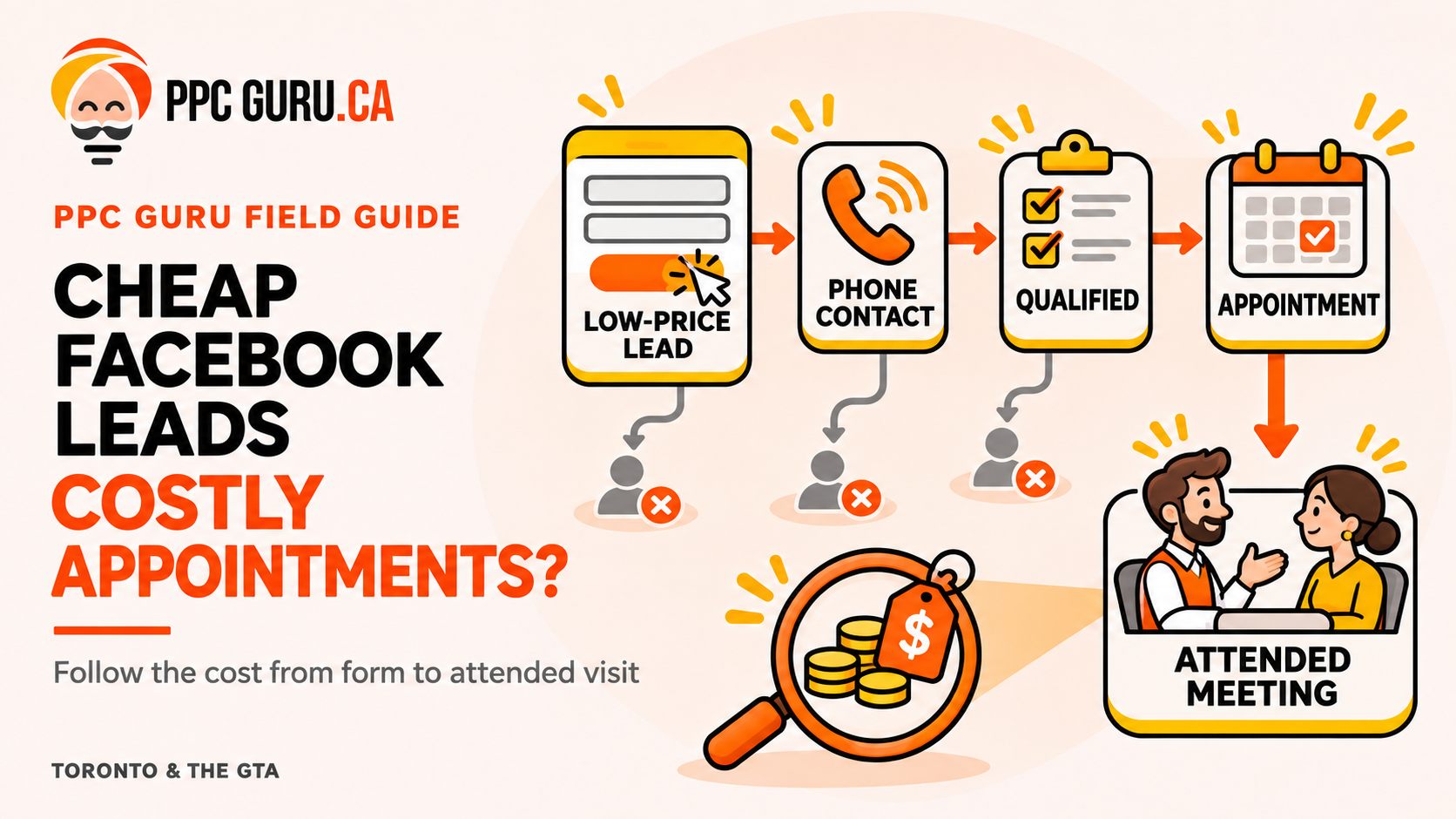
The Facebook campaign report looks excellent: more leads, lower cost per lead, and a form that people complete quickly. Then the appointment calendar tells another story. The team cannot reach many of the contacts. Some want a service you do not offer. Others book but never arrive. The campaign that looked cheapest on Monday’s dashboard may be the most expensive way to fill a real appointment slot.
This is not an argument that low-cost leads are always poor. It is an argument for following the lead far enough to know what it became. For Toronto and GTA service businesses, the useful unit is often an attended, qualified appointment or a completed job, not a form submission.
A lead is the start of the cost calculation#
Meta lets advertisers collect inquiries through an instant form inside Facebook or Instagram, or send people to a form on a website. An instant form can be quick and mobile-friendly; a website form can give people more context or let them book directly. Meta’s lead-form guidance describes both options and recommends connecting leads to a CRM for faster follow-up.
Neither form type guarantees quality. A short form may produce more submissions, while a detailed form may reduce volume and filter out people who would have become customers. The correct comparison is what each path produces after contact, qualification and attendance.
For a dental clinic, that might be a patient who attends a consultation for a service the clinic provides. For a renovation company, it might be a homeowner in the service area who attends a site visit and has a plausible project. For an HVAC company, it could be a booked service call the crew can actually cover. Define the useful outcome for your business before judging the campaign.
Follow the lead through five gates#
Every lead passes through a sequence. Record the count at each stage:
- Submitted: A unique person sent a form or called.
- Contacted: The team reached that person and confirmed the inquiry is real.
- Qualified: The request fits the service, location and basic buying conditions.
- Booked: A specific appointment or estimate was accepted.
- Attended: The prospect showed up, or the scheduled visit took place.
For some businesses, add a sixth stage: sold or completed job. Do not treat these stages as synonyms. A calendar booking can be cancelled, and an attended consultation can still be a poor fit.
At each gate, calculate the conversion rate and ask why people drop away. The answer may sit in the ad, the form, the offer, the phone process or availability. Without the stages, every loss gets labelled “bad leads,” even when the team simply did not call back.
The cheap-lead trap in numbers#
Consider two hypothetical campaigns for the same GTA service business. Each spends $1,500 in media during the same period. Campaign A uses a very easy lead form. Campaign B costs more per lead and sets clearer expectations before submission.
| Funnel stage | Campaign A | Campaign B |
|---|---|---|
| Media spend | $1,500 | $1,500 |
| Leads submitted | 100 | 40 |
| Media cost per lead | $15 | $37.50 |
| People contacted | 60 | 30 |
| Qualified prospects | 24 | 18 |
| Appointments booked | 12 | 12 |
| Appointments attended | 6 | 10 |
| New customers | 2 | 4 |
If the report stops at the first three rows, Campaign A appears to be the winner. Both campaigns actually book 12 appointments, so their media cost per booked appointment is the same: $125. After attendance, Campaign A costs $250 per attended appointment; Campaign B costs $150. After sales, their media cost per new customer is $750 versus $375.
Now allocate a hypothetical $300 management cost to each campaign for the period. The all-in cost per attended appointment becomes $300 for A and $180 for B. These figures still exclude any extra staff time or other campaign costs. The table is an illustration, not a benchmark or a forecast for your account.
The important point is where the apparent saving disappeared. Campaign A generated more names, but it lost people at contact, qualification and attendance. A lower cost per form made the sales team’s workload larger without delivering more attended visits.
Make the comparison fair#
Use the same date range and the same definitions for both campaigns. Deduplicate people who submit twice or contact you through more than one channel. A person who fills a Facebook form, later calls from a search ad and books through the website should appear as one opportunity in the CRM, with the touchpoints preserved. Otherwise, two platforms may each claim a separate lead while the calendar has only one appointment.
Also allow enough time for both groups to reach the appointment stage. A campaign launched last week may look worse on attendance than an older one simply because its bookings have not happened yet. Compare cohorts by the date the inquiry arrived, then update their outcomes as appointments occur. If one campaign targets a different service, region or offer, separate those differences before attributing the result to form type. The exercise should reveal what to change.
Count the time that cheap leads consume#
In the example, Campaign A creates 100 records to review; Campaign B creates 40. If the first contact attempt and basic record update take an average of eight minutes per lead, that is about 13 hours of initial handling for A and five hours for B. Follow-up attempts add more time.
Staff time is not always an additional cash expense: a salaried coordinator may be paid the same either way. It still has a capacity cost if those hours could have been spent confirming qualified appointments, answering new calls or preparing quotes. If the team needs overtime or another hire to handle the extra volume, the cash cost belongs in the campaign calculation too.
This is where a lead can become more expensive than its ad invoice suggests. A full calendar of weak appointments can also crowd out stronger prospects. Track that displacement rather than assuming every booked slot has equal value.
Diagnose the drop-off before changing the ad#
A low contact rate can have several causes. The form may collect an outdated phone number, the prospect may not remember submitting it, or the team may respond after the moment has passed. Check when the lead arrived, when the first attempt happened, how many attempts were made and whether SMS or email confirmation was sent. A campaign should not be penalized for a routing failure.
A low qualification rate points elsewhere. Read a sample of conversations. Are people outside your service area? Are they seeking a different service, a free consultation you do not offer, or a price far below your usual project range? If a mismatch repeats, make the ad and form more specific. State the service, location and next step plainly. Ask one or two questions that help route the inquiry; avoid a long form built only to make people work harder.
A low attendance rate needs its own investigation. The appointment may be too far away, the prospect may not understand what happens during the visit, or reminders may be missing. Confirm the date, time, location or video link, and what the person should prepare. Offer a simple way to reschedule. No-shows are not automatically a creative problem.
Finally, if attended appointments rarely become customers, inspect the offer, sales conversation, pricing fit and the service itself. A paid-social campaign can introduce a business to new prospects, but it cannot repair every gap after the meeting starts.
Make the form earn its place in the funnel#
An instant form should ask enough to identify a useful next step. For a local service brand, that may mean service needed, postal code, preferred timeframe and contact method. If appointment capacity is limited, say when the business can respond. If a project has a meaningful minimum scope, explain it before asking the person to submit.
Test these choices against qualified and attended appointments, not just the form-completion rate. Adding a question may increase cost per lead while lowering the cost per attended visit. It may also screen out people who would have bought. The data has to decide.
Meta’s lead generation guidance discusses using first-party data and CRM integrations to optimize for lead quality. That only helps when the CRM stages mean the same thing across the sales team. If one representative marks every conversation “qualified” and another waits until payment, the feedback is too inconsistent to guide spend.
Website forms deserve the same scrutiny. A landing page can explain the offer and show proof, but slow loading, unclear pricing, a broken mobile form or too many required fields can lose strong prospects. The right choice between instant form and website form depends on the service and the downstream outcome.
Give marketing a short, usable feedback loop#
The sales team should not have to write a paragraph about every lead. Record a few fields after the first real conversation: contact outcome, service fit, location fit, timing and next step. If a lead is closed, choose a reason such as wrong area, wrong service, no availability, price mismatch or unreachable. Keep uncontacted leads separate from unqualified ones.
Review the results weekly by campaign, offer and form. Look at contact rate, qualified rate, booking rate, attendance rate and cost per attended appointment. For longer sales cycles, compare lead cohorts after enough time has passed; yesterday’s leads cannot be judged on next month’s sales today.
Do not use a handful of appointments to make a sweeping decision. One cancellation can swing a small campaign’s attendance rate dramatically. Look for a repeated pattern, read the actual lead notes, and change one important element at a time where practical. A clearer offer, different form, faster follow-up and new creative are distinct tests.
The question to ask before scaling#
When someone proposes doubling the Facebook budget because leads are “cheap,” ask what would happen to the attended appointment cost if volume doubled. Can the intake team make more contact attempts promptly? Are there enough suitable appointment slots? Are the people who attend becoming customers at a rate that covers media, management and delivery costs?
Scaling an inexpensive lead source can also scale the work it creates. Scaling a source of qualified, attended appointments is a different decision. PPC Guru’s Meta Ads approach connects creative and campaigns to lead quality, booked jobs and CRM outcomes. For a Toronto service business, that is the report worth asking for: how many Facebook inquiries became customers.