
Local SEO helps a Toronto business become easier to find when nearby customers search for a service, compare providers, or use Google Maps. This PPC Guru guide explains the practical work behind local visibility so an owner can decide what to fix, what to measure, and when a Toronto SEO service is worth considering.
Materially reviewed October 14, 2026 against Google guidance on local ranking and Business Profile representation.
Key takeaways#
- Local visibility is shaped by relevance, distance and prominence—not a tactic that guarantees a fixed map position.
- A complete Google Business Profile helps, but it cannot replace useful service pages or credible local evidence.
- Storefront and service-area businesses need different, policy-compliant location setups.
- Track qualified calls, bookings and estimates alongside rankings.
How local SEO works in Toronto#
Direct answer: Local SEO helps a business appear when people search for a nearby service on Google Search or Maps. It combines accurate business information, useful service and location pages, genuine reviews, consistent business details, and credible local references. The practical objective is qualified calls, bookings and enquiries—not a guaranteed ranking.
Google describes local results through three main factors: relevance, distance, and prominence. Relevance is how well the available business information matches a search; distance is the searcher's proximity; prominence reflects how well-known the business appears online. Google's local-ranking guidance is a better foundation than a generic “rank number one” promise.
| Local-ranking factor | What a Toronto business can improve | What it cannot manufacture |
|---|---|---|
| Relevance | Accurate categories, services, website copy and business details | A service it does not offer |
| Distance | Clear, honest service-area information | Proximity to every searcher in the GTA |
| Prominence | Helpful reviews, legitimate local mentions and a useful website | Trust through bought reviews or misleading listings |
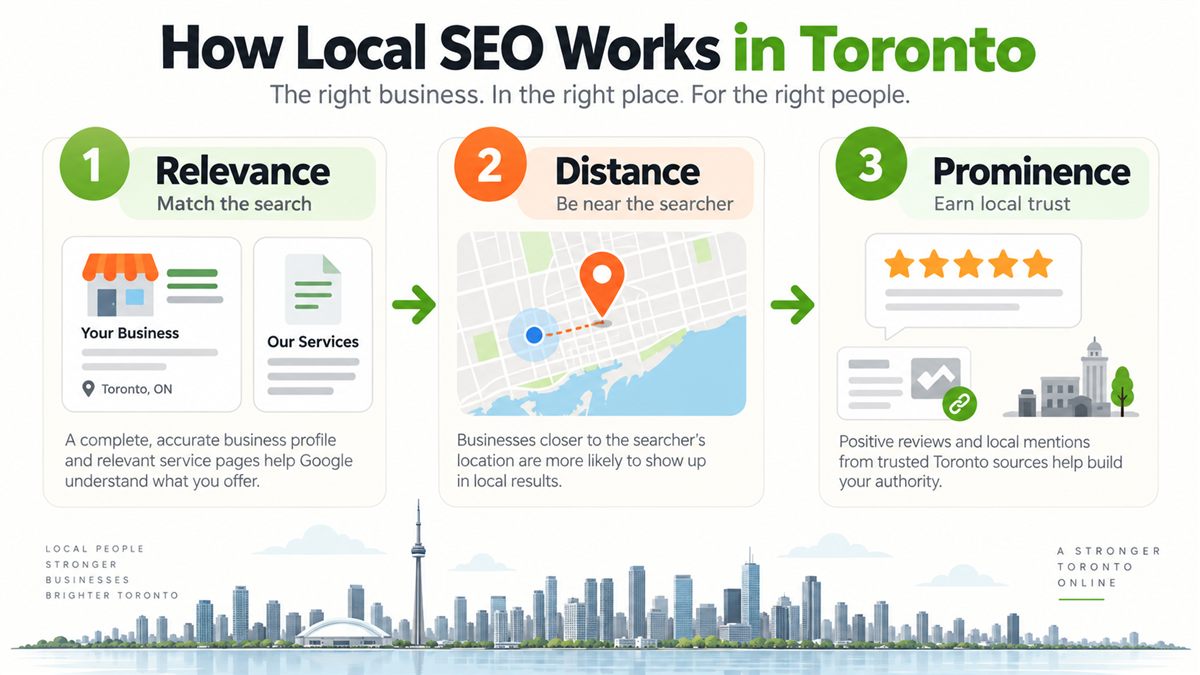
The three local-ranking factors work together. Improving one does not override the others.
The four local SEO workstreams that matter#
1. Google Business Profile and accurate business details#
Start with the listing a customer may see before visiting your website. Keep the business name, category, hours, phone number, website, services and photos accurate. Choose the fewest, most specific categories that describe the core business; do not use the name field to add keywords or locations.
For a service-area business, use one profile for the real operating location and the genuine service area. Google does not allow a virtual office that is not staffed by the business to be used as a Business Profile location. Google's representation guidelines are particularly important for contractors and other GTA businesses that travel to customers.
2. Service pages that answer a local buyer's question#
“Toronto” added to every title is not a local strategy. A strong page explains a real service, the customer problem it solves, the areas the business genuinely serves, and the next step a buyer can take.
For example, a renovation company may need distinct, useful pages for basement renovations and kitchen renovations. It does not need a copied version of each page for Toronto, North York, Scarborough, Vaughan and Mississauga. Create a location page only when it can add local proof, a distinct service constraint, relevant FAQs or original project context.
3. Reviews and consistent business identity#
Customers compare businesses before they contact them. Make it easy for real customers to leave feedback after service delivery, reply professionally, and resolve legitimate concerns. Google notes that reviews and responses can help a business stand out; they are not a substitute for offering a service customers value.
Keep the same real-world business identity across the website, Business Profile and relevant third-party profiles. The goal is simple: a customer should not have to guess which address, phone number, service area or business name is correct.
This is citation consistency: the real business details agree wherever a customer or search engine encounters them. It is not a reason to create dozens of low-value directory listings.
4. Local authority and measurement#
Local authority is not a directory-volume contest. Useful references can come from relevant associations, suppliers, local partnerships, community participation, industry publications or earned coverage. Focus on relationships and evidence that would still be useful if search rankings did not exist.
Then measure the outcome. A local SEO report should connect work completed with relevant visibility, calls, booking requests, estimate requests and lead quality. For a realistic evaluation window, see our guide to how long local SEO takes in Toronto.
Google Maps / Map Pack versus organic results in Toronto#
Direct answer: Google Maps results are strongly shaped by the searcher's location, Business Profile relevance and local prominence. Organic results rely more on the website's crawlability, useful service content, internal linking and broader authority. A Toronto business needs both because appearing in one result type does not guarantee visibility in the other.
| Question | Google Maps / Map Pack | Organic results |
|---|---|---|
| What the customer sees | A map and nearby business listings | Website pages in the standard search results |
| Strongest practical signals | Accurate Business Profile, proximity, reviews and local prominence | Helpful pages, technical accessibility, internal links and topical authority |
| How location changes the result | Can vary materially block by block | Usually less dependent on the searcher's exact location |
| Useful conversion action | Calls, directions, bookings or website visits | Page visits, enquiries, estimates and deeper service research |
The practical implication is simple: a business can have a useful website but weak Maps visibility, or a strong profile without enough website evidence to compete in organic results. Diagnose both before choosing the next local SEO task.
Storefront versus service-area businesses#
A downtown clinic and a contractor serving Scarborough from a home office should not use the same local setup.
| Business model | Practical local SEO priority |
|---|---|
| Storefront | Accurate address, customer-facing hours, directions, categories and review management |
| Service-area business | Honest operating location, realistic service area, service pages and proof of work—not a virtual office |
| Multi-location business | One eligible profile per real staffed location, with clear ownership and distinct local information |
This distinction answers a common AI-search prompt: “Can a Toronto service-area business rank without a storefront?” Yes—when it represents the business honestly and provides useful evidence about the services and areas it actually covers. It is not a reason to create multiple profiles or addresses.
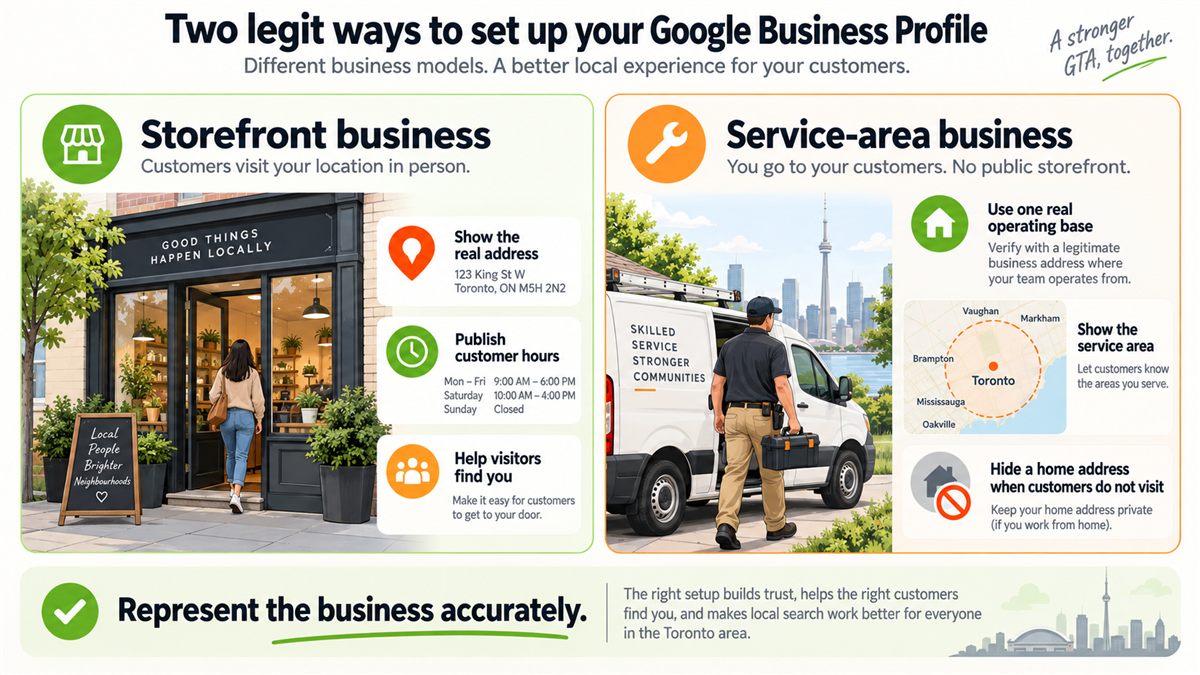
Choose the Business Profile setup that reflects how customers actually interact with the business.
What local SEO means for AI search visibility#
People now ask broader questions such as “Who offers this service near North York?” or “Which Toronto contractor serves my neighbourhood?” AI answers can vary by system, time and prompt. No agency can guarantee inclusion in an AI response.
The sensible preparation is the same work a customer needs: make the business easy to identify, make important information available in crawlable text, publish useful service content, maintain accurate public details and earn credible third-party evidence. Google says its existing SEO fundamentals apply to AI features; there is no separate schema or file required to qualify. Google's AI Search guidance supports that approach.
A five-minute local visibility check#
- Search your core service and area from a customer perspective.
- Confirm that your Business Profile name, category, hours and contact details are accurate.
- Check whether the website has one useful page for each priority service.
- Review whether the public business details agree across the website and major profiles.
- Identify how local calls, bookings or estimates are currently tracked.
If the answer to several of these checks is “we are not sure,” begin with a diagnosis rather than buying a generic package. A specialist can help compare the local-search work against broader SEO measurement and ROI before committing to a programme.
Local SEO FAQ#
How does local SEO work for a Toronto business?#
Local SEO helps a business become easier to find when people search for nearby services on Google Search or Maps. It combines accurate business information, useful service pages, genuine reviews, local evidence and measurement of qualified enquiries. Results vary with competition, proximity and implementation.
Can a service-area business rank without a storefront?#
Yes. It can use one accurate Business Profile for its real operating location and designated service area. It should not use a virtual office or misleading address simply to appear in another neighbourhood.
Should a Toronto business create a page for every neighbourhood?#
No. Create a location page only when it answers a distinct customer need with useful local detail. Repetitive pages with only a neighbourhood name changed are poor user experience and weak site architecture.
What should a business measure from local SEO?#
Measure qualified calls, booking requests, estimate requests, direction requests, relevant search visibility and lead quality. Rankings alone do not show whether local search is helping the business grow.
Need a local SEO roadmap?#
PPC Guru can review the relationship between your Business Profile, website, service coverage and conversion path, then identify the work that is likely to matter first. Talk to the team when you are ready for a scoped local SEO assessment.