
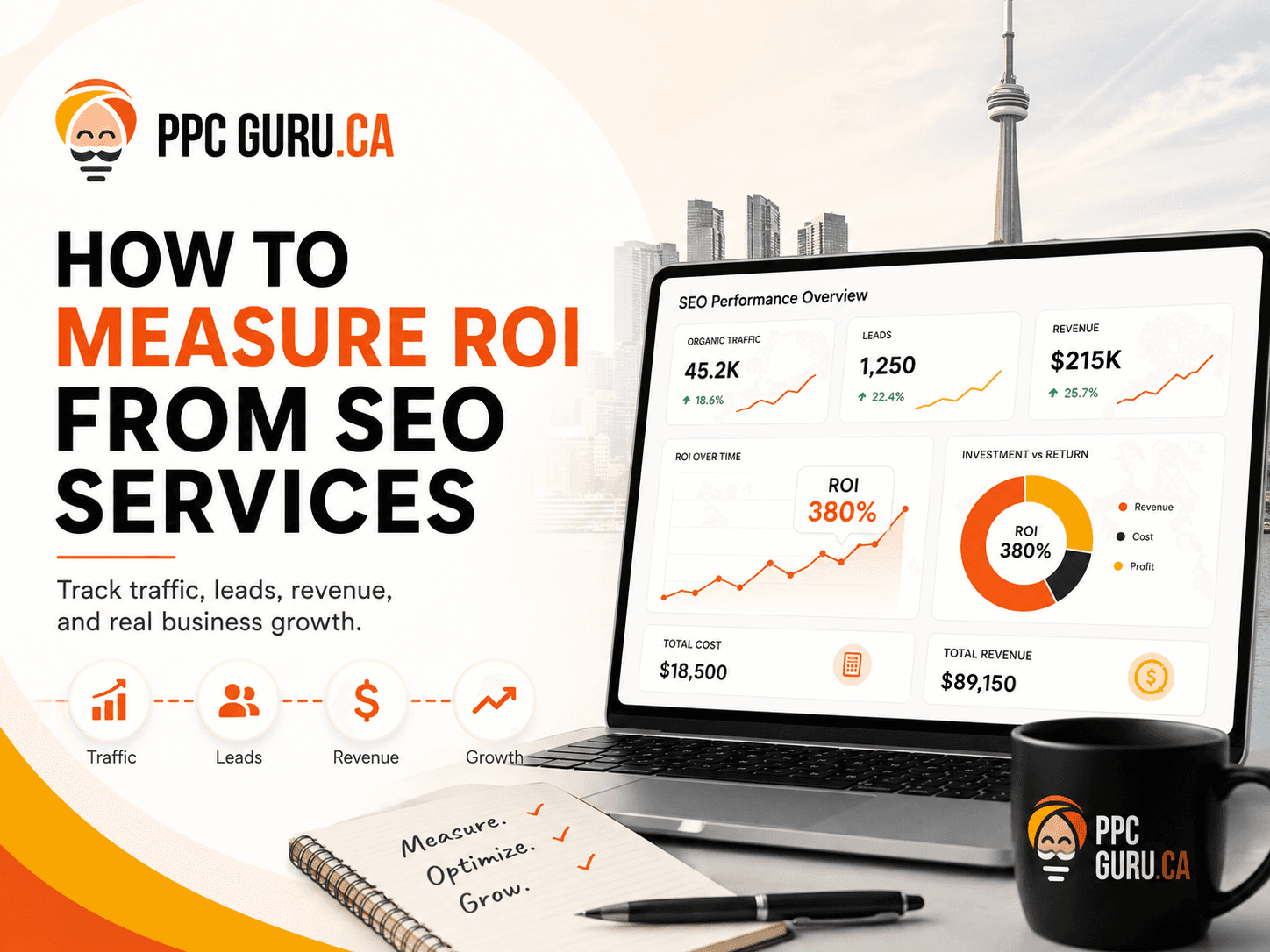
Quick answer. To measure the ROI of SEO services, subtract your total SEO investment from the revenue you attribute to organic search, divide by that investment, and multiply by 100. Accurate measurement needs full cost accounting, GA4 and CRM tracking, correct attribution, and lead-to-revenue tracking for B2B.
An SEO report can throw dozens of numbers at you. Traffic, rankings, impressions, backlinks, clicks, conversions, AI citations.
But a Toronto business owner wants one answer. Is SEO making more money than it costs?
That is why you need a reliable way to measure the ROI of SEO services. It is a measurement problem, not a marketing problem. And it is harder than it looks.
Here is why. Organic search is rarely a one-click sale. A Toronto prospect finds you on Google, comes back through branded search, reads three articles, sees you in an AI Overview, returns directly, then buys weeks later.
So dividing this month's organic sales by this month's SEO invoice gives you a number that is almost always wrong. If you're not sure what your program returns today, a free SEO audit is the fastest way to find the gaps.
Key Takeaways#
- SEO ROI = (Organic Revenue − SEO Cost) ÷ SEO Cost × 100. Simple formula, hard inputs.
- Most firms undercount the cost side, not the revenue side. That inflates ROI.
- You can't measure the ROI of SEO services without connecting Search Console, GA4, and your CRM.
- For B2B, a form fill is not the outcome. A closed deal months later is.
- In competitive Toronto markets, SEO compounds. Judge it over 6 to 12 months, not one.
- AI-search visibility is a leading indicator, not revenue. Track it, don't bank it.
Why Measuring the ROI of SEO Services Matters More in Toronto#
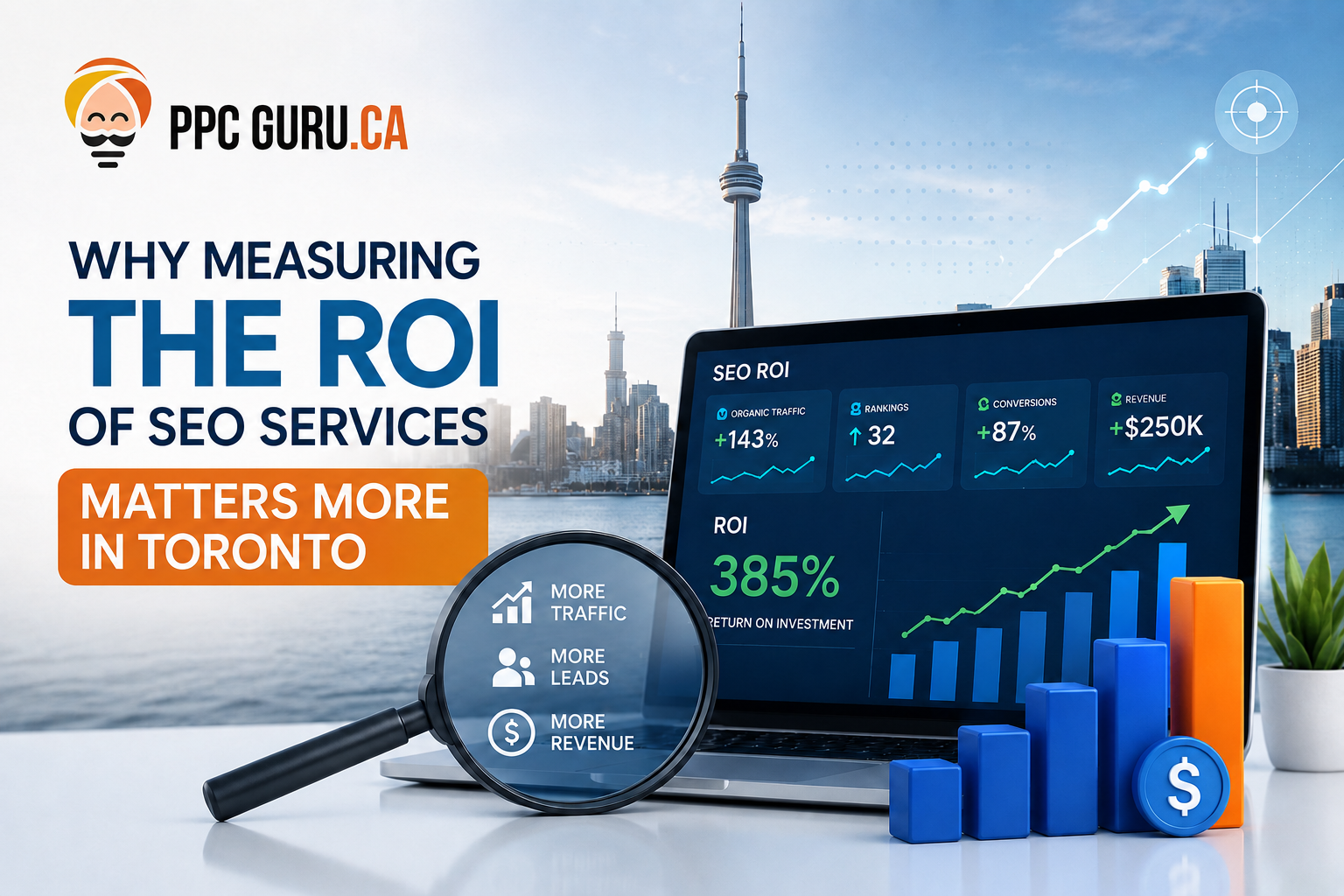
Toronto is a crowded, expensive market. In competitive local industries, you are often bidding against businesses that outspend you.
Measurement is how you outsmart them instead. When you know your real cost per organic customer, you can move budget to what works and stop funding what doesn't.
Without that, you are guessing. And guessing is expensive in a city this competitive. For the local-search side of this, see how local SEO works for Toronto businesses.
Pillar 1: The Formula, and What Actually Counts as "SEO Cost"#
The SEO ROI formula:SEO ROI (%) = (Organic Revenue − Total SEO Investment) ÷ Total SEO Investment × 100
Worked example. A Toronto business spends $24,000 on SEO over 12 months and attributes $72,000 in revenue to organic search.
ROI = ($72,000 − $24,000) ÷ $24,000 × 100 = 200% ROI. For every $1 invested, it generated $3 in attributable revenue, including the original dollar back.
What counts as total SEO investment?#
The most common reporting mistake isn't inflating revenue. It's undercounting cost. "Total SEO Investment" means every input, not just the agency invoice.| Cost category | Examples |
| Agency or consultant | Monthly SEO management fees |
| Internal labour | Marketing managers, SEO staff, writers (hours × fully loaded rate) |
| Content | Writers, editors, subject-matter experts |
| Development | Technical fixes, templates, schema, page speed |
| Creative | Photography, graphics, video |
| Technology | SEO tools, analytics, crawling platforms |
| Digital PR & links | Research, outreach, legitimate content and PR production |
| Localization | Translation and multilingual SEO |
| Analytics | GA4 configuration, CRM integration, call tracking |
Pillar 2: Setting Up Tracking (GA4 + Search Console + CRM)#
You can't measure the ROI of SEO services until you connect search visibility to business outcomes. Google recommends using Search Console and GA4 together, because they answer different questions.Step 1: Search Console shows visibility, not ROI#
Track organic clicks, impressions, queries, landing pages, and average position.As of June 2026, Search Console also has a Generative AI performance report, showing how often your pages appear in AI Overviews, AI Mode, and generative features in Discover.
Accuracy note: that report currently shows impressions, pages, countries, devices, and date trends only. No click or CTR data yet. Don't build a report around AI-feature click volume, because that data does not exist in the platform yet.
A nuance most Toronto agencies skip: filter branded keywords out of your organic reporting, and report non-brand traffic separately. Mixing them inflates performance and makes SEO look better than it is.
Step 2: Configure GA4 key events for the full lead lifecycle#
For e-commerce, GA4's native setup captures purchases and revenue directly.For lead generation, Google's recommended lead-generation event schema goes well beyond one "form submitted" event. It tracks the whole lead lifecycle:
| Event | Fires when |
| generate_lead | A lead is generated (usually on-site) |
| qualify_lead | The lead meets qualification criteria |
| disqualify_lead | The lead is marked unsuitable, with a reason |
| working_lead | A rep contacts, or is contacted by, the lead |
| close_convert_lead | The lead becomes a paying customer (include value + currency) |
| close_unconvert_lead | The lead is closed as lost |
Once that is live, GA4 stops treating every form fill as equal, and starts separating new, qualified, working, and converted leads.
Add call tracking with dynamic number insertion for phone leads. For many Toronto service businesses, the phone is the main conversion, and it is the piece most owners forget to track.
Step 3: Connect the CRM#
For B2B, the real conversion usually happens off-site. A visitor reads an article, submits a form, talks to sales, gets qualified, and closes 45 days later.Without CRM integration, GA4 shows "1 organic lead" when the real outcome was "1 customer worth $25,000." The Measurement Protocol sends those offline events back into GA4, so the original organic source stays attached to the eventual revenue.
Setting this up is exactly what our SEO and local search services and CRM and attribution setup handle.
Attribution: what GA4 actually offers in 2026#
This is where a lot of guides get it wrong. Google deprecated first-click, linear, time-decay, and position-based attribution models as selectable GA4 options in November 2023. Two remain:| Model | How it works |
| Data-driven attribution (GA4 default) | Machine learning spreads credit across touchpoints that actually influenced the conversion. Needs roughly 400+ conversions per key event and 20,000 total to activate, or GA4 quietly falls back to last-click. |
| Last-click (paid and organic) | 100% credit to the final touchpoint before conversion |
Pillar 3: How to Measure the ROI of SEO Services for E-Commerce vs. B2B#
E-commerce: direct revenue attribution#
Worked example. Organic search drives 1,000 purchases over 12 months at a $120 average order value = $120,000 revenue. SEO investment: $24,000 agency + $8,000 content + $4,000 development = $36,000.ROI = ($120,000 − $36,000) ÷ $36,000 × 100 = 233.3% ROI.
Revenue isn't profit, though. For lower-margin businesses, a CFO will want the profit version:
SEO Profit ROI = (Organic Gross Profit − SEO Cost) ÷ SEO Cost × 100
B2B: convert leads to revenue first#
Organic search rarely closes a B2B sale directly. It produces a lead your team closes over weeks. Bridge the gap:Lead Value = Average Deal Size × Sales Close Rate
Worked example. Average closed deal is $10,000, close rate on organic leads is 20%, so Lead Value = $2,000. Organic search generates 45 qualified leads this quarter, so estimated attributable revenue = 45 × $2,000 = $90,000. SEO investment for the quarter: $28,000.
ROI = ($90,000 − $28,000) ÷ $28,000 × 100 = 221.4% ROI.
Use qualified leads, not raw submissions. If 100 leads came in but only 45 passed qualification, calculate on the 45. This is exactly what the qualify_lead and close_convert_lead events are built for.
Pillar 4: 2026's Advanced Metrics (Assisted Conversions, LTV, AI Visibility)#
Assisted organic conversions. Measure how often organic appears anywhere in the journey, even without final-touch credit. In a path like Organic → Email → Direct → Sale, last-click credits SEO with nothing, while journey analysis shows its real role.Customer lifetime value. A customer won through SEO may pay for years. Measuring only the first purchase understates the true ROI of SEO services.
LTV = Average Purchase Value × Purchase Frequency × Customer Lifespan
A customer whose first purchase was $2,000 but who generates $12,000 over three years tells a very different ROI story than the first sale alone.
Brand search growth. SEO builds awareness that later shows up as branded search. Track it as supporting evidence. But don't attribute all branded growth to SEO as if it were measured revenue.
AI Overview, AI Mode, and LLM visibility. For ChatGPT, Claude, Gemini, and Perplexity, measurement is less standardized. One useful experimental metric:
LLM Share of Voice = (Prompts mentioning your brand ÷ Total relevant prompts tested) × 100
Test the prompts your buyers actually ask across the models, and track how often you get named. We cover the mechanics in how Google AI Overviews choose their sources. Treat it as a visibility indicator, not revenue.
The Tools You Actually Need#
You don't need a bloated stack. Five tools cover it:- Google Analytics 4 for traffic, conversions, and attribution. Free and essential.
- Google Search Console for queries, positions, and AI-feature visibility. Free.
- A CRM (HubSpot, Zoho, Salesforce) to connect leads to closed revenue.
- Call tracking (like CallRail) with dynamic number insertion for phone leads.
- Ahrefs or Semrush for rankings and competitive context. Paid, optional early on.
SEO ROI by Time Horizon#
SEO's cost is front-loaded. The pages keep generating leads long after the work is done. So don't judge a compounding channel on one month, especially in a competitive Toronto niche.| Horizon | Focus | Key metrics |
| 30–90 days | Leading indicators | Technical health, indexing, impressions, keyword visibility, early organic leads |
| 3–6 months | Early commercial signal | Non-branded traffic, qualified leads, assisted conversions, cost per organic lead |
| 6–12+ months | Financial ROI | Cumulative organic revenue, CAC, LTV, profitability, SEO ROI %, AI-search trend |
How to Prove SEO ROI to Your CFO or Stakeholders#
Direct answer. Report business outcomes, not crawl stats. Show a monthly or quarterly dashboard with organic-attributed revenue, qualified leads, cost per acquisition, and ROI %, as trend lines over time. Executives care about revenue and efficiency, not rankings screenshots.Skip the technical jargon in the boardroom. Lead with the chain that matters: qualified leads, customers, revenue, and cost to acquire.
Trend lines over quarters tell a stronger story than a single big month. And separating branded from non-branded traffic keeps your numbers honest, which is what builds trust with a skeptical CFO.
What Is a "Good" SEO ROI?#
Direct answer. There is no universal percentage. 100% ROI may be excellent for one business and poor for another, depending on gross margin, LTV, sales cycle, and what else you could do with the money. The real test is whether SEO beats your next-best use of the same budget.So the better question isn't "what percentage is good." It is: does SEO return more than the alternative? SEO vs Google Ads, SEO vs Meta Ads, agency vs in-house.
Paid search ROI resets to zero the moment you stop paying. SEO compounds. We break the trade-off down in our PPC vs SEO comparison and you can sanity-check typical numbers against our industry benchmarks.
The PPC Guru Approach: Revenue Reporting, Not Vanity Metrics#
An SEO report shouldn't stop at "traffic increased 35%."The next questions are the ones that matter. Did qualified leads increase? Which pages produced them? How many became customers? What revenue did they generate, and what did they cost to acquire?
At PPC Guru, we help you measure the ROI of SEO services around that full chain: search visibility → qualified traffic → leads → sales → revenue → ROI. Using the same cost accounting, GA4 lead-event tracking, and CRM attribution covered here. You can see the pattern in our anonymized client results.
As a Toronto agency, Google Partner, and Meta Business Partner, we tie every metric back to revenue, on an account you own.
Get a free, no-obligation audit of your tracking setup and a clear read on organic revenue versus spend. Get my free audit or message us. More breakdowns on the PPC Guru blog.
Frequently Asked Questions#
How do I measure the ROI of SEO services?Subtract your total SEO investment from the revenue you attribute to organic search, divide by the investment, and multiply by 100. Count every cost, connect GA4 to your CRM, and for B2B, measure closed deals, not just form fills.
Is SEO worth it for a Toronto business?
In most cases, yes, if you measure it properly. Toronto is competitive, so SEO usually takes 6 to 12 months to show clear financial ROI, but it compounds. Unlike paid ads, the traffic doesn't stop when you stop paying.
How do I know if my SEO agency is actually working?
Ask for revenue outcomes, not rankings screenshots. A good agency shows qualified leads, customers, revenue attributed to organic, and cost per acquisition, on trend lines over time, using an account and data you own.
How do I prove the ROI of SEO services to my CFO?
Report business outcomes on a simple dashboard: organic-attributed revenue, qualified leads, cost per acquisition, and ROI %, shown as trends over quarters. Lead with revenue and efficiency, and leave crawl stats out of the boardroom.
How long does it take to see positive SEO ROI?
There is no fixed timeframe. Judge early work on leading indicators like impressions and indexing, and assess financial ROI cumulatively, usually in the 6 to 12 month range. Competitive Toronto industries tend toward the longer end.
Should SEO ROI be calculated using revenue or profit?
Revenue-based ROI is fine for marketing reporting. But profit-based ROI, using gross margin, is more rigorous and usually what a CFO wants to see, especially for e-commerce and lower-margin businesses.
How is SEO ROI different from PPC ROI?
The formula is the same, but PPC ROI resets to zero when spend stops, because paid visibility disappears immediately. SEO compounds. Content and authority built early keep generating revenue later with no extra spend.