
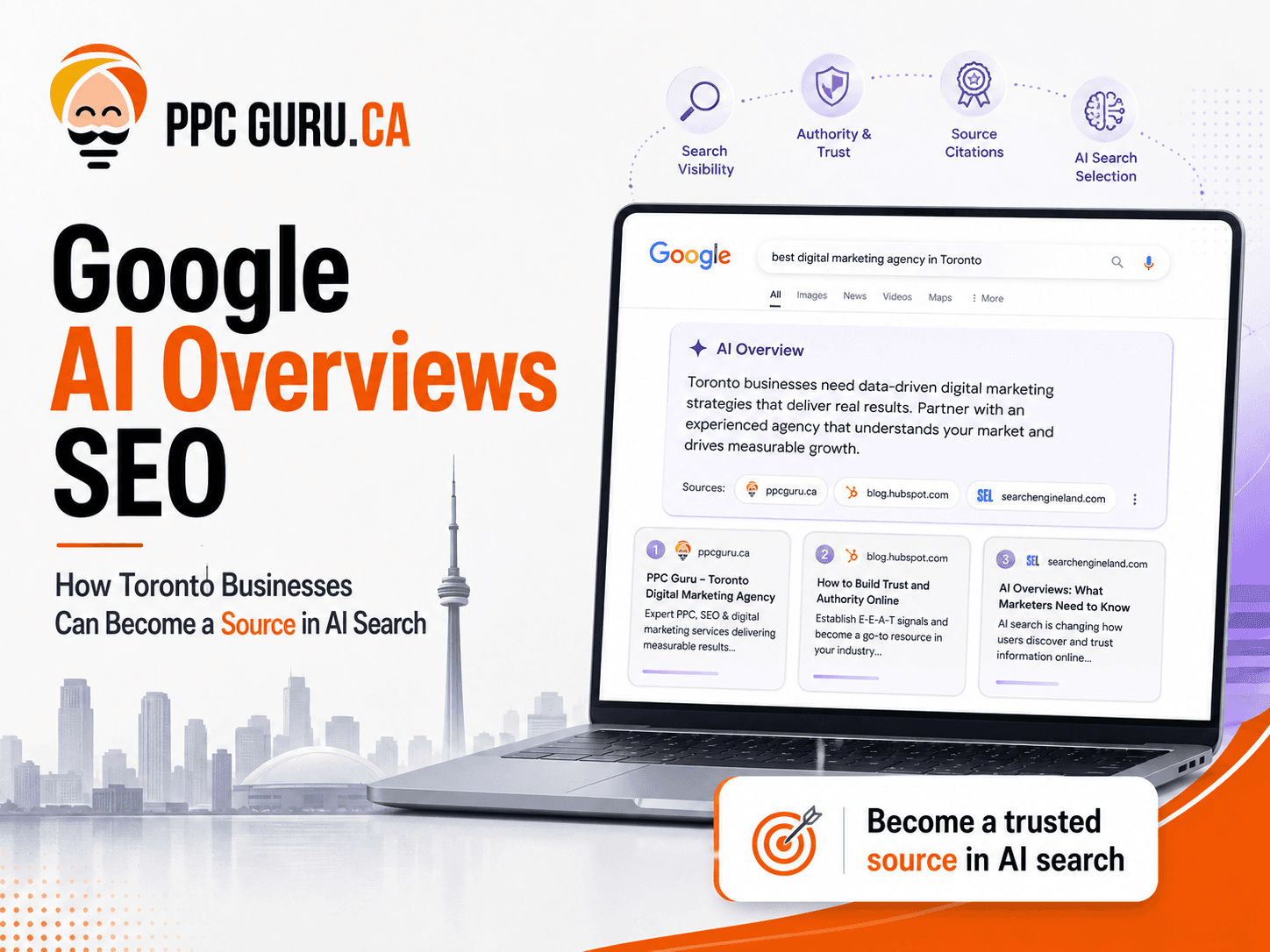
In July 2026, Google did something it had never done for AI Overviews before: it published an official guide explaining, in plain terms, how its generative AI search features actually retrieve and cite sources — and which popular "AI SEO" tactics are a waste of time.
That second part is the more useful one. Most of what's published about AI Overviews is speculation dressed up as certainty — "Google's algorithm favours X," "Google's AI prioritizes Y" — from people who, by their own admission, are reverse-engineering a black box. Google's own guidance cuts through a lot of that guesswork directly.
This article by PPC Guru, Best digital marketing agency in Toronto walks through what Google actually said, what independent citation data shows, and what it means specifically for a Toronto service business trying to show up when someone asks ChatGPT, Gemini, or Google's AI Overview a question about a plumber, a dentist, or an immigration consultant in the GTA.
The short version#
Google's AI Overviews and AI Mode are built on two mechanisms layered on top of Google's existing Search index — not a separate ranking system with its own rules:
- Retrieval-augmented generation (RAG): Google's own term for grounding. The AI response pulls from pages already sitting in Google's Search index, using the same core ranking and quality systems as regular Search, then reads specific passages from those pages to write a more accurate, current answer.
- Query fan-out: one search becomes several. Google's own example: a search for "how to fix a lawn that's full of weeds" might silently trigger related searches like "best herbicides for lawns" and "remove weeds without chemicals" — and the AI Overview draws on whichever pages best answer each of those sub-questions, not just the original query.
Neither of these is a new algorithm to game. They're existing Search infrastructure, run more times, per query, before the AI writes an answer.
Does a page have to rank #1 to appear in an AI Overview?#
No — but rank still correlates with citation more than most AI-SEO commentary admits, and that correlation has been loosening.
Ahrefs' most recent large-scale study (863,000 keywords, roughly 4 million AI Overview citations) found that only about 38% of cited URLs also ranked in the traditional top 10 for the same query — down sharply from about 76% in mid-2025. Filtered to standard organic listings only, the number lands in the same range, around 37%. Roughly a third of citations come from pages ranking 11–100, and another third come from pages that don't crack the top 100 organic results at all for that exact query.
The reason lines up with what Google describes: because of query fan-out, a page can earn a citation by strongly answering one of the sub-queries Google generated behind the scenes, even if it never ranks well for the exact phrase the user typed. A Toronto HVAC company's page on "furnace not turning on troubleshooting" might get pulled into an AI Overview for "furnace repair cost Toronto" not because it ranks for that phrase, but because it answers a fan-out query Google generated along the way.
Practical read: rank still matters - position 1 still converts to citations noticeably more than position 10, but a page one or two spots off the podium is not automatically shut out of AI Overviews the way it would be shut out of, say, a featured snippet.
How does Google actually choose supporting sources?#
Per Google's own documentation, it comes down to the same fundamentals that have always driven Search visibility, applied through RAG:
- The page has to be eligible for regular Search first. It must be indexed, meet Google's technical requirements, and be eligible to show with a snippet. AI Overviews don't have a side door — a page invisible to normal Search is invisible to AI Overviews too.
- Non-commodity content wins. Google explicitly distinguishes "commodity content" — generic, could-have-been-written-by-anyone material like a generic "7 tips" listicle — from content built on direct experience or a genuine point of view. Google's own example of the latter: an article about waiving a home inspection and what that actually cost the buyer, versus a summary of general home-buying tips.
- Clear structure matters for extraction, not for ranking. Content organized into readable paragraphs and sections with real headings is easier for Google's systems to pull specific facts from — this is a readability point, not a hidden ranking factor.
- Core ranking and trust signals still apply. Because RAG is explicitly built on Google's "core Search ranking and quality systems," the things that have always mattered for organic visibility — backlinks, topical authority, site trustworthiness — still feed into whether a page gets retrieved in the first place. AI Overviews are a presentation layer on top of that foundation, not a replacement for it.
Does schema markup help?#
This is where Google directly contradicts a large chunk of AI-SEO advice being sold right now, including some of the "signals that matter" checklists ranking for this exact topic. Google's guidance states plainly that no special schema.org markup is required for inclusion in AI Overviews or AI Mode, and that overfocusing on structured data isn't the lever people think it is.
That doesn't make schema worthless. It's still worth implementing as part of standard technical SEO, because it helps a page qualify for rich results and gives Google cleaner signals about what a page is about. But treating schema as an "AI Overview unlock" — a framing found on several ranking articles about this exact topic — isn't something Google supports.
Do backlinks still matter?#
Yes. Google's guidance doesn't call out backlinks by name, but it's explicit that RAG relies on "core Search ranking systems", and backlinks remain one of the primary trust and authority signals inside those systems. Nothing in Google's AI Overviews guidance suggests link-based authority has been retired; if anything, the RAG framing makes it more central, since a page has to clear the bar for regular Search relevance before it's even eligible to be retrieved for an AI answer.
Does local SEO influence AI answers?#
Yes, directly. Google's guidance calls out Google Business Profiles and Merchant Center feeds specifically as inputs that can surface in generative AI responses — local business details, product listings, and service information can all appear inside an AI-generated answer, not just a standard local pack.
For a Toronto business, this means the un-glamorous local SEO work — accurate categories, complete business details, review volume, consistent NAP (name, address, phone) data — isn't a separate track from AI visibility. It's one of the more direct inputs Google names outright.
Do AI Overviews use different URLs than standard organic results?#
Often, yes — and that's the most important practical takeaway from the Ahrefs data above. An AI Overview citation and a page's organic ranking position are related but separate outcomes. A page can rank on page one and never get cited; a page can rank on page three and get cited because it best answers one specific fan-out sub-query. Treat citation tracking (Search Console's Generative AI performance report, plus manual spot-checks of your own target queries) as its own metric, not a proxy read off your existing rank tracker.
Should Toronto businesses build special pages for fan-out queries?#
No, and Google is unusually direct about this one. Creating separate pages to cover every conceivable variant of a query, specifically to manipulate AI responses, falls under Google's scaled content abuse spam policy. Google's own language: a high volume of thin, near-duplicate pages doesn't make a site more relevant, and its systems are already good at understanding topical relevance without an exact keyword match.
The better version of the same instinct — genuinely useful, isn't gaming anything — is writing one strong page that thoroughly covers a topic and its natural sub-questions in the body content. A Toronto plumbing company's page on "emergency plumber Toronto" naturally answering "how much does an emergency plumber cost," "what counts as a plumbing emergency," and "is a burst pipe covered by insurance" within that one page is exactly the kind of depth query fan-out rewards. Ten separate thin pages for each variation is the version that gets penalized.
What Google says you can stop worrying about#
Google's guide includes a section it explicitly labels "mythbusting," and it's worth Toronto business owners reading it directly rather than trusting third-party interpretations. Google states outright that none of the following are needed to appear in AI Overviews:
- llms.txt files or other special AI markup. Google Search doesn't read them. Creating one won't hurt you, but it also won't help — Google Search itself ignores the file entirely.
- "Chunking" content into small fragments. There's no ideal page length or format requirement for AI parsing; Google's systems can find the relevant piece of a longer page without the content being pre-sliced.
- Rewriting content in "AI-friendly" phrasing. Google's systems already understand synonyms and intent, so there's no need for unnatural keyword variants aimed at an AI reader instead of a human one.
- Chasing inauthentic brand mentions. Google's guidance is blunt that seeking artificial "mentions" across the web doesn't move the needle the way some GEO vendors claim, and that both its quality and spam systems apply to generative AI features exactly as they apply to standard Search.
If a vendor's pitch leans heavily on any of these four as the core of an "AI visibility strategy," that's a signal worth taking seriously, worth asking exactly how they've verified the tactic works.
What this means for a Toronto business, practically#
Nothing here replaces solid SEO — it reframes what solid SEO is being asked to do. In practical order:
- Make sure the page is eligible for standard Search first. Indexed, technically sound, no crawl or snippet-eligibility issues. This is the floor, not a bonus step.
- Write content with a genuine point of view, not a generic overview a dozen competitors could have written. A first-hand account of a specific Toronto job — what a basement underpinning actually cost in North York, what a real immigration case timeline looked like — outperforms generic "top tips" content for AI citation specifically because Google names this distinction directly.
- Structure for a human reader, with clear headings and direct answers early in each section. This helps extraction without requiring any special format.
- Keep Google Business Profile complete and current — this is one of the few AI-visibility levers Google names explicitly, and it's also one of the cheapest to execute well.
- Keep building genuine backlinks and topical depth. RAG runs on top of core ranking systems; there's no AI Overview shortcut around earning authority the normal way.
- Track citations separately from rankings, using Search Console's Generative AI performance report alongside manual checks of your own priority queries.
- Skip the llms.txt panic, the schema-as-magic-bullet pitches, and the "one page per fan-out query" content mills. Google has said, in writing, that none of it works — and that some of it actively risks a spam penalty.
Where PPC Guru fits in#
This is the kind of work that's easy to describe and genuinely time-consuming to execute correctly across dozens of pages — auditing technical eligibility, rewriting commodity content into something with a real point of view, keeping Google Business Profile data accurate across every location, and tracking citation performance separately from rank. It's also exactly the ground PPC Guru's SEO & Local Search service is built around: technical SEO audits, Google Business Profile optimization, and content and rankings tracking for Toronto and GTA service businesses, the same foundation Google's own guidance says AI visibility is actually built on.
If you're not sure where your site currently stands, PPC Guru's free website and ad-account audit includes a review of technical SEO health and local search signals - the two levers Google names most directly in its own AI Overviews guidance — with no obligation attached.