
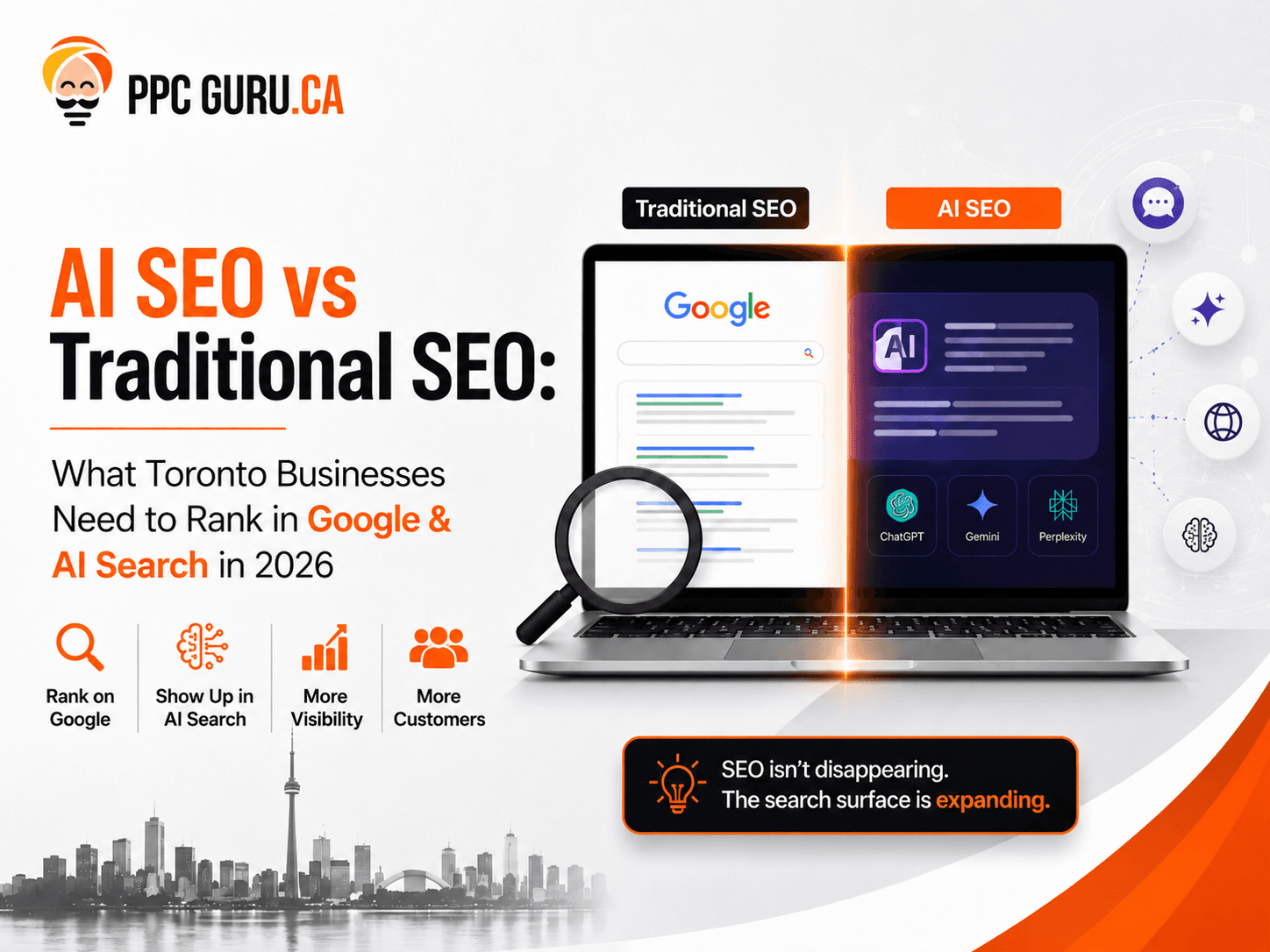
Search is changing, but SEO is not disappearing.
For Toronto businesses, the bigger shift in 2026 is that customers no longer discover companies through one search experience.
Someone looking for a physiotherapist, renovation contractor, immigration consultant or professional service may still search Google. But that same customer can now ask ChatGPT for recommendations, use Gemini to compare providers, explore a topic through Google AI Mode or ask Perplexity to research their options.
That means businesses are competing for visibility in AI search results, AI-generated answers, citations and recommendations at the same time.
The answer is not to abandon traditional SEO for the newest acronym.
It is to build a strong SEO foundation and then make that foundation easier for AI-powered search systems to discover, understand and reference.
Google itself reinforced this point in May 2026, stating that established SEO best practices remain foundational for visibility in its generative AI search experiences. (Google Search Central)
So what actually changes with AI SEO? And what should Toronto businesses do differently?
What Is AI SEO?#
AI SEO is the practice of improving a brand's visibility across traditional search engines and AI-powered discovery experiences such as Google AI Overviews, Google AI Mode, ChatGPT Search, Gemini and Perplexity.You may also hear related terms such as:
- Answer Engine Optimization (AEO)
- Generative Engine Optimization (GEO)
- LLM optimization
- AI search optimization
For a business owner, the terminology matters less than the goal:
Make your business and its information easy for search engines and AI systems to discover, understand, trust and reference when potential customers research a problem you solve.
Traditional SEO primarily asked:
“How can this page rank higher?”
AI SEO adds another question:
“How can this information become useful enough to contribute to an AI-generated answer?”
Those goals overlap much more than they conflict.
Traditional SEO vs AI SEO: The Practical Difference#
| Area | Traditional SEO | AI SEO |
| Primary visibility | Organic search results | Organic results + AI-generated answers |
| Typical target | Search queries and keywords | Keywords + conversational questions |
| Content goal | Rank the page | Rank, surface, cite or reference useful information |
| Technical requirement | Crawlable and indexable website | Same foundation, plus access for relevant AI search crawlers |
| Content structure | Search-intent optimized | Search-intent + answer-friendly passages |
| Authority | Links, brand trust, expertise | Authority plus corroboration across trusted sources |
| Measurement | Rankings, clicks, leads | Rankings, clicks, citations, mentions and leads |
| Local strategy | Local pages, reviews, GBP | Same signals plus clearer entity and service information |
The important point is that AI SEO sits on top of traditional SEO rather than replacing it.
If Google cannot crawl your website, your pages are poorly structured, your services are unclear and your content does not satisfy real search intent, adding an “AI SEO strategy” will not solve the underlying problem.
For businesses competing organically across Toronto and the GTA, the starting point should therefore remain a strong SEO and Local Search strategy.
Why AI Search Matters More in 2026#
AI-driven search is no longer an experimental corner of search behaviour.Google reported in June 2026 that AI Overviews had more than 2.5 billion monthly active users, while AI Mode had surpassed one billion monthly users. (Google)
Google also reported that AI Mode queries had been more than doubling each quarter since launch.
More importantly, the way people search is changing.
Instead of typing:
seo company toronto
a user can ask:
“What should I look for when comparing SEO companies in Toronto for a local service business that wants both Google rankings and visibility in ChatGPT?”
That is a much richer query.
Google has said people use AI Mode for longer and more complex questions, and its system can use a technique called query fan-out, breaking one complex request into multiple related searches.
This has major implications for content strategy.
A single page optimized around one keyword is less likely to cover every question, comparison and supporting concept associated with a customer's decision.
That makes topic clusters, internal linking and comprehensive service-page architecture increasingly valuable.
What Traditional SEO Still Gets Right#
Businesses should be careful not to discard proven SEO work because AI search is receiving attention.Many fundamentals remain essential.
1. Crawlability and Indexability#
Search engines need to access and understand your pages.That includes basics such as:
- sensible site architecture
- XML sitemaps
- appropriate robots directives
- canonicalization
- internal linking
- indexable service pages
- resolving duplicate or thin content
- avoiding important content hidden entirely behind scripts or interfaces
OpenAI similarly states that public websites can appear in ChatGPT Search and recommends allowing OAI-SearchBot if publishers want their content to be discoverable for ChatGPT Search. OpenAI also makes clear that inclusion or top placement cannot be guaranteed. (OpenAI Publisher FAQ)
2. Search Intent#
Keywords still matter because they reveal demand.But strong SEO has never been about repeating keywords a specific number of times.
A page targeting SEO Toronto, for example, should understand what someone using that query is actually trying to accomplish.
They may want to know:
- What SEO services include
- what SEO costs in Toronto
- how long results take
- whether they need local or national SEO
- how agencies measure performance
- how SEO compares with paid advertising
- whether SEO can affect AI search visibility
3. Internal Linking and Topic Clusters#
Suppose a Toronto SEO service page is the commercial hub.Supporting articles could cover:
- Local SEO
- technical SEO
- Google Business Profile optimization
- AI SEO
- SEO vs PPC
- content clusters
- keyword research
- AI Overviews
- ChatGPT Search
- SEO measurement
The result is not simply “more blog content.”
It creates a connected information architecture that helps users and search systems understand which pages are authoritative for each topic.
4. Original, Useful Content#
This arguably matters more now.Google's current guidance for generative AI search specifically emphasizes valuable, unique and non-commodity content.
If ten sites repeat the same definition of “What is GEO?”, publishing an eleventh rewrite adds little value.
A stronger article may include:
- original examples
- first-party data
- expert commentary
- screenshots
- comparisons
- methodology
- case observations
- Toronto-specific considerations
- limitations and caveats
What Changes With AI SEO?#
The foundation stays familiar. The search surface changes.Here are the additions businesses should make.
1. Optimize Around Questions, Not Just Keywords#
LLM users often express context that traditional keyword searches omit.Compare:
Traditional query:
“local SEO Toronto”
AI-style query:
“I own a physiotherapy clinic in North York. Should I invest in Local SEO, Google Ads or both if I want more assessment bookings?”
The second query contains:
- industry
- location
- business objective
- alternatives
- decision criteria
- desired outcome
This is where service clusters become particularly powerful.
2. Write Passages That Can Stand on Their Own#
AI systems frequently retrieve and synthesize specific pieces of information rather than treating every page as one indivisible document.That means important explanations should be clear without requiring five paragraphs of surrounding context.
For example:
Weak:
“There are several reasons this matters, as discussed above.”
Better:
“Local SEO helps Toronto service businesses improve visibility for location-dependent searches by strengthening their website, Google Business Profile, local relevance and external business signals.”
The second statement carries meaning independently.
That is good for readers, featured snippets and machine retrieval alike.
3. Make Your Business Entity Clear#
An AI system should not have to guess:- Who your business is
- Where you operate
- What you sell
- Who you serve
- What expertise you have
- Which locations belong to the company
- Which people represent the company
- website
- About page
- service pages
- Google Business Profile
- professional profiles
- reputable directories
- relevant industry listings
- structured data
4. Strengthen Third-Party Validation#
A company saying “we are experts” is a claim.Independent evidence is stronger.
Useful external validation can include legitimate:
- media coverage
- professional associations
- expert contributions
- customer reviews
- industry publications
- business directories
- citations
- research references
That does not mean manufacturing mentions or spamming forums.
The objective should be to become genuinely reference-worthy.
5. Use Evidence Inside Your Content#
The original Generative Engine Optimization research introduced by researchers from Princeton and other institutions tested methods for improving visibility in generative responses and reported that some optimization approaches increased visibility substantially in its experimental setting. (GEO research paper)The takeaway is not that adding random statistics guarantees AI citations.
It is that well-supported content has advantages.
Whenever appropriate, include:
- source names
- dates
- statistics
- methodology
- expert attribution
- definitions
- first-party evidence
Do You Need Separate AEO, GEO and SEO Strategies?#
For most Toronto businesses, probably not as three isolated programs.A better model is:
Foundation: SEO
Build:
- technical health
- crawlability
- useful service pages
- Local SEO
- topical authority
- links and mentions
- conversion tracking
Improve:
- direct answers
- FAQs where genuinely useful
- question-based headings
- concise definitions
- comparison sections
- clear entity information
Layer 3: Generative Search Visibility#
Expand:- AI crawler accessibility
- original evidence
- citation-worthy resources
- external authority
- conversational-query coverage
- tracking of AI mentions and referrals
This is far more efficient than creating one page “for Google,” another “for ChatGPT,” and another “for Gemini.”
What Should a Toronto Business Do First?#
If you already invest in SEO, do not rebuild everything around AI.Audit what you have.
Start with these seven questions:
- Can search engines and AI search crawlers access our important pages?
- Does every important service have a genuinely useful page?
- Do our pages answer the questions customers ask before hiring us?
- Is our business name, location, expertise and service area consistently represented?
- Do trustworthy third-party sources corroborate our business and expertise?
- Are we publishing information that competitors cannot easily reproduce?
- Are we measuring leads and revenue instead of treating rankings as the final outcome?
It is fixing the foundation.
PPC Guru's SEO and Local Search services approach SEO through technical health, local visibility, service and location pages, content clusters, internal linking and authority building—the same foundations that remain relevant as search becomes increasingly AI-assisted.
How Should AI SEO Success Be Measured?#
Traditional rankings are no longer enough.A modern organic search dashboard should include:
Traditional SEO
- organic impressions
- clicks
- keyword positions
- organic leads
- conversion rate
- revenue
- map visibility
- Google Business Profile actions
- calls
- direction requests
- location-specific conversions
- referral traffic from AI platforms
- cited URLs
- brand mentions
- appearance for important prompts
- AI-assisted conversions where measurable
Do not obsess over one screenshot showing your company mentioned by ChatGPT.
AI responses can vary by wording, context, location, freshness and system behaviour.
Track patterns over time.
SEO Is Not Dying. Search Is Expanding.#
The biggest mistake Toronto businesses can make in 2026 is treating this as a choice between:SEO or AI SEO.
The better question is:
How do we build an organic presence that remains discoverable wherever customers search?
Google Search is becoming more conversational. ChatGPT can search the web and cite sources. Gemini is deeply integrated into Google's search ecosystem. Perplexity is built around answer-and-source experiences.
Yet the underlying business requirement remains familiar:
Create information people actually need, make it technically accessible, demonstrate real expertise, build authority and clearly communicate what your company does.
AI SEO adds new surfaces and new measurement.
It does not remove the need for good SEO.
For Toronto businesses, the strongest strategy in 2026 is therefore not replacing traditional SEO with AEO or GEO.
It is expanding SEO so your brand can compete across Google search results, local search and AI-generated discovery at the same time.
Frequently Asked Questions#
Is AI SEO replacing traditional SEO? No. Google explicitly states that SEO best practices remain foundational for visibility in its generative AI search features. AI SEO expands traditional SEO to account for AI-generated answers, citations, conversational queries and emerging discovery platforms.What is the difference between SEO and GEO? SEO traditionally focuses on earning organic search visibility. GEO focuses on improving visibility within generative search and AI-generated answers. In practice, many useful tactics overlap, including crawlability, high-quality content, authority, clear structure and strong entity information.
Can SEO help my business appear in ChatGPT? It can improve discoverability, but nobody can guarantee placement. OpenAI says public websites may appear in ChatGPT Search and recommends allowing OAI-SearchBot to crawl content intended for discovery. Ranking is determined by multiple factors related to relevance and reliability.
Should Toronto businesses optimize for ChatGPT, Gemini and Perplexity separately? Not initially. Start by building a technically sound, authoritative and comprehensive web presence. Once that foundation exists, monitor important queries across different platforms because sourcing behaviour can differ between AI systems.
Does schema markup guarantee AI citations? No. Structured data can help search engines understand page information, but there is no supported evidence that simply adding schema markup guarantees inclusion or citations in ChatGPT, Gemini, Perplexity or Google AI results.
Is Local SEO still important in the AI era? Yes. Customers still have location-specific needs, and AI tools increasingly answer local recommendation questions. Accurate business information, useful local pages, reviews, Google Business Profile optimization and strong local relevance remain important parts of an organic visibility strategy.