

What does an SEO audit include when your Toronto business needs more than a list of broken links? It should examine whether the right pages can appear in search, answer the searches that matter to your customers, earn local trust, and turn relevant visits into enquiries. PPC Guru put together this buyer's checklist to help you judge the work before you commit. If you are comparing agencies, our SEO and local search service explains the commercial work that may follow an audit; this guide explains what a useful diagnosis should contain.
The short answer: A full SEO audit usually covers technical access and indexing, page content and search intent, internal links and authority, local search where relevant, and measurement of enquiries. Its most useful output is not a health score. It is a prioritized plan that names the evidence, affected pages, proposed fix, expected business relevance, owner, and method of checking whether the fix worked.
Contents#
- What an audit should check
- What you should receive
- Free versus paid audits
- Seven questions to ask an agency
- Frequently asked questions
If you only have a minute, ask the auditor these three questions:
- Which finding affects a service page that could bring us qualified enquiries?
- How do you know it is a problem rather than an intentional site setting or a tool warning?
- What should we do first, who will do it, and how will we verify it?
An audit that cannot answer those questions may still be useful as a quick scan. It is not yet an implementation plan.
First, what is the audit trying to solve?#
Imagine a North York renovation company whose website gets search impressions but few quote requests. A generic report might flag every missing image description, redirect, and slow page. Some of those findings matter. But if its main bathroom-renovation page cannot be indexed, or the quote form fails on a phone, the owner needs to know that before spending weeks rewriting blog posts.
That example is illustrative, not a PPC Guru client case study. The point is that an audit needs a business question, not just a crawl. Before examining the site, the auditor should agree on:
- The services, locations, and customer enquiries that matter most.
- Which pages are meant to win those enquiries.
- What access is available to Search Console, analytics, the website, and—when local visibility matters—the Google Business Profile.
- What the audit includes and excludes: diagnosis only, or diagnosis plus implementation and follow-up.
Without that scope, a 100-page report can feel thorough while leaving the actual lead problem untouched.
What should an SEO audit check?#
1. Can search engines reach and understand the important pages?#
The technical portion should examine the pages the business depends on, not treat every URL as equally valuable. Typical checks include crawl access, indexing signals, redirects, canonical tags, internal navigation, page speed, and mobile usability. The auditor should also check whether any structured data accurately reflects visible page content.
For an important service page, request the specific URL and evidence. Was it blocked, marked noindex, redirected, duplicated, or simply not yet indexed? Those are different situations with different fixes. A redirected page or an intentionally excluded page is not automatically an error. Google's URL Inspection tool can show information about the indexed version of a page and test whether the live URL might be indexable; neither test promises that the page will appear in results.
Speed belongs in the audit too, especially on pages where people call or submit a form. But “the site is slow” is too vague. Ask which template and device were tested, what users experienced, and whether the recommendation is likely to matter more than another unresolved problem. Google's Core Web Vitals guidance is a useful reference, not a reason to assume every speed warning has the same priority.
2. Do the pages match the searches you want to win?#
An audit should map important searches to the right pages. For a Toronto service business, a query such as “bathroom renovation Toronto” calls for a different page and level of detail than “how long does a bathroom renovation take?” One is closer to hiring; the other is planning. Trying to make one generic page do both jobs can leave visitors without the answer they expected.
The auditor should review titles and headings, but also the substance beneath them: services offered, locations actually served, proof, common objections, and an obvious next step. Check whether several pages on your site are unintentionally competing for the same intent. If two pages overlap, the answer is not always “delete one.” The right choice may be to clarify their roles, improve one page, consolidate them, or leave both in place when they genuinely serve different needs.
Internal links matter here. A useful audit identifies where a related page should point to a priority service page and whether the anchor text tells a reader what they will find. It should not recommend adding dozens of repetitive links merely to hit a count.
For owners also investing in AI-search visibility, this is the place to check whether the page gives clear, accurate answers and whether the business information is consistent. It is not a separate promise that an AI model will recommend the business. Google says its AI search features continue to rely on foundational SEO and useful, original content; there is no special markup requirement to appear in AI Overviews. Read Google's guidance on AI features.
3. Is local information accurate where it affects discovery?#
For a business serving Toronto and the GTA, the audit should review the local presence when that is in scope: the Google Business Profile, its services and categories, contact details, website destination, relevant location pages, and customer-facing information across important listings. It should also check whether the website makes the actual service area clear without inventing offices or copying the same thin page for every suburb.
Google describes local results as relying mainly on relevance, distance, and prominence. An audit can improve the information a business controls, but it cannot move an office closer to every searcher or buy a better map position. Google's local-ranking guidance is the sensible reference.
Ask the auditor to distinguish a website problem from a Business Profile problem. A clinic in Scarborough with an incorrect booking link needs a different fix from a contractor in Vaughan whose service page does not explain the work it performs. Local SEO is not one checkbox.
If the audit exposes incomplete profile information, weak reviews, or thin location content, use PPC Guru's local SEO checklist for GTA service businesses to turn those findings into a practical follow-up list. The checklist is for improving local presence; this audit guide is for deciding what needs investigation first.
4. Are trust and authority claims backed by evidence?#
An off-site review can look at relevant links, mentions, reviews, and how competitors establish credibility. The auditor should explain why a gap matters to your market. “Competitor has more backlinks” is not, by itself, an instruction to buy links. Likewise, a tool's warning about a “toxic” link is not proof that removing it should be your first project.
For a healthcare, construction, or immigration business, accuracy, qualifications, and claims may also need an appropriate professional review before publication. An SEO audit can identify unclear or unsupported website copy; it should not pretend to replace that review.
5. Can you measure enquiries—not just traffic?#
An audit for lead generation should test the path from landing page to contact. Can someone call or complete the form on a phone? Does the thank-you state work? Is the enquiry recorded in the right system? Can the team distinguish a qualified prospect from an accidental click or spam submission?
Google Analytics 4 can measure a lead submission as a generate_lead event, but the implementation has to match the actual form and reporting needs. Google's recommended-events documentation is a starting point. The auditor should say what was tested and what remains unverified. A measurement gap does not necessarily hurt rankings, but it can hide whether the SEO investment produces real opportunities.
Once lead tracking is trustworthy, measure the return from SEO services against qualified enquiries and customer value—not only sessions or average position. That is a separate measurement decision from the audit's job of finding what is broken or missing.
This is where an audit may uncover a website or landing-page issue rather than an SEO-only issue. If the page earns relevant visitors but the enquiry path is poor, PPC Guru's website and landing-page work may be more relevant than publishing another article.
What should you receive at the end of the audit?#
You should be able to hand the final document to an owner, marketer, or developer and know what happens next. It need not be long. It does need enough evidence and context to make decisions.
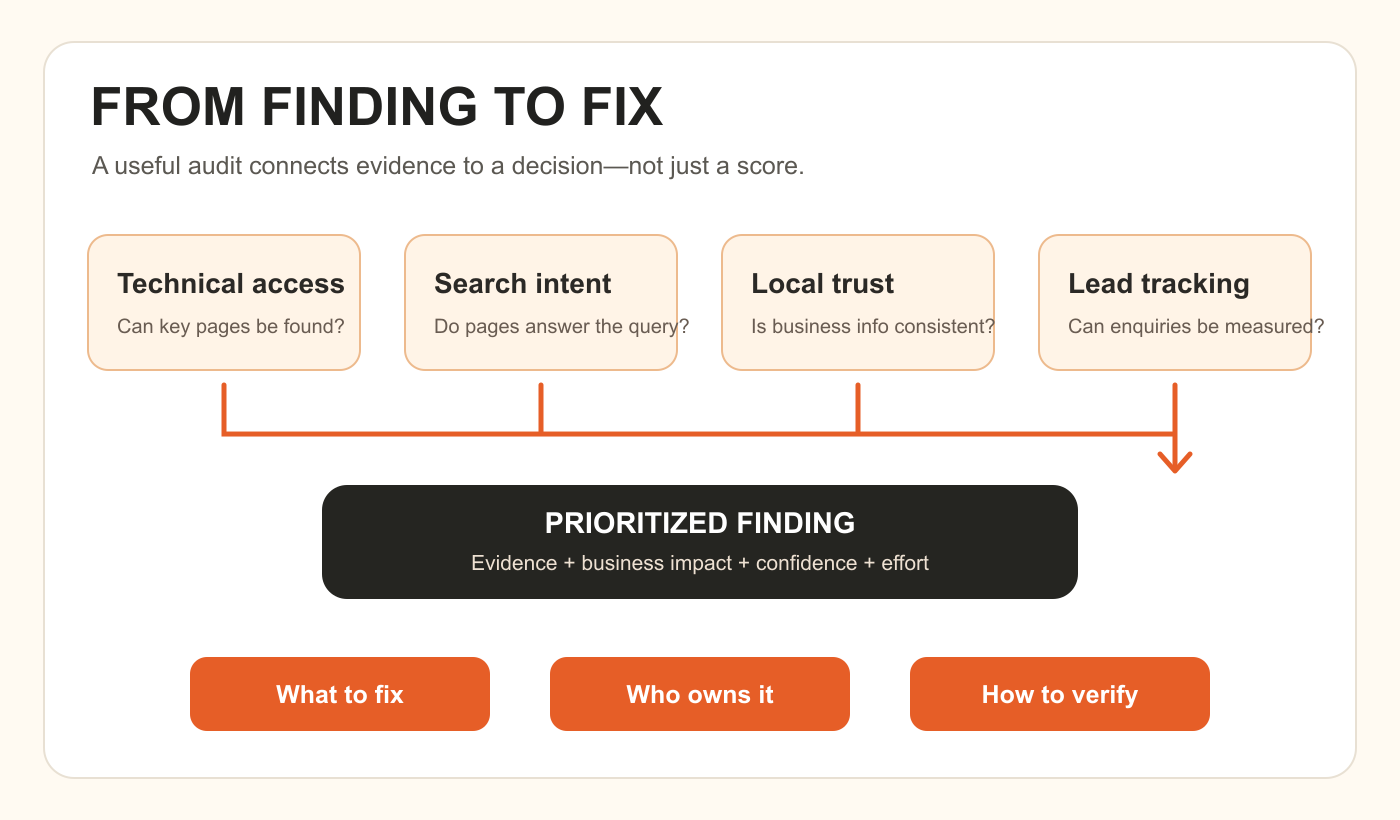
The diagram in plain text: Technical access, search intent, local trust, and lead tracking are possible evidence areas. The auditor weighs a finding's evidence, business impact, confidence, and effort, then states what to fix, who owns it, and how to verify the outcome. These areas are considered together; the diagram is not a fixed sequence of work.
Here is what an actionable finding might look like. All entries below are illustrative, not findings from a PPC Guru client audit.
| Finding | Evidence to request | Why it may matter | Next action and owner | How to verify |
|---|---|---|---|---|
Priority service page carries an unintended noindex directive | Page URL, live HTML/header, and Search Console inspection | The intended page may be ineligible for Google indexing | Developer confirms the setting was unintentional, then removes it | Test the live URL and monitor its indexed status; allow for recrawling |
| Two service pages appear to answer the same hiring query | Query-to-page map, page content, and Search Console performance | Searchers may reach the less useful page; content effort may be split | SEO lead decides whether to clarify, improve, or consolidate | Recheck page targeting and query/page performance after changes |
| Quote form works but its lead event is not recorded | Test submission and analytics event check | The business cannot reliably evaluate enquiries from the page | Analytics owner implements and tests the appropriate event | Submit a test lead and confirm it is recorded correctly |
Notice what the table does not do: assign “high priority” to every missing title or promise that a fix will lift rankings by a certain percentage. Priority depends on the page, the customer journey, the strength of evidence, and the effort involved.
A simple way to sort the work#
Ask the auditor to put each recommendation into one of three groups:
- Fix now: Strong evidence, important page or enquiry path, and a clear remedy—such as an unintended block on a core service page.
- Investigate next: A plausible issue where more data is needed before changing URLs or content.
- Maintain or monitor: Low-impact housekeeping, intended exclusions, or work that is unlikely to beat higher-value tasks this month.
The report should also say whether the agency will implement the changes, whether a developer is needed, and what follow-up is included. “We will optimize your site” is not a work order.
After the diagnostic, a recurring programme should turn agreed fixes into shipped work and reviewed results. PPC Guru's monthly SEO services checklist for Toronto businesses explains what to expect from that ongoing cycle; an audit alone is not a monthly SEO plan.
Is a free SEO audit enough?#
Sometimes a free review is exactly the right first step. It can help you identify a visible problem, clarify the business goal, and decide whether a deeper investigation is warranted. A paid or more comprehensive engagement may involve access to Search Console and analytics, a fuller crawl, query-to-page mapping, competitor review, a prioritized implementation plan, and follow-up testing.
But free versus paid does not define quality on its own. Ask what is included in the specific offer. Will you receive a written summary? Which pages are reviewed? Is the work based on public information only, or on your account data? Who explains the findings? Are fixes included or separately scoped?
PPC Guru's SEO service page offers a free website audit. Before requesting one—or accepting any agency's offer—confirm the exact scope and expected deliverable. This article is a checklist for evaluating an audit; it does not promise that the free review includes every check described above.
Seven questions to ask the agency before you hire#
Use this as an audit-specific scorecard. Follow the three checkpoints—scope, evidence, then delivery—and listen for a specific answer at each one. A clear answer is more valuable than a polished slide deck. If you are comparing the agency as a whole—not only its audit—see our separate guide to choosing an SEO agency in Toronto.
Your SEO audit buyer's map
Scope: what will be examined?#
- Which pages and locations will you examine?
Look for the services and GTA markets that actually generate revenue for you.
- What data will you need from us?
They should distinguish public-page observations from Search Console and analytics findings.
Evidence: how will findings be judged?#
- How do you separate tool warnings from real problems?
Listen for what they verify manually before recommending a change.
- Will you review local search and lead tracking?
Ask whether Google Business Profile and enquiry measurement are included when relevant.
- How will you decide what to fix first?
Expect a reasoned order based on evidence, business impact, confidence and effort.
Delivery: what happens after the report?#
- Who implements the recommendations?
Clarify whether the fee covers diagnosis, changes, developer coordination and retesting.
- What will we receive, and when will we review it together?
Confirm the report format, action plan, explanation and follow-up commitment.
If you have a limited monthly budget, ask the agency to show the smallest credible first phase. An audit should help you spend deliberately, not turn every flagged item into a new retainer line.
Frequently asked questions#
How long does an SEO audit take?#
It depends on the site's size, the number of important services and locations, access to data, and the depth of the deliverable. A quick public scan and a full diagnostic with implementation planning are different products. Ask for the scope and delivery date in writing rather than accepting a universal time estimate.
Will an SEO audit improve rankings on its own?#
No. An audit identifies and prioritizes opportunities. Changes still need to be approved, implemented, and checked. Search engines may take time to recrawl pages, and no agency can guarantee a ranking, a lead, or an AI citation. Google notes that requesting a recrawl does not guarantee immediate inclusion in results.
Should a Toronto SEO audit include Google Business Profile?#
For a business that depends on local discovery, usually yes—if the profile is relevant and the agreed scope includes local SEO. The audit should review accurate business information and how people interact with the profile, while keeping profile findings separate from website findings. Google provides Business Profile performance data for verified profiles.
Should the audit check visibility in ChatGPT or Google AI Overviews?#
It can check whether important pages are accessible, helpful, and factually consistent, and it can record representative AI answers as observations. Those observations can vary by query and time. They should not be sold as proof that a model will cite the business next month. Google says there are no additional technical requirements for appearing as a supporting link in its AI features beyond eligibility for Google Search with a snippet. Source: Google Search Central.
What if the audit finds dozens of issues?#
Ask for the first three actions, the evidence behind each one, the affected page or enquiry path, and a way to verify the fix. A useful audit gives you permission to defer lower-value work.
The bottom line#
An SEO audit should leave you with a clearer decision, not just a larger spreadsheet. For a Toronto business, that means knowing which pages and local touchpoints matter, which findings are verified, what the business should fix first, and who is accountable for the work.
If you want PPC Guru to review your website, start with the SEO and local search service page and ask what the free review will include for your specific site. You can use the seven questions above with us—or with any agency you consider.