
Picture one customer in Toronto.
They find an HVAC contractor on Google Maps. They skim the reviews. Then they ask ChatGPT for a second opinion, watch one Instagram clip, come back through a Google ad, and finally call.
That is one customer. Six touchpoints before the phone rang.
So here is the shift for 2026. You can't run "SEO," "PPC," and "social" as separate boxes anymore. You need one connected system, because your customers already move across five or six channels before they reach out.
Quick answer. A strong 2026 strategy for a Toronto small business combines local SEO, a fully optimized Google Business Profile, AI-search visibility, high-intent Google Ads, useful content and video, reviews, and first-party data. Measure every channel against booked jobs and revenue.
Key Takeaways#
- Toronto is many markets, not one. Your service geography is a strategy, not an afterthought.
- Ranking is no longer enough. Most searches end with zero clicks, and AI answers you on the page.
- Use paid and organic together. Paid gets leads today. SEO compounds over months.
- AI mentions are hard to earn. Nobody can guarantee ChatGPT names you.
- First-party data is your safest asset. No platform can take your customer list.
- Measure the full funnel. Spend to lead to qualified lead to appointment to customer to revenue.
What's in This Guide#
- Why Toronto is different
- Pillar 1: Local SEO and AI search
- Can AI actually recommend you?
- Pillar 2: Paid search and paid social
- Pillar 3: Content and video
- Pillar 4: Reviews
- Pillar 5: First-party data
- How much should you spend?
- How long until it works?
- How to choose an agency
- FAQ
Why Digital Marketing Is Different in Toronto#
Toronto is not one market. It is a stack of small ones.Search behaviour changes from Downtown to North York to Scarborough to Mississauga. A physio clinic in North York needs people nearby who want physio now. A GTA-wide contractor needs the opposite: reach across Toronto, Mississauga, and Vaughan. So your service area is the first decision, and it shapes everything after it.
The money is following this online. Statistics Canada's Q2 2025 Canadian Survey on Business Conditions found that 45.0% of businesses invested in digital infrastructure over the prior three years.
But the winners aren't the ones with the most tools. They are the ones who tie marketing to revenue. And there is a second shift that changes how you measure everything.
Zero-click reality. Independent research (SparkToro/Datos) puts the share of Google searches ending with no click at roughly 60 to 65%, and around 83% when an AI Overview appears. Showing up is not the same as getting the click.
Pillar 1: Local SEO and AI Search#
Google Business Profile · Map Pack · AEO and GEOLocal SEO is how you get found for searches tied to a place: Google results, Google Maps, and the local Map Pack. In 2026 it also means being readable by AI Overviews, ChatGPT, Gemini, Claude, and Perplexity.
The goal is simple. Make your business easy to verify as a real, consistent entity across the web.
The rule this runs on. Google says local rankings come from three things: relevance, distance, and prominence. You can't change distance. So every move below pushes relevance or prominence.
Your Google Business Profile Checklist#
- Category. Correct primary category, plus relevant secondary ones.
- NAP. Accurate address or service areas, with consistent phone and website.
- Details. Current hours, full services, and authentic photos.
- Reviews. A steady flow, with a reply to every one.
- Honesty. Real descriptions. No keyword-stuffed names or fake locations.
Build Pages Around Real Intent#
Don't cram every service onto one "Renovations" page. A focused page at /basement-renovations-toronto/ beats a homepage trying to rank for everything.Add location pages only where the market is truly distinct, and give each real substance: the neighbourhoods you serve, parking and TTC access, which insurers you direct-bill. "Serving Scarborough and the surrounding area" on a template page is not substance, and Google can tell.
Want this handled? That is our SEO and local search service.
Showing Up in AI Search#
People ask full questions now. "Who's a reliable plumber in Toronto for emergency repairs with strong reviews?" has replaced "plumber Toronto."Good news: Google's 2026 guidance says core SEO still applies to AI Overviews and AI Mode, because they run on the same ranking systems, using RAG (pulling from the Search index) and query fan-out (running several sub-queries, then assembling one answer).
We broke this down in how Google AI Overviews choose their sources. The takeaway? No secret trick. Just indexable pages, helpful content, and clear coverage.
Can AI Actually See and Recommend Your Business?#
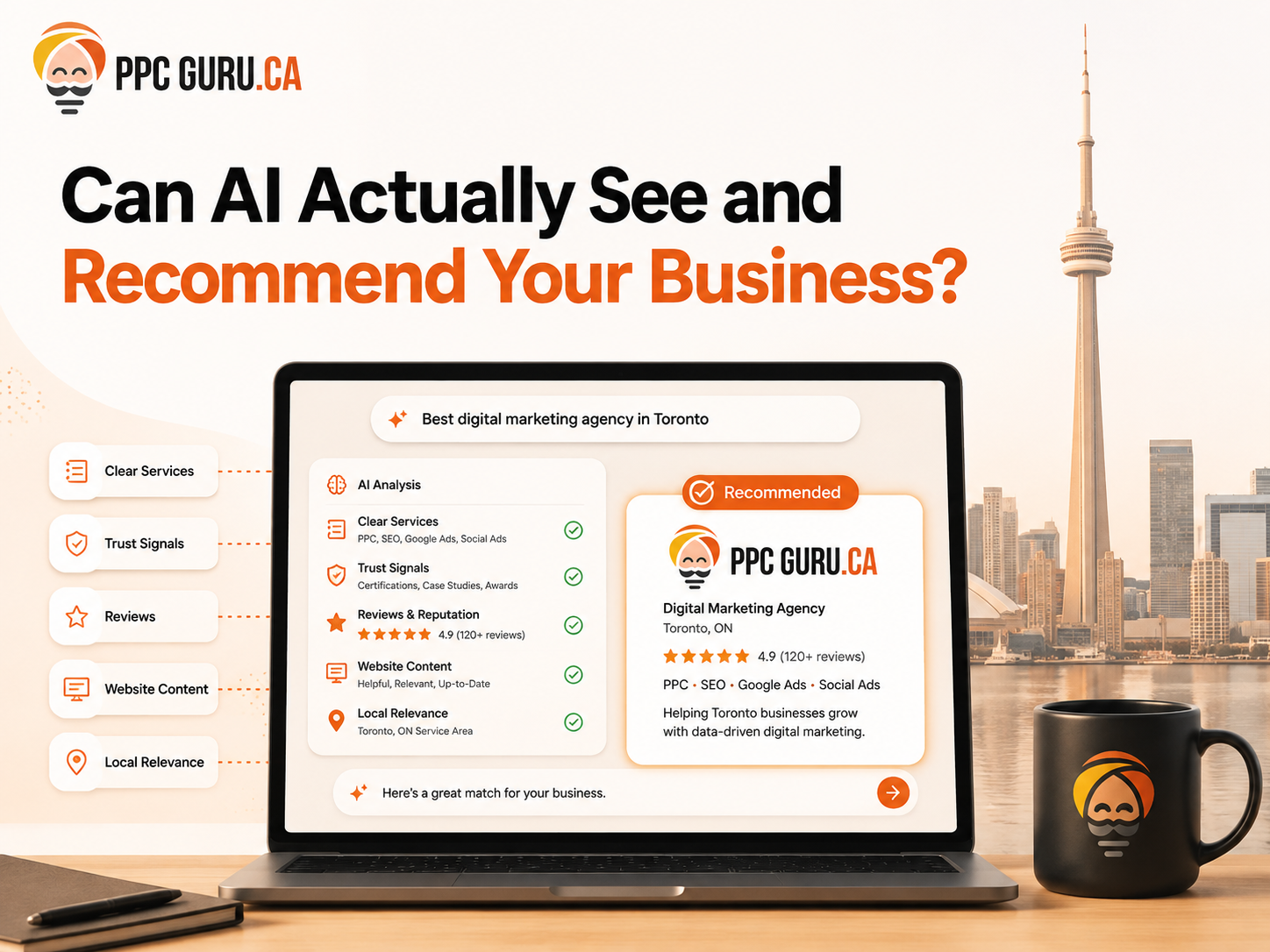
Sometimes, but it is picky. AI visibility means whether assistants like ChatGPT, Gemini, and Perplexity can find, trust, and recommend you. It depends less on one page and more on how consistent and well-reviewed you are across the whole web.
Now the honest part most agencies skip.
AI use for local recommendations grew from 6% to 45% in a year (BrightLocal, Research Report 2026). Yet an audit found only 1.2% of local businesses actually get recommended by ChatGPT
Demand grew about sevenfold. But AI is stingy about who it names. "Showing up in ChatGPT" is a much harder bar than page one. And no agency can guarantee it.
So what moves the needle? Mostly off-page work:
- Consistency. Same name, address, and phone everywhere, so your sources agree.
- Reviews. Real, recent, and in volume.
- Mentions. Your business named on directories, local press, and industry lists.
- Clarity. Content that says what you do, who you help, where, and what it costs.
Pillar 2: Paid Search and Paid Social#
Google Ads · Local Services Ads · Meta retargeting · trackingPaid search puts you at the top when someone is searching right now. SEO compounds slowly. Paid search captures demand today, when the intent is hot: "emergency plumber Toronto," "dentist North York accepting patients."
Match geography to what you can service. Split campaigns by market (Toronto, North York, Scarborough, Mississauga, Vaughan, Brampton) so you can compare cost per customer by area, not just clicks. That is the core of our Google Ads management in Toronto.
Sort keywords by intent. "How much does a basement renovation cost?" and "basement contractor near me" touch the same topic but sit at very different points in the journey. Push budget toward the queries closest to a sale.
Local Services Ads pay for leads, not clicks. LSAs are a separate Google product. You pay only when someone calls or messages, and verified businesses get a Google Verified badge. The Canadian eligible list is narrower than the US list and changes, so confirm with Google before you budget for it.
Paid social does a different job. Google Ads catch people who are searching. Meta creates demand and brings back visitors who left. For most local businesses the combo is search for ready buyers, plus a lean Meta retargeting layer so warm leads don't slip. That is part of our Meta Ads management.
Then measure past the form fill. Say Google Ads gives you 30 form fills, 15 qualified leads, 8 appointments, and 3 customers. Optimize for the 3 customers, not the 30 forms.
Google's enhanced conversions for leads tie offline sales back to the ad using consented, hashed data. With third-party cookies gone, that loop is the baseline, and it is what our CRM and tracking setup exists to build.
Pillar 3: Content and Video for Toronto Audiences#
Short-form video · original evidenceContent and video earn trust before a customer contacts you. Every piece needs a job, and usually that job is answering a real buying question: "How Much Does Furnace Replacement Cost in Toronto?" or "Does Insurance Cover Physiotherapy in Ontario?"
These win twice. They serve Google and conversational AI, because they answer a question instead of chasing a keyword.
Original evidence beats generic AI content. AI can spit out generic content in seconds, so generic content is worth less now. First-hand evidence is worth more: real project photos, before-and-afters, pricing you have actually seen, case studies. A competitor can't copy those, and it is exactly what AI models quote and credit.
Short-form video is a trust layer. 78% of people prefer to learn about a product through short video, versus 9% who prefer text (Wyzowl), and short-form gets about 2.5x more engagement than long-form.
A customer might find you on Google, then validate you on Instagram or TikTok. Useful formats: 30-second FAQs, project walkthroughs, before-and-afters, team intros. Need production help? That is our creative production service. For big-ticket buys like renovations or dentistry, video builds trust that pays off at the sale, not always in immediate leads.
Pillar 4: Reviews and Reputation#
Review generation · response workflowReputation management is the ongoing work of getting, watching, and replying to reviews. It is a sales strategy and a local-search strategy at once.
97% of people read reviews before choosing a local business. 41% now "always" read them, up from 29% a year earlier (BrightLocal 2026).
Google says review volume and ratings feed local prominence, so the work pays off twice: more people pick you, and you get easier to rank.
Copy this workflow: service done, confirm they are happy, ask for a review, send one reminder, monitor, reply. Automate the reminders. Keep the review itself real and voluntary.
- Never buy reviews, use fake accounts, reward only positive ones, or have staff pose as customers.
- Positive reviews: thank them, personalize the reply, reinforce the service.
- Negative reviews: stay calm, own the concern, take detail offline, explain the fix.
Pillar 5: First-Party Data (The One Most Businesses Skip)#
CRM · attributionFirst-party data is the customer info you own: your email list, past customers, leads, and booking history.
Here is why it matters. SEO algorithms change. Ad costs jump. Social reach drops overnight. Your customer list does not move under you.
A contractor with 200 enquiries and no follow-up has a marketing problem, even if every ad was perfect. So build a simple CRM flow: new lead, contacted, qualified, appointment, quote, won or lost, revenue. Tag the source every time.
That is what finally answers the real question: which channels bring customers, not just leads.
Want proof it works? See our anonymized client results across HVAC, physiotherapy, dental, and construction.
How Much Should a Toronto Small Business Spend?#
Direct answer. There is no universal number. Work backward from economics. Find what a customer is worth, decide what you can profitably pay to win one, then set a budget big enough to generate the data to hit that number.Make it concrete. Say a new customer is worth $2,000 in profit and you will spend up to 25% to win one. That is a $500 target cost per customer. If it takes about 10 leads to close one, you can pay up to $50 per lead and still win.
Now your budget ties to profit, not a guess. For real Toronto numbers by industry, see our industry benchmarks. For how fees work, see our pricing.
How Long Until It Works?#
Direct answer. Paid search can bring leads within days. SEO and content usually take three to six months to gain traction, and six to twelve to compound into cheaper, steady lead flow. Reviews and first-party data build over the same window.The smart play? Use paid for quick wins while SEO, reviews, and content build the cheaper authority underneath.
How to Choose a Digital Marketing Agency in Toronto (and Red Flags)#
One test beats all others. Does the agency tie your spend to revenue, and report it plainly? Vanity metrics are easy to sell. Booked jobs and cost per customer are not.Before you sign, ask for a clear line from spend to revenue, reporting you can actually read, local proof, honest timelines (no guaranteed rankings or AI mentions), and full ownership of your accounts and data.
Walk away if you see reporting built on impressions with no revenue attached, guaranteed rankings or a "secret Google trick," long lock-in contracts, or template work with the neighbourhood swapped on fifty pages.
That is the bar we hold ourselves to. Want a second opinion? Our free audit is the fastest way to get one.
How PPC Guru Turns Marketing Into Revenue#
We work backward from your business, not from traffic: which services have the best margins, what you can pay to win a customer, which leads become customers. The whole process is measured in booked jobs and revenue.As a Google Partner and Meta Business Partner, we run Google Ads, Meta Ads, SEO, and CRM as one accountable team.
Get a free, no-obligation audit of your Google Business Profile, ads, and site. Get my free audit or message us. More on the PPC Guru blog.
Frequently Asked Questions#
What is the best digital marketing strategy for a small business in Toronto?Start with a conversion-ready website, a fully optimized Google Business Profile, local SEO, reviews, and accurate tracking. Add Google Ads once demand is strong. Then layer in content, video, and CRM automation.
How much should a Toronto small business spend on digital marketing?
There is no fixed number. Find what a customer is worth, decide what you can profitably pay to win one, then budget enough to generate real data. Many local budgets start around a few thousand dollars a month.
Should I start with SEO or Google Ads first?
Need leads this quarter? Start with Google Ads. It works in days. Want your cost per lead to drop over time? Add SEO, because it compounds. Most businesses run both, since they solve different timing problems.
Is SEO still worth it with ChatGPT and AI Overviews around?
Yes. Google says core SEO still applies to AI Overviews and AI Mode, because they use the same ranking systems. Strong SEO also feeds the content and consistency signals that help you show up in AI answers.
Can ChatGPT and AI assistants actually recommend my business?
Sometimes, but it is selective. You improve your odds with consistent business info everywhere, genuine recent reviews, third-party mentions, and clear content about what you do and where. No one can guarantee a mention.
How long does digital marketing take to work?
Paid search can produce leads within days. SEO and content usually show traction in three to six months, then compound over six to twelve. Reviews and first-party data build over the same window.
How do I measure whether my marketing is working?
Track the full funnel, not clicks. Spend, leads, qualified leads, appointments, customers, revenue. Connect analytics, call tracking, ad platforms, and your CRM, and use Search Console alongside Analytics.
How do I choose a digital marketing agency in Toronto?
Pick the one that ties spend to revenue and reports it plainly. Ask how they track customers, ask for local proof, and confirm you keep your accounts. Avoid guaranteed rankings, vanity metrics, and long lock-ins.